AI Is Reshaping the Neuroscience Lab in 2026 — And the FENS Forum Will Show You How
From brain-tuned LLMs to AI-powered data ecosystems, the modern neuroscience lab looks nothing like it did five years ago. The FENS Forum 2026 symposium lays out the roadmap.
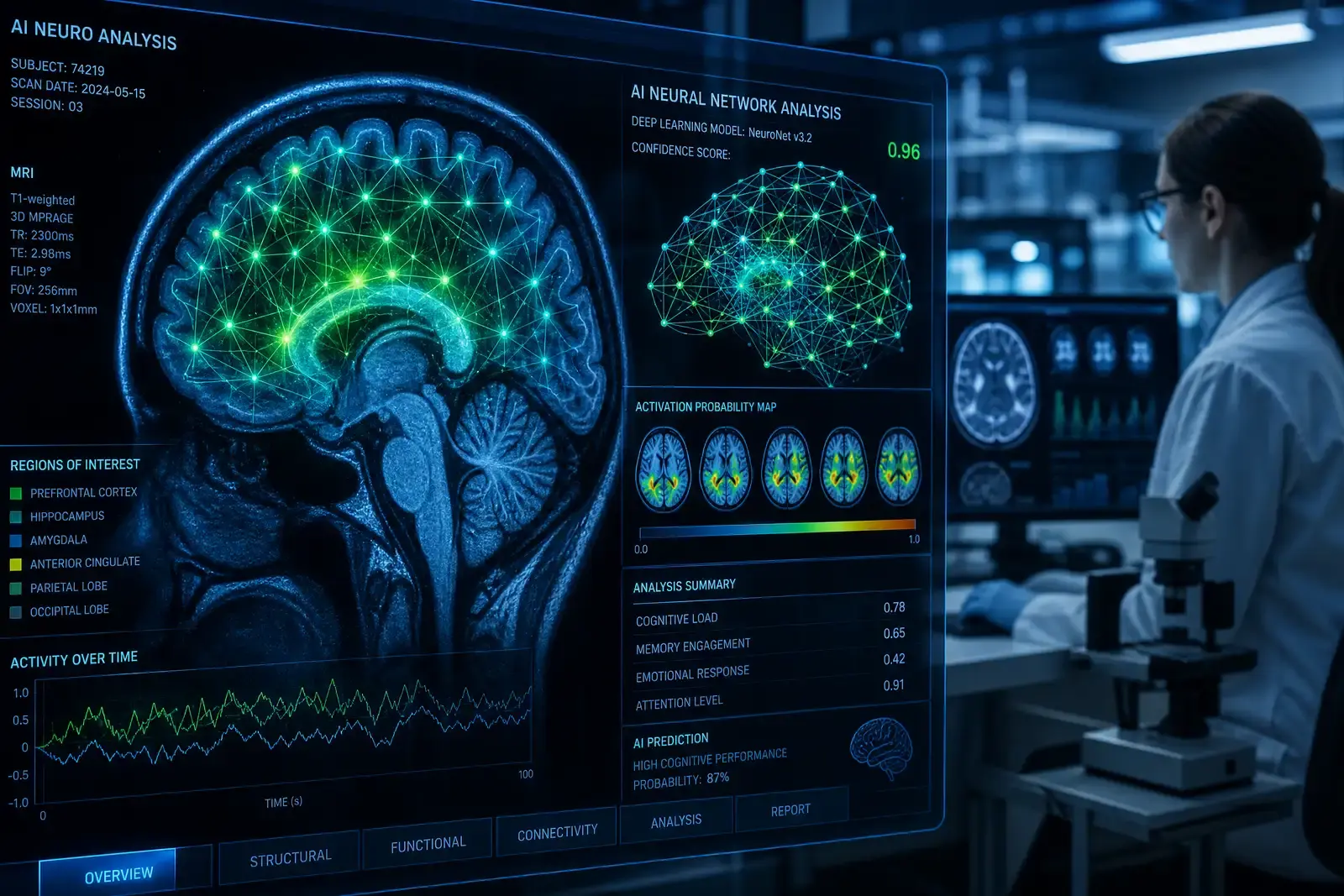
Artificial intelligence isn’t just changing what neuroscience studies — it’s changing how neuroscience gets done.
On July 8, 2026, the International Neuroinformatics Coordinating Facility (INCF) and The Transmitter are hosting a symposium at FENS Forum 2026 called “The Modern Neuroscience Lab in the Age of AI.” The session lineup reads like a roadmap for the next decade of brain research, and it reveals something that might surprise you: the biggest AI impact on neuroscience isn’t in analyzing brain scans. It’s in the infrastructure — literature review, data curation, metadata generation, and reproducibility.
The symposium takes place from 09:45 to 11:15 in Hall B, chaired by Emily Singer (Chief Opinion Editor at The Transmitter) and Mathew Abrams (Director of Science and Training at the INCF Secretariat). Four speakers, four distinct angles on a single question: what does a neuroscience lab look like when AI is baked into every layer of the workflow?
The Four Ways AI Is Changing Neuroscience
1. LLMs as Models of the Human Brain
Mariya Toneva from the Max Planck Institute for Software Systems is asking a question that sounds almost circular: can large language models serve as scientific models for understanding how the human brain processes language?
The answer, increasingly, is yes — with important caveats.
Toneva’s work involves “brain-tuning” LLMs using neural recordings. The approach is straightforward in principle: record brain activity — typically through fMRI or intracranial electrodes — while subjects read or listen to text. Then feed the same text through an LLM and compare the model’s internal layer activations with the neural activity patterns. Where the model’s representations align with brain activity, you’ve found a computational match. Where they diverge, you’ve found something the model doesn’t capture about human language processing.
This isn’t just an academic exercise. If an LLM’s internal representations partially mirror the brain’s language processing architecture, then studying the model becomes a legitimate way of studying the brain — a computational model organism for neuroscience, analogous to how fruit flies and mice serve as biological model organisms. The difference is that you can run experiments on the model in minutes rather than months.
The clinical implications are real. Better models of language processing in the brain could accelerate our understanding of aphasia, dyslexia, and the neural basis of bilingualism. Toneva’s framework also offers a way to evaluate whether AI systems not only resemble human behavior but share the underlying computational principles — a distinction that matters enormously when you’re building AI for healthcare applications.
2. The Computational Knowledge Ecosystem
Satrajit Ghosh from MIT’s McGovern Institute is building something that every neuroscience researcher wants but few have access to: a unified computational knowledge ecosystem that integrates data across scales, species, and experimental modalities.
The problem is structural and deeply entrenched. Modern neuroscience generates enormous amounts of multimodal data — fMRI scans at millimeter resolution, EEG recordings at millisecond resolution, single-neuron spike trains, behavioral assay results, genetic expression profiles — and most of it lives in siloed databases with incompatible formats. A researcher studying memory consolidation might need to combine data from a mouse hippocampus study, a human fMRI experiment, and a computational model, but the integration work takes months of custom scripting.
Ghosh’s vision, drawing on work within major U.S. BRAIN Initiative programs, is an infrastructure that supports three things simultaneously: reusable workflows, scalable computation, and continuously improving knowledge generation. The key word is reusable. Instead of every lab writing custom scripts to parse every dataset format, a shared ecosystem provides standardized pipelines that get better with each use.
Think of it like GitHub for neuroscience data — but with built-in computation. You don’t just download a dataset. You run a standardized analysis pipeline on it, contribute your results back to the ecosystem, and the next researcher who runs the same pipeline on a different dataset gets the benefit of your refinements.
3. AI-Powered Reproducibility Infrastructure
Sean Hill from Senscience is tackling one of science’s most persistent and least glamorous problems: the gap between data generation and data reuse.
His work focuses on how LLMs can strengthen research workflows across four dimensions — literature review, data curation, annotation, and analysis. The specific mechanisms are where the practical value lies:
Automated metadata generation. When researchers upload a dataset, an LLM can generate structured metadata — experimental conditions, sample sizes, methodology details, ethical approval numbers — that makes the data discoverable and reusable by others. This is trivial for a human to understand from reading a methods section but tedious to formalize into a machine-readable schema, which is exactly the kind of task where LLMs excel.
Interactive data portals. Instead of static supplementary files that nobody reads, AI-powered portals let researchers query datasets conversationally. “Show me all trials where the subject’s reaction time exceeded 500ms and the stimulus was a face” becomes a natural language query rather than a custom Python script. This dramatically lowers the barrier for researchers who want to reuse existing data but lack the technical skills to parse raw datasets.
Community standards enforcement. LLMs can check datasets against community standards for formatting, completeness, and documentation, flagging issues before they become reproducibility problems. This is the equivalent of a linter for scientific data — catching errors early, when they’re cheap to fix.
The goal isn’t to replace researchers. It’s to remove the friction that keeps good data trapped in individual labs, inaccessible to the broader community.
4. Benchmarking AI for Scientific Review
Rachel Parkinson from Queen Mary University of London is running a project called MetaBeeAI that uses pollinator ecotoxicology as a testbed for evaluating AI-assisted scientific review.
The methodology is elegant in its simplicity: compare LLM-generated literature reviews and data assessments against expert human evaluations. Where the AI agrees with experts, it validates the approach. Where it disagrees, you learn something — either about the AI’s limitations or about areas where expert consensus is weaker than assumed.
This project matters because it addresses a critical gap in the AI-for-science conversation. We know LLMs can write convincing scientific prose. We know they can summarize papers, extract findings, and even generate hypotheses. What we don’t yet have are domain-specific benchmarks that tell us whether that prose is correct — not just grammatically fluent or structurally sound, but scientifically accurate.
MetaBeeAI is building exactly those benchmarks, starting with a domain where expert assessments are relatively clear-cut (does this pesticide reduce bee foraging efficiency?) and expanding from there. The framework they develop could become the standard for evaluating AI-assisted scientific review across all of biology.
What This Means for AI Researchers
The neuroscience community isn’t just adopting AI tools. It’s creating a feedback loop where neuroscience informs AI development and AI accelerates neuroscience discovery.
The “brain-tuning” approach directly improves LLM architectures by grounding them in biological reality. The computational knowledge ecosystem creates training data that’s cleaner, better-structured, and more comprehensive than anything scraped from the web. The benchmarking work produces evaluation frameworks that go beyond surface-level fluency to assess genuine scientific reasoning.
For AI researchers, this means the next generation of models may be partially shaped by neuroscience data — not just in terms of training corpora, but in terms of architecture design, evaluation methodology, and even the fundamental objectives we optimize for. The brain has had 500 million years to solve the problem of processing information efficiently. AI researchers who study how the brain actually works — rather than just borrowing superficial architectural inspirations — may find shortcuts that pure engineering can’t reach.
The Bigger Picture
The FENS Forum 2026 symposium is one event, but it represents a broader shift that’s already underway. Neuroscience labs that were once defined by their hardware — fMRI machines, electrophysiology rigs, behavioral testing arenas — are increasingly defined by their computational infrastructure. The lab with the best AI pipeline for data integration, annotation, and analysis has an accelerating advantage, because every new dataset makes their system smarter.
This isn’t a future prediction. It’s the current trajectory, visible in every major neuroscience institution’s hiring patterns and funding allocations. Computational neuroscientists and AI engineers are now as central to a lab’s success as the experimentalists who design and run studies.
For anyone building AI systems, the neuroscience community’s experience offers a preview of how AI will transform any data-intensive scientific field. The pattern is consistent: AI starts as a convenience tool (automating literature searches, generating metadata), becomes an infrastructure component (data pipelines, quality control), and eventually reshapes the research questions themselves (brain-tuned models, computational model organisms).
The researchers who embrace this shift early — who treat AI not as a tool but as an integral part of their scientific methodology — will define the next era of discovery. The ones who resist will find themselves managing data by hand while their competitors’ AI systems do it automatically.
The direction of travel is clear. The only question is how fast you decide to move.
Reader Dispatches
No reader responses yet. Share your technical perspective below.
Related Posts
Meta's NameTag Face-Recognition Code in Its Smart Glasses App: What WIRED Found and Why It Matters for Privacy
WIRED found dormant face-recognition code, called NameTag, in the Meta AI companion app for its smart glasses; Meta removed it a day later. What the code did, Meta's response, and the privacy questions for AI wearables.
Apple Unveils Siri AI at WWDC 2026: A Complete Overhaul Powered by Apple Intelligence
Apple introduced an entirely new Siri AI at WWDC 2026, featuring natural conversational responses, deeper system integration, and a rebuilt Apple Intelligence stack. Here is everything we know.
Claude Fable 5 Is Out: Anthropic Opens Up the Mythos That 'Spooked the Government,' With a Gate in Front
On June 9, Anthropic released Claude Fable 5, the first Mythos-class model available to the public. It shares its underlying model with the restricted Mythos 5; the difference is Fable 5's classifier gate, which reroutes high-risk requests in cybersecurity and bio-chem to Opus 4.8. Pricing is double Opus 4.8. Here's the capability, the limits, and the controversy.