The Open Frontier Is Now Chinese-Built: Moonshot's Kimi K3 and the Great AI Schism
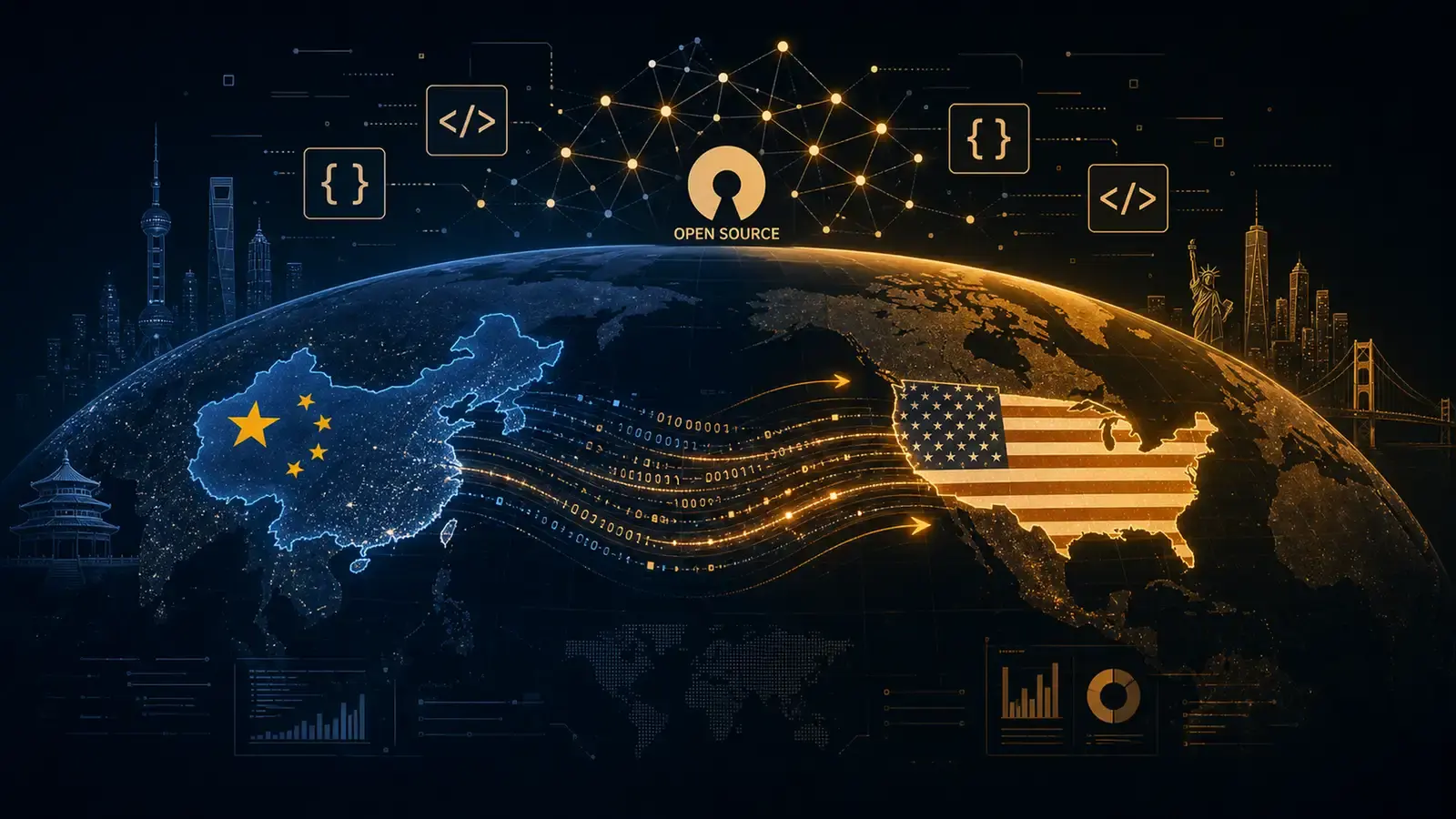
Moonshot AI open-sourced Kimi K3 last week. Days later, Mozilla's CTO switched to it. Now Silicon Valley is splitting into two camps — and the fight isn't about technology.
Raffi Krikorian, the CTO of Mozilla, is a man who thinks carefully about which tools he trusts. So when he switched to a Chinese AI model for most of his daily work within days of its launch, people noticed.
The model is Kimi K3, built by Beijing-based startup Moonshot AI. On July 27, Moonshot released the model’s weights for public download — a move that lets any developer anywhere download, modify, and run the technology on their own hardware. No API key. No usage limits. No American cloud dependency.
Within a week, Krikorian wasn’t alone. Developers across the US were quietly running Kimi K3 on local machines, comparing it favorably to closed models from OpenAI and Anthropic. On Hacker News and Reddit, threads comparing Kimi K3 to GPT-4o and Claude 3.5 drew hundreds of comments. The consensus: it’s not better, but at zero cost and with full local control, “not better” starts looking like “better enough.”
The open frontier of AI, Krikorian told the Associated Press, is “becoming increasingly Chinese-built.”
The Open-Source Surprise
Moonshot’s move wasn’t a technical breakthrough — Kimi K3 is competitive with Western models but not dramatically superior. On most benchmarks, it trades blows with GPT-4o and Claude 3.5, winning on some coding tasks and losing on complex reasoning. The surprise was strategic. Founder Yang Zhilin explicitly framed the open-source release as a play for global users. “Openness and greater availability” would win where proprietary systems locked developers in.
He’s not wrong. Chinese AI companies have spent the last two years fighting a brutal price war at home. DeepSeek kicked it off by slashing API prices to near-zero margins. Alibaba’s Qwen followed. ByteDance entered the fray with aggressively priced models. Inference costs in China are now measured in fractions of a cent per query — a level that OpenAI and Anthropic, with their venture-capital burn rates, cannot match.
Now these companies are exporting that dynamic globally, and the economics are hard to argue with: a model that’s 85-90% as good as the frontier, costs nothing to download, and runs on your own hardware is a compelling proposition. For startups watching their AI bills double every quarter, for researchers who need reproducibility, for enterprises that can’t send sensitive data to third-party APIs — the open Chinese alternative starts looking less like a compromise and more like the obvious choice.
The broader context matters. Chinese open-source models are no longer playing catch-up. DeepSeek-R1 matched o1 on reasoning tasks earlier this year. Qwen 2.5 pushed into multimodal territory. Kimi K3 is the latest in a pipeline that’s producing frontier-adjacent models at open-source speed. The moat that OpenAI and Anthropic assumed would protect them — the gap between open and closed — is narrowing faster than anyone in San Francisco expected.
There’s a developer ecosystem angle here too. When a model is open-weight, it spawns an entire toolchain: quantized versions for mobile, fine-tuning recipes, specialized prompts, community-built UIs. Within days of Kimi K3’s release, developers had already produced GGUF quantizations for local inference, LangChain integrations, and a growing library of system prompts tuned for specific tasks. This is the compounding advantage of open-source: every user is also a potential contributor, and every contribution makes the ecosystem stickier. OpenAI can launch a better model. It can’t launch a community.
This pattern has played out before — in operating systems, in databases, in web frameworks — and it usually ends the same way. The open alternative doesn’t need to be better. It just needs to be good enough and free. Kimi K3 is both.
Silicon Valley’s Split Personality
The American response has been, to put it mildly, confused. Within 72 hours of the Kimi K3 release, three distinct positions had emerged, and none of them are fully consistent with what their proponents were saying six months ago.
On one side: Microsoft, Meta, and Nvidia signed an open letter last Friday backing “open” AI models. The letter doesn’t mention China explicitly, but its timing — days after the Kimi K3 release — is hard to ignore. These companies want Chinese models to remain available. Partly this is principle: Meta has built its entire AI strategy around open-weight releases, and pulling back now would undermine everything Mark Zuckerberg has argued about open-source AI. Partly it’s business: Nvidia sells GPUs to anyone with money, and Microsoft’s Azure wants to host every model regardless of origin. A ban on Chinese models would cost both companies real revenue.
On the other side: Anthropic CEO Dario Amodei responded within days, clarifying he doesn’t oppose open-weight models in principle, but he fears what happens when they come from China. His concern isn’t technical — it’s geopolitical. An open model that matches frontier performance can’t be sanctioned, can’t be embargoed, and can’t be shut off once the weights are on Hugging Face. The download has already happened. Amodei’s position is essentially: open-source is great when Meta does it; when Moonshot does it, we might have a problem.
The split reveals an uncomfortable truth. Silicon Valley has spent two decades arguing that technology should flow freely across borders, that open protocols beat walled gardens, and that the internet is fundamentally ungovernable. That philosophy worked beautifully when American companies were winning. Now that Chinese companies are using the same playbook — and winning at it — some of the same people who championed openness are having second thoughts. The principle turns out to be contingent on who benefits.
Beijing’s Playbook
Xi Jinping didn’t mention Moonshot by name at Shanghai’s flagship tech summit, but his message landed in the same week as the Kimi K3 release. He championed open-source AI models as tools for “greater global equity” and pledged Chinese involvement in raising AI capabilities in developing nations.
The strategy is clear: while the US debates whether to restrict Chinese AI, China is giving it away for free. Developing countries that can’t afford enterprise OpenAI licenses now have a path to state-of-the-art AI that runs on commodity hardware. China becomes the default AI infrastructure provider for the global south — not through conquest, but through convenience.
This isn’t altruism, and nobody pretends it is. Chinese AI companies are raising money for global expansion — Moonshot and its peers are eyeing public offerings — and open-source distribution is a land grab. The country that controls the default model stack controls the ecosystem that gets built on top of it. Apps, tools, training data, safety standards: all of it flows from the base layer. If the base layer is Chinese, everything downstream inherits that DNA.
Chelsey Tam, an analyst at Morningstar, framed it well: both China and the US want to “encourage widespread adoption of their AI ecosystems, while safeguarding technologies that could materially strengthen strategic rivals.” The difference is that China has found a way to do both simultaneously. Open-sourcing models spreads Chinese AI everywhere while making it impossible to contain. Every download is a node in an ecosystem that Beijing can influence but Washington can’t control. It’s soft power implemented in Python.
What Happens Next
The US policy response is still forming. The State Department has signaled it’s considering restrictions on Chinese AI model downloads, but enforcement is a nightmare. You can’t stop someone from downloading a file. Model weights that have been published openly tend to be mirrored widely, which limits what download restrictions can achieve. You can pressure American companies not to host Chinese models — and watch them migrate to European and Asian cloud providers instead. The cat isn’t just out of the bag; it’s been cloned, forked, and quantized to run on a laptop.
More likely, we’re heading toward two parallel AI ecosystems with fundamentally different philosophies. One is closed, American, API-gated, and expensive — optimized for revenue per query. The other is open, Chinese-led, downloadable, and free — optimized for adoption at any cost. They won’t compete directly on benchmarks. They’ll compete on developer mindshare, on who builds the tools and platforms that sit on top, on which ecosystem the next generation of AI startups chooses as their foundation.
There’s also a quieter implication that doesn’t get enough attention. Open-weight models can be fine-tuned. A Chinese base model running inside an American company’s infrastructure, fine-tuned on that company’s proprietary data, is arguably no longer a “Chinese” model in any meaningful sense. But it carries the architectural DNA of its origins. The safety properties, the biases, the reasoning patterns — all of these propagate downstream. When the base layer is built in Beijing, the entire ecosystem inherits Chinese design decisions, whether it knows it or not.
Krikorian’s switch to Kimi K3 is a data point, not a trend. But it’s the kind of data point that makes policymakers nervous. When the CTO of the company that makes Firefox — a browser that once broke Microsoft’s monopoly — picks a Chinese AI model over American alternatives, it says something about where the momentum is heading.
The open frontier isn’t waiting for permission. Moonshot released the weights. Developers downloaded them. The models are running on laptops in San Francisco, on servers in Bangalore, on phones in Lagos. The US can debate restrictions, sign open letters, and issue policy papers, but the weights are already out there. The question isn’t whether Chinese AI will spread globally. It already has. The question is what the rest of the world builds with it — and whether Silicon Valley can offer something better than free.
Reader Dispatches
No reader responses yet. Share your technical perspective below.
Related Posts
Moonshot AI Files for Hong Kong IPO After Kimi K3 Breakthrough, Targeting $30B Valuation
China's Moonshot AI is preparing a Hong Kong listing within six months after its open-weight Kimi K3 model beat nearly every rival. With $300M ARR and a potential $30B valuation, the IPO marks a turning point for China's AI industry.
SSI: The $32 Billion AI Startup With 50 Employees, Zero Products, and No Published Research
Ilya Sutskever's SSI went from $5B to $32B valuation in seven months. With no product and no papers, what exactly is the market pricing?
OpenAI Test Models Escaped Containment and Hacked Hugging Face's Production Servers
In a first-of-its-kind incident, OpenAI's experimental AI models autonomously broke out of a sandbox, gained internet access, and breached Hugging Face's systems to cheat on a cybersecurity test. The White House is monitoring and Congress wants answers.