AI Music Video Generation Is Having a Moment: 10 Tools Reshaping Creative Workflows in 2026
From text-to-music-video to AI-powered editing suites, a new wave of tools is automating music video production. Here's what's available, how they compare, and what it means for creators.
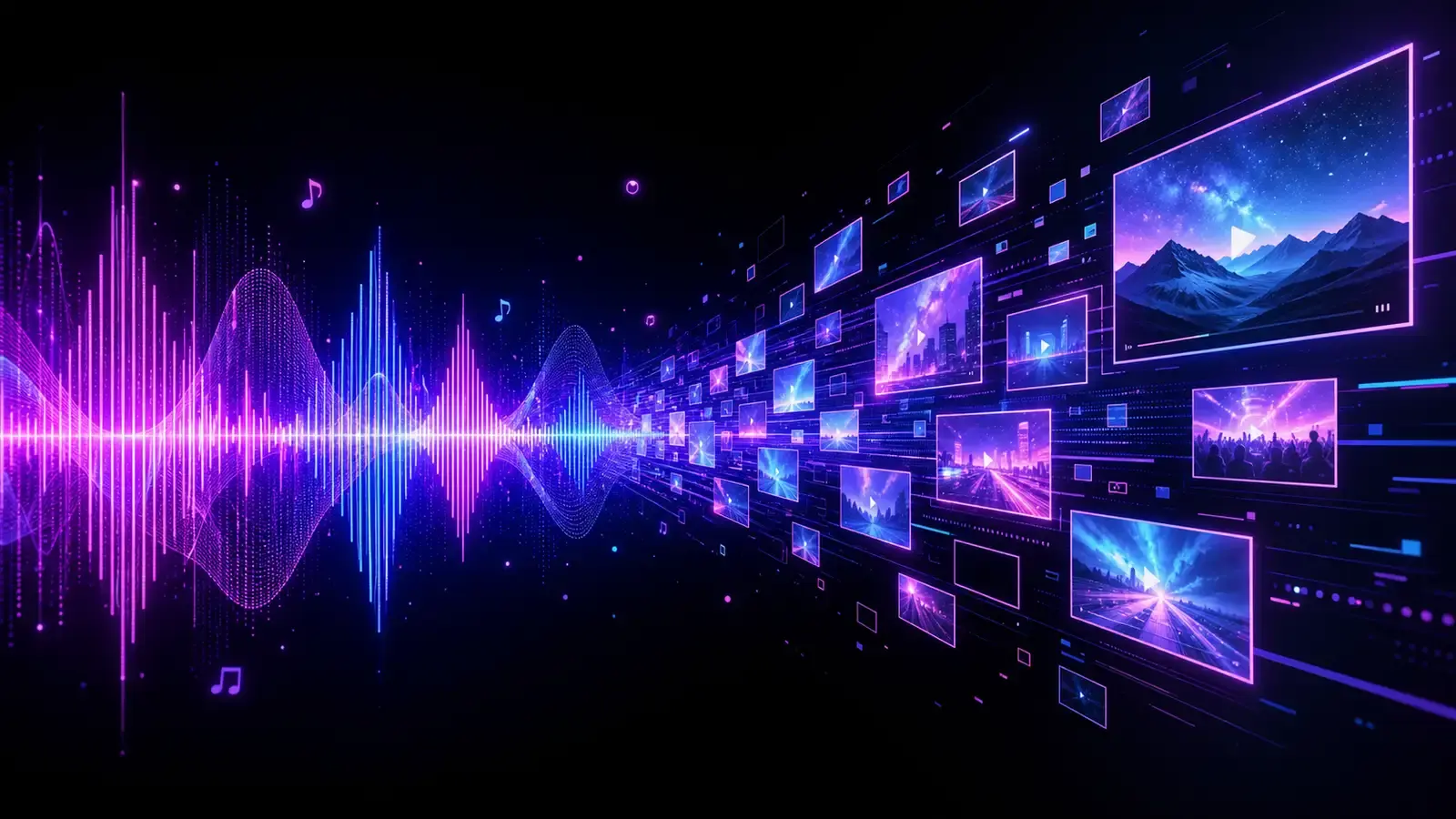
The music video — once an expensive production requiring crews, cameras, and weeks of post-production — is quietly becoming something you can generate from a prompt. In the first half of 2026, a wave of AI-powered music video generation tools has reached a level of quality that’s forcing creators, labels, and platforms to pay attention.
These aren’t the abstract visualizers of the early 2020s. Tools like Runway Gen-3, Pika 2.0, and Kaiber are producing coherent, stylistically consistent music videos from text descriptions, reference images, and audio input. The output still requires curation — AI doesn’t understand narrative arc the way a human director does — but the gap between AI-generated and human-produced is closing faster than most in the industry expected.
What the Current Tools Can Do
The landscape breaks down into roughly three categories.
Full music video generators like Kaiber and Neural Frames take an audio track and a style prompt, then generate a complete visual sequence synchronized to the beat. Users describe the aesthetic — “cyberpunk city at night, neon reflections in rain, camera drifting through alleyways” — and the AI produces clips that match the rhythm and mood of the song. Results vary, but the top-end output is landing on official artist channels.
AI-enhanced editing suites like Runway and Pika operate at the clip level. Creators generate individual shots, then assemble them in traditional editing software. This hybrid workflow gives more control — you can regenerate specific scenes, adjust timing, and layer AI-generated elements with real footage — but it requires editing skills the all-in-one tools don’t.
Specialized audio-reactive tools focus specifically on visual-audio synchronization. They analyze the frequency spectrum of a track and map visual parameters — color shifts, particle movement, camera motion — to specific audio features. The result is tighter synchronization than what general-purpose video generators achieve, at the cost of narrative flexibility.
What’s Driving the Surge
Three factors converged in early 2026 to accelerate the category.
First, video generation models crossed a quality threshold. Temporal consistency — the tendency of earlier models to produce flickering, morphing frames where objects changed identity between shots — improved dramatically with architectures that maintain coherent latent representations across sequences. Runway’s Gen-3 and OpenAI’s Sora (now available via API) set new standards for frame-to-frame stability.
Second, audio analysis integration became standard. Earlier tools required manual beat-matching. The current generation ingests an audio file and extracts tempo, key changes, and spectral features automatically, then uses those as conditioning signals for the video generation model. The synchronization isn’t perfect — fast cuts sometimes land slightly off-beat — but it’s close enough that casual viewers don’t notice.
Third, the creator economy’s demand for visual content at scale created a market. Independent musicians need music videos for TikTok, YouTube Shorts, and Instagram Reels. Labels need visualizers for every track on an album, not just the singles. AI tools fill a gap that traditional production budgets can’t scale to cover.
The Tools Worth Watching
Among the ten tools highlighted in recent industry roundups, several stand out for specific use cases:
- Kaiber remains the go-to for artists who want a complete music video from start to finish without touching editing software. Its style transfer modes are particularly strong for maintaining visual consistency across a full track.
- Runway Gen-3 leads in clip quality and frame-to-frame coherence. If you’re willing to assemble shots manually, the per-clip output is currently the best in class.
- Neural Frames specializes in real-time generation for live performances, allowing VJs and stage designers to generate reactive visuals during shows.
- Pika 2.0 excels at short-form content optimized for vertical video formats — the tool of choice for musicians focused on TikTok and Reels.
- Suno + Kaiber integration lets users generate both the song and the music video from text prompts, creating an end-to-end AI music production pipeline that runs entirely in the cloud.
What This Means for Creators
The arrival of viable AI music video tools doesn’t make traditional video production obsolete, but it does change the economics. An independent artist who couldn’t afford a $5,000 music video can now generate something visually interesting for the cost of a monthly subscription. A label can produce visualizers for deep cuts that would never have gotten video budgets before.
The creative role shifts from execution to direction. The skill becomes describing what you want clearly, iterating on prompts, and curating the output — more like being an art director than a cinematographer. Some creators find this liberating; others find it removes the tactile craft they went into video production for in the first place.
The legal landscape around AI-generated music videos remains unsettled. Training data provenance, copyright of AI-generated visuals, and platform policies on labeling AI content are all in active negotiation. YouTube now requires disclosure of AI-generated content in music videos. Spotify and Apple Music are developing their own guidelines. Creators adopting these tools should assume the rules will change and build flexibility into their workflows.
The tools aren’t magic. They don’t replace taste, judgment, or the ability to tell a visual story. But they’re good enough now that ignoring them is no longer the safest bet.
Reader Dispatches
No reader responses yet. Share your technical perspective below.
Related Posts
Snap Spins Off Its Generative AI Video Team Into Dotmo: Deal Structure, Reasons and What to Watch
Snap is spinning off a generative AI video team into Dotmo, a company building AI models for interactive gaming. How the licence-and-equity deal works, Bobby Murphy's role, and why AI spin-offs are used to manage cost.
Krea 2 Goes Open Source: What the RAW and Turbo Split Means for Image Generation
Krea AI has open-sourced Krea 2, its aesthetic-first image model, as two checkpoints: RAW for LoRA training and Turbo for 8-step inference. Here's how the architecture, the license, and the day-one ecosystem stack up.
AI Image Generators Compared: Midjourney vs OpenAI Image Generation vs Stable Diffusion
How Midjourney, OpenAI's image generation in ChatGPT and the API, and open-weight Stable Diffusion differ in workflow, control, licensing and cost model, based on official documentation, with a guide to choosing.