AI Video Generation Enters 'Director Mode': Multi-Scene Orchestration as the Defining Shift of 2026
AI video tools are moving beyond single-prompt clips to full multi-scene narrative workflows with character consistency, visual continuity, and parallel generation. Here's how the technology evolved and how creators are using it.
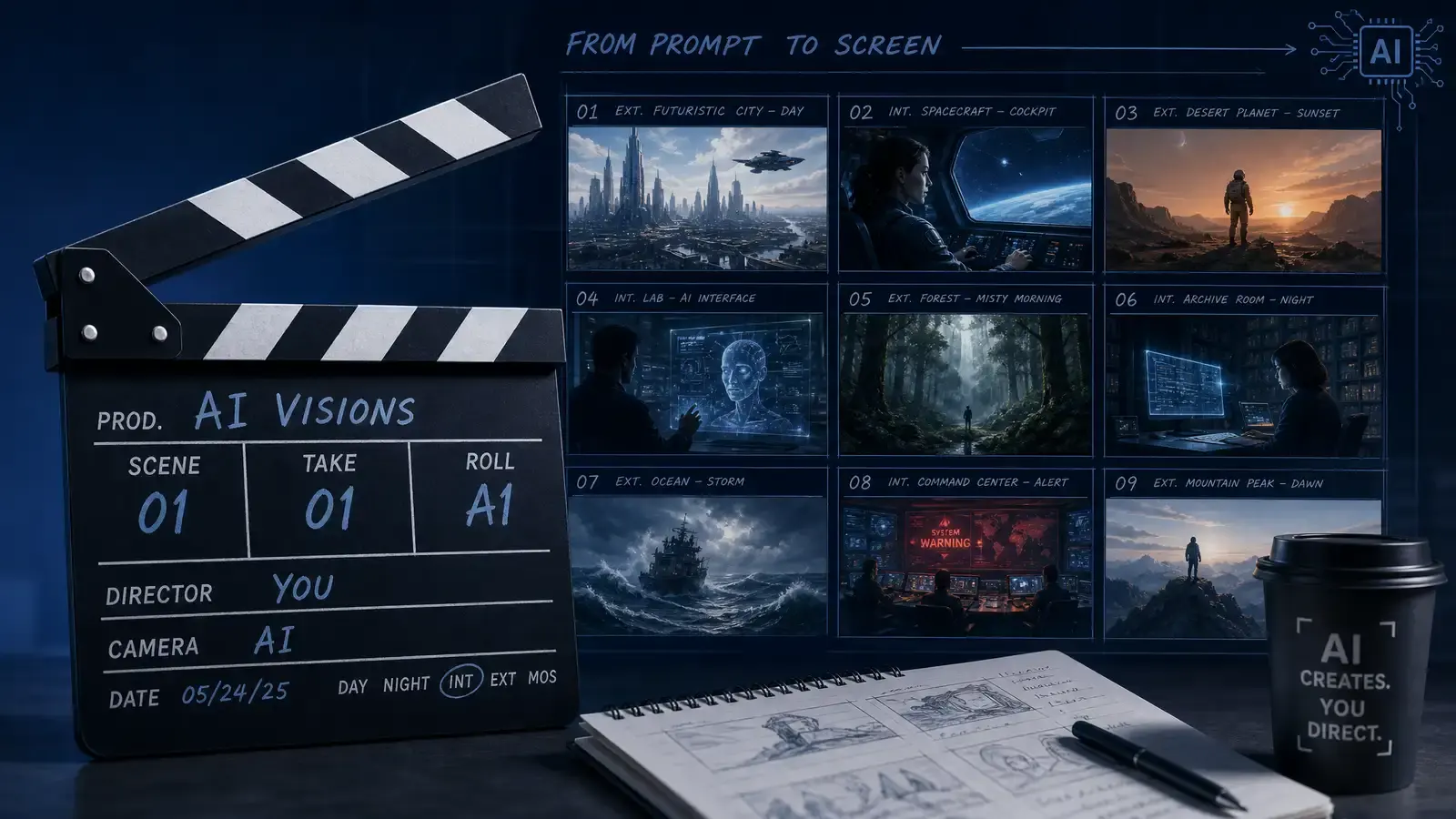
From “One Prompt, Ten Seconds” to Full Short Films
If you asked what AI video generation tools could do at the start of this year, the answer was nearly universal: type a text description, get back a 5- to 15-second video clip. The visual quality was impressive, but creators were left with a pile of disconnected fragments — characters looked different in every shot, scene transitions were jarring, and narrative pacing required manual editing outside the AI tool.
By mid-2026, that paradigm has fundamentally shifted. Major AI video platforms — including Runway Gen-4, Kling 2.0, Luma Dream Machine 2.0, and Google Veo — have all rolled out multi-scene orchestration features under various branding. The core idea is straightforward: let creators control an entire video’s production from a director’s perspective, not a single-prompt inputter’s perspective.
This isn’t just a UI refresh. It’s a structural rethinking of how generative video models operate.
The Technical Foundations: Why Now?
Character Consistency Models
The single biggest pain point in early AI video generation was the inability to maintain character identity across shots. Every generation felt like the model was “reimagining” what the character looked like. In 2026, this has seen meaningful technical progress:
- Reference Image Anchoring: Platforms now let creators upload reference photos or concept art for characters, and the system injects those visual features as conditioning across all related shots rather than relying on text descriptions alone
- Identity Embedding Vectors: Some platforms generate dedicated mathematical vector representations for each character, ensuring consistent identity recognition even under different lighting, angles, and expressions
- Semantic Binding: Key objects in scenes — a distinctive watch on the protagonist’s wrist, a landmark building in the background — can be bound to characters together, maintaining visual coherence across multi-scene generation
Narrative Graphs
Previously, AI video generation was linear: one prompt → one shot. Director mode introduces a narrative graph concept. Creators lay out multiple scene nodes on a visual timeline, each with its own prompt, character assignments, camera motion, and duration. The system then handles transitions between scenes in a visually coherent way.
This means the AI isn’t just generating individual shots — it’s maintaining an understanding of the entire video’s narrative structure: which characters appear in which scenes, what the temporal relationships between scenes are, and how visual style stays consistent throughout.
Multi-Track Parallel Generation
Another critical breakthrough is parallel processing. Under director mode, multiple scenes can be fed to the model simultaneously rather than queued one by one. This dramatically reduces total production time and enables cross-scene consistency checking — for instance, ensuring the lighting at the end of scene A transitions naturally into scene B.
How the Leading Tools Approach the Workflow
Runway Gen-4: Visual Storyboard Editor
Runway’s director mode centers on a storyboard interface. Creators arrange scene frames on a canvas, each containing independent prompts, camera motion settings (zoom in, zoom out, pan), and character references. The system offers real-time preview and automatically suggests transition effects between scenes.
Runway’s advantage lies in its integration with existing editing ecosystems — generated scenes can be exported directly to professional editing software, with multi-layer timeline and keyframe control support.
Kling 2.0: Narrative-Driven Auto-Storyboarding
Kling takes a “tell the story, get the shots” approach. Creators provide a complete narrative description — say, “a robot walks through an abandoned city, discovers a flower, bends down to examine it, camera pulls up to reveal the cityscape” — and the system automatically breaks this into multiple shots, assigning appropriate prompts, character references, and camera motions to each, then generates them in parallel.
This lowers the technical barrier for directors who don’t need to precisely control every shot parameter and can focus on storytelling instead.
Google Veo: Multimodal Narrative Understanding
Veo’s distinguishing feature is its capacity to accept multimodal input. Beyond text prompts, it can take audio tracks, musical tempo, and even rough sketches as guiding conditions for scene generation. This lets creators work closer to traditional filmmaking methods — start with a soundtrack, then generate visuals that match the music’s rhythm.
A Practical Workflow Example
Here’s what a typical director-mode production pipeline looks like for a 60-second sci-fi short:
Phase 1: Narrative Planning (~30 minutes)
- Write a full story outline, marking key scene transition points
- Create scene nodes in the platform’s storyboard editor
- Generate or upload reference images for main characters
Phase 2: Character & Scene Setup (~20 minutes)
- Use the character consistency tool to build identity profiles for each main character
- Set environment descriptions, lighting conditions, and camera motions per scene
- Define transition types between scenes (hard cut, dissolve, match cut, etc.)
Phase 3: Parallel Generation & Iteration (~1-2 hours)
- Launch multi-track parallel generation — the system processes all scenes simultaneously
- Review results, flag scenes that need adjustment
- Fine-tune prompts or parameters for problematic scenes
- Regenerate affected scenes and run consistency checks
Phase 4: Post-Production & Output (~30 minutes)
- Import generated scenes into the editing timeline
- Add music, sound effects, and text overlays
- Perform color grading and final rendering
- Export to the target video format
Overall, a 60-second AI-generated short film can go from concept to finished product in 3-4 hours — something that was inconceivable a year ago.
Remaining Challenges
Despite the progress, director-mode AI video still faces unresolved issues:
- Long-take narrative tension: Current AI video models show significant quality and consistency degradation when handling single shots longer than 30 seconds
- Precise control of complex interactions: When scenes involve precise multi-character interactions — two people playing chess, for example — AI still struggles with logical consistency
- Audio-visual synchronization: While some platforms now support audio-guided generation, lip-sync and precise action-to-sound alignment remain unsolved problems
- Training data transparency: The sourcing of training data for AI video models remains insufficiently transparent, creating potential legal risks in commercial applications
What’s Coming in H2 2026
AI video generation is evolving from a tool to a collaborator. Director mode signals that AI is no longer passively responding to prompts — it’s beginning to understand narrative structure, maintain visual continuity, and make creative decisions across multiple dimensions.
For creators, this represents a fundamental shift: from “how do I get AI to generate a nice clip” to “how do I co-create a complete narrative with AI.” The former is about technical tricks; the latter returns to the essence of creation — telling a good story.
As more tools enter the director-mode race, H2 2026 should bring more mature narrative controls, tighter character consistency, and smoother integration with traditional post-production pipelines. For anyone interested in AI video creation, now is the time to get involved.
Reader Dispatches
No reader responses yet. Share your technical perspective below.
Related Posts
Snap Spins Off Its Generative AI Video Team Into Dotmo: Deal Structure, Reasons and What to Watch
Snap is spinning off a generative AI video team into Dotmo, a company building AI models for interactive gaming. How the licence-and-equity deal works, Bobby Murphy's role, and why AI spin-offs are used to manage cost.
Epic Games Shows How Generative AI Fits Into Fortnite's Concept Art Process
In a June 2026 video, Epic Games showed how Fortnite artists start from hand-drawn designs and 3D block-outs, then use its internal GenMedia Bridge tool with Nano Banana and GPT Image for rendering and variations. Here is what the video shows, what Epic said, and what remains unanswered.
Krea 2 Goes Open Source: What the RAW and Turbo Split Means for Image Generation
Krea AI has open-sourced Krea 2, its aesthetic-first image model, as two checkpoints: RAW for LoRA training and Turbo for 8-step inference. Here's how the architecture, the license, and the day-one ecosystem stack up.