AI's Next Race Isn't About Smarter Models. It's About Cost, Control, and Compute.
The frontier model race is giving way to a more important competition: who can run AI cheaper, who controls the infrastructure, and whether open-source models can match proprietary performance at a fraction of the cost.
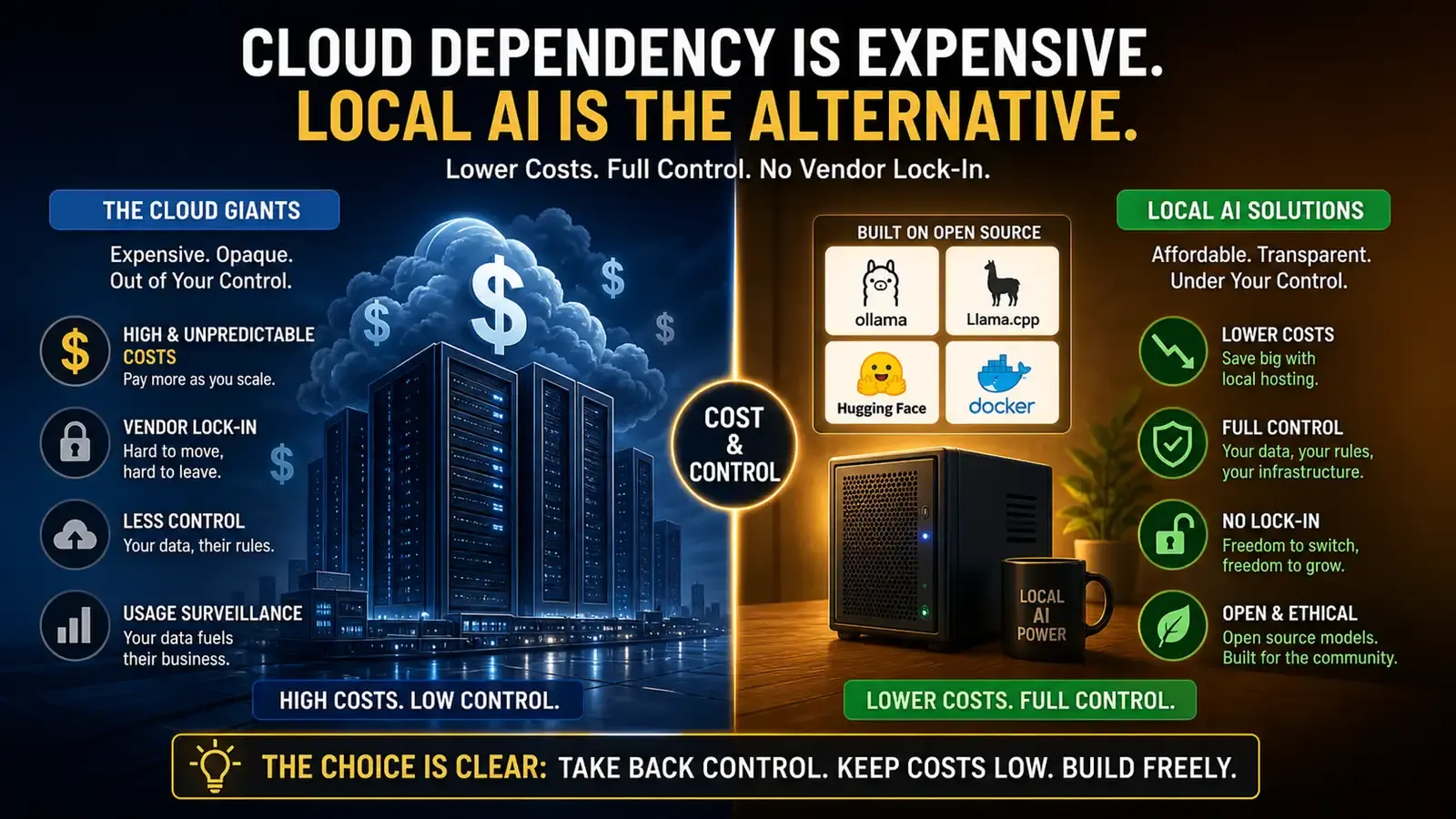
The AI industry spent the past three years obsessing over one question: who can build the smartest model? Every quarter brought a new benchmark leader, a new parameter count, a new claim about approaching AGI. The race was simple and legible: bigger models, better scores, more funding.
That race is not over, but it is no longer the one that matters. A quieter, more consequential competition is reshaping the industry: who can run AI cheaper, who controls the infrastructure it depends on, and whether open-source models can match proprietary performance at a fraction of the cost. The answers will determine which companies win the next phase of AI adoption — and which ones become irrelevant despite having the best models.
The end of the frontier-only era
TechCrunch reported on July 14 that the real AI race “may no longer be at the frontier.” The evidence is mounting. Hugging Face CEO Clement Delangue told the publication that companies are increasingly “done renting their AI” — meaning they are moving away from paying per-token API fees to foundation model providers and toward running their own models on their own infrastructure.
The economics driving this shift are straightforward. API pricing for frontier models has come down dramatically, but enterprise-scale usage still generates bills that make CFOs uncomfortable. A company processing a million customer service interactions per month through GPT-5.6’s API might spend $100,000 monthly. Running an equivalently capable open-source model on dedicated hardware might cost $20,000. The gap narrows every quarter as open models improve and inference hardware gets cheaper.
But cost is only part of the story. Control is the other half. Companies that depend on API providers are subject to rate limits, model deprecation, pricing changes, and terms of service that can shift without notice. A fintech company that builds its fraud detection on OpenAI’s API has no guarantee that the model will be available next year at the same price, or at all. Running your own model — whether open-source or self-hosted — means you control the deployment, the latency, the data flow, and the cost structure.
Open source closes the gap
The open-source AI ecosystem in mid-2026 is unrecognizable from two years ago. Meta’s Llama 4 models compete with GPT-4-class performance on most benchmarks. Mistral’s latest release matches proprietary mid-tier models at a tenth of the inference cost. Qwen and DeepSeek from China have produced models that run on consumer hardware and outperform GPT-4 on specific tasks. The gap between the best proprietary model and the best open-source model is measured in single-digit percentage points on most benchmarks, not the yawning chasm it was in 2024.
Hugging Face has become the infrastructure layer for this shift. The platform hosts over 900,000 models and serves as the distribution point for the open-source AI ecosystem. It is where Meta releases Llama, where Mistral publishes its latest weights, and where the community fine-tunes and optimizes models for specific use cases. The platform’s growth mirrors the broader shift: more models, more downloads, more companies running AI on their own terms.
Delangue’s argument is that the industry is repeating the pattern of cloud computing: early adoption favors managed services, but as the technology matures, the economics favor self-hosting. AWS still makes money, but companies that run their own data centers spend less per compute cycle. The same dynamic is now playing out in AI. And just as the cloud did not kill the data center, API providers will not disappear — but their share of total AI inference will shrink as open-source models get good enough and cheap enough to run locally.
The Chinese wildcard
The NPR report on July 15 added another dimension: American AI is expensive, and some startups are turning to Chinese models as a cheaper alternative. DeepSeek’s latest models cost roughly 90% less per token than OpenAI’s equivalent offerings. For startups operating on venture funding with a finite runway, the math is compelling.
This creates a geopolitical complication that the industry has not fully reckoned with. The US government has restricted the export of advanced chips to China, aiming to slow Chinese AI development. The irony is that these restrictions may be accelerating the development of more efficient Chinese models — when you cannot access the latest NVIDIA chips, you optimize your software to run on what you have. The result is models that are not necessarily smarter than their American counterparts but are dramatically cheaper to run, which for most commercial applications is the more important metric.
The question for American policymakers is whether restricting chip exports actually achieves the goal of maintaining US AI leadership, or whether it inadvertently creates a competitor whose cost advantage makes it more attractive to the global market. Early evidence suggests the latter.
What this means for the industry
The shift from a frontier race to a cost-and-control race has three major implications.
First, the value in AI is migrating from model training to model deployment. Building a frontier model requires billions of dollars and teams of hundreds. Running a capable model at scale requires operational expertise, infrastructure management, and integration work — none of which are exclusive to the companies that trained the model. The moat is shifting from “who has the best model” to “who runs AI best in production.”
Second, the API-only business model is under structural pressure. OpenAI, Anthropic, and Google charge per-token fees that look less sustainable every time an open-source model matches their performance at a lower cost. These companies are not going away — their models are still the best for many use cases, and their brand recognition and enterprise relationships are real assets — but their pricing power is eroding. The long-term equilibrium probably involves a mix of API and self-hosted usage, with APIs winning for low-volume and experimental use cases and self-hosting winning for high-volume production workloads.
Third, China’s role in the AI ecosystem is becoming impossible to ignore. US policy has focused on slowing China’s access to hardware, but China’s response — building more efficient models that run on less powerful chips — has produced an unexpected result: Chinese AI models are now cost-competitive in the global market. American companies that want to compete on price will have to match not just OpenAI and Anthropic but also DeepSeek and Qwen. That is a harder conversation than anyone in Silicon Valley was preparing for.
The broader pattern here is that AI is following the trajectory of every previous technology platform. Early winners capture attention with breakthrough capabilities. Later winners capture markets with cost efficiency and deployment scale. The internet went from AOL’s walled garden to the open web. Smartphones went from the iPhone’s premium monopoly to Android’s global dominance. Cloud computing went from AWS’s first-mover advantage to a three-way price war. AI appears to be following the same arc, and the transition from a capability race to a cost race is the inflection point where that arc bends.
For startups and enterprises alike, the practical implication is clear: do not bet your architecture on a single model provider. The API that looks essential today may be a commodity next year. The model that is unmatched on benchmarks may be undercut on price by an open-source alternative within six months. Build for model portability. Invest in deployment infrastructure, not model allegiance. The companies that treat AI as an operational capability rather than a vendor relationship will be the ones that thrive when the cost race overtakes the capability race — which, based on everything happening in July 2026, is happening right now.
The bottom line
The frontier model race was dramatic and easy to follow. Every new release was a press event. Every benchmark improvement was a headline. GPT-5, Claude 4, Gemini Ultra — each launch cycle brought more parameters, more capabilities, and more breathless speculation about when the models would surpass human intelligence.
But the race that actually determines who wins AI — the race to run it cheaper, to control the infrastructure, to make it accessible to companies that cannot afford million-dollar API bills — is happening quietly, in data centers and model repositories, far from the keynote stages. It does not generate the same headlines because cost-per-token and inference latency benchmarks are not as exciting as “model achieves human-level performance on graduate-level physics.” But for the thousands of companies that need to deploy AI in production at scale, those unglamorous metrics matter more than any benchmark score.
The companies that win this race may not have the smartest models. They will have the cheapest, the most controllable, and the most widely deployed ones. And if the current trajectory holds, an increasing share of those models will be open-source, self-hosted, and potentially built in countries with different economic incentives and regulatory frameworks than the US. The frontier race was a spectacle. The cost race is a business. And businesses are won on margins, not on press releases.
Sources: TechCrunch (July 14, 2026; July 10, 2026); NPR/WYSO (July 15, 2026).
Reader Dispatches
No reader responses yet. Share your technical perspective below.
Related Posts
The AI Industry Just Split in Two — and the Free Side Is Winning
Chinese open-weight models now dominate real-world usage, inference infrastructure companies have raised $4 billion in weeks, and OpenAI and Anthropic are preparing trillion-dollar IPOs. The AI race isn't about better models anymore — it's about who controls the pipes.
EU Pushes AI Act High-Risk Deadline to December 2027: What the 16-Month Delay Actually Means
The EU Council approved the Digital Omnibus package on June 29, 2026, pushing the compliance deadline for high-risk AI systems from August 2026 to December 2027. The delay isn't a concession to industry — it's an admission that the regulatory infrastructure isn't ready. Here's what businesses need to know.
The Open-Source AI Cold War: Why the US Is Rethinking Its Ban on Chinese Models
Moonshot AI's Kimi K3 just became the first Chinese model to top a major coding benchmark. The US government is quietly reconsidering its ban on foreign open-source AI — and the timing isn't a coincidence.