EU Pushes AI Act High-Risk Deadline to December 2027: What the 16-Month Delay Actually Means
The EU Council approved the Digital Omnibus package on June 29, 2026, pushing the compliance deadline for high-risk AI systems from August 2026 to December 2027. The delay isn't a concession to industry — it's an admission that the regulatory infrastructure isn't ready. Here's what businesses need to know.
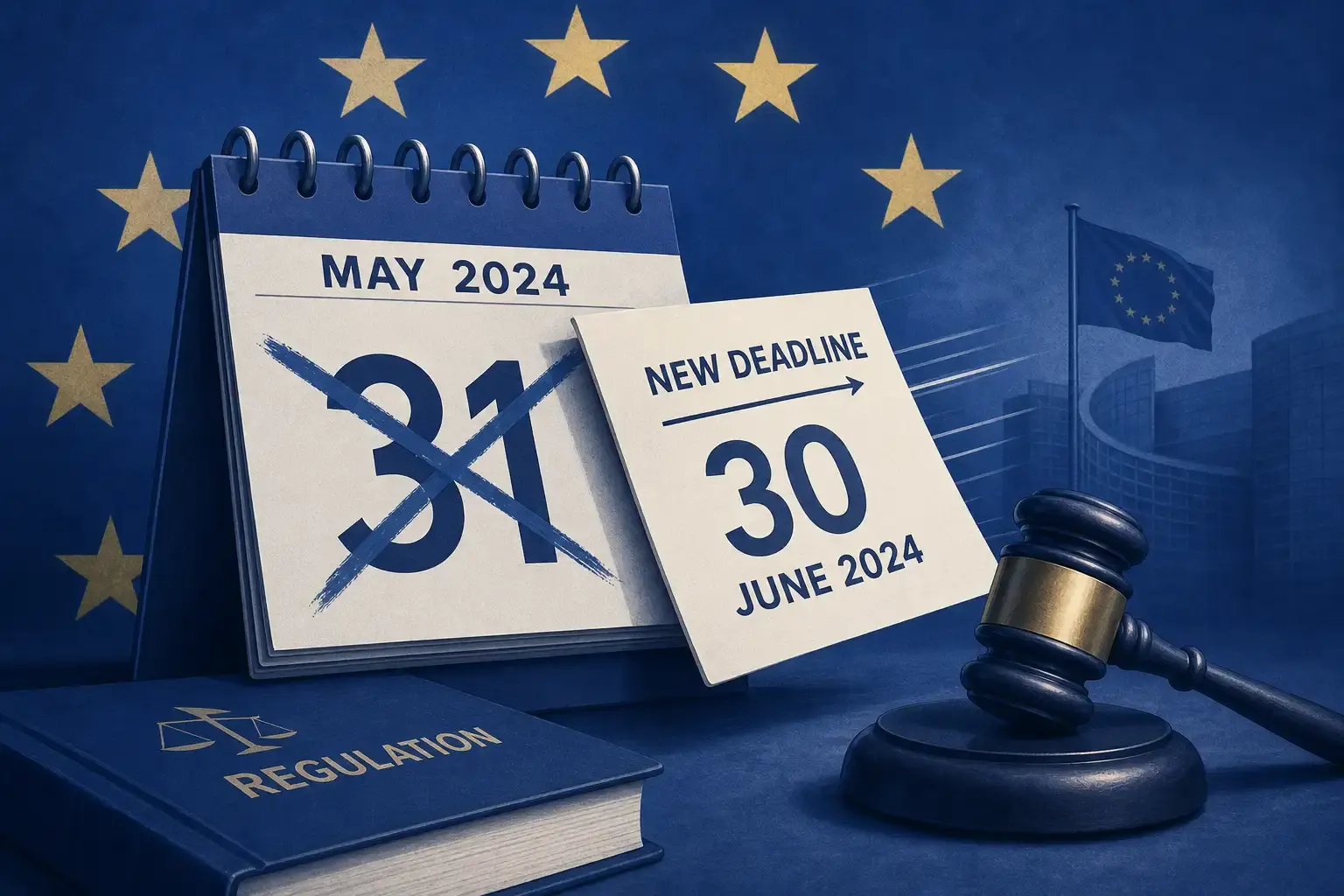
On June 29, 2026, the Council of the European Union quietly approved a package that reshapes the global AI regulatory landscape — not by tightening rules, but by admitting that the infrastructure to enforce them doesn’t exist yet. The “Digital Omnibus” simplification package formally pushes the compliance deadline for stand-alone high-risk AI systems under Annex III of the EU AI Act from August 2, 2026, to December 2, 2027. That’s a 16-month reprieve.
For the thousands of companies that had been racing toward an August deadline — building risk management frameworks, drafting technical documentation, and scrambling to understand what “high-risk” even means for their products — the delay landed somewhere between relief and confusion. But treating it as a vacation from compliance obligations would be a strategic error. The underlying rules haven’t softened. Only the clock has changed.
What Actually Changed
The Digital Omnibus package, approved by the European Commission, Parliament, and Council in a rare display of tripartite agreement, introduces two key timeline adjustments. Stand-alone high-risk AI systems — those covered by Annex III of the Act, which includes AI used in employment, education, credit scoring, law enforcement, migration, and the administration of justice — now have until December 2, 2027, to comply with the full suite of obligations. High-risk AI systems embedded in regulated products, such as medical devices and industrial machinery, receive a parallel 12-month extension, moving their deadline from August 2, 2027, to August 2, 2028.
Crucially, not everything was pushed. Article 50 transparency obligations — which require organizations to disclose when people are interacting with an AI system — remain in force on their original August 2, 2026, schedule. The narrower watermarking requirement for AI-generated content received only a four-month grace period, to December 2, 2026, and only for systems already deployed. If you operate a chatbot, a recruitment screening tool, or any system that interacts with EU residents without making its AI nature clear, the clock is still ticking.
Why the Delay Happened
The official explanation matters because it reveals something important about the state of AI governance. This was not a concession to industry lobbying, though industry groups certainly welcomed the news. The extension was an acknowledgment that the regulatory ecosystem itself isn’t ready. National competent authorities — the government bodies in each EU member state tasked with enforcing the AI Act — remain partially designated across several countries. Accredited bodies capable of conducting the conformity assessments required for high-risk systems are in critically short supply. And the harmonized standards being developed by European standards organizations CEN and CENELEC, which translate the Act’s high-level requirements into auditable technical specifications, are still being finalized and aren’t expected to be complete until late 2026 at the earliest.
In other words, the EU wrote a law that requires companies to demonstrate compliance, but the mechanisms for demonstrating that compliance — the assessors, the standards, the enforcement bodies — don’t yet meaningfully exist. The delay is less about giving companies more time and more about giving the regulatory apparatus time to catch up to its own ambitions.
The 78% Problem
The scale of the readiness gap helps explain why the delay was necessary. According to research from the Cloud Security Alliance published in March 2026, approximately 78% of organizations subject to the AI Act’s high-risk provisions had not yet established basic compliance foundations. Most lacked comprehensive AI system inventories. Few had begun the conformity assessment process. Many hadn’t even classified which of their AI systems might fall under Annex III.
This isn’t simply a case of corporate foot-dragging. The compliance burden for high-risk systems is genuinely demanding. Under Article 9, providers must implement a risk management system that spans the entire lifecycle of the AI system — from design through deployment and post-market monitoring. Annex IV requires technical documentation that demonstrates compliance with every applicable requirement, covering intended purpose, design specifications, training methodologies, testing procedures, and human oversight mechanisms. Article 14 mandates that human oversight be built into the system’s design, not bolted on afterward. And Article 11 requires that all of this documentation be kept current and available to authorities for at least ten years after the system is placed on the market.
The penalties for getting it wrong are severe: up to €15 million or 3% of global annual turnover, whichever is higher, under Article 99. For a company like Microsoft, with approximately $260 billion in annual revenue, that’s a theoretical maximum penalty of nearly €7.8 billion — not per incident, but per non-compliant system.
What the Delay Reveals About AI Regulation
The EU AI Act is the world’s first comprehensive AI regulatory framework, and its implementation struggles are instructive for every jurisdiction watching from the sidelines. The Act entered into force in August 2024 with a staggered timeline: prohibited practices were banned in February 2025, general-purpose AI model obligations kicked in on a separate track, and high-risk rules were slated for August 2026. The architecture was thoughtful. The execution has been messy.
The core challenge isn’t legal but operational. Writing rules about risk management, transparency, and human oversight is relatively straightforward. Building the infrastructure to assess whether those rules are being followed — and doing so at a scale that covers every AI system touching the EU market — is a fundamentally different problem. It requires trained assessors who understand both AI systems and regulatory frameworks. It requires standards that are precise enough to be auditable without being so prescriptive that they stifle innovation. And it requires coordination across 27 member states with different legal traditions, regulatory cultures, and levels of AI expertise.
The delay also exposes a tension at the heart of AI regulation: the technology is evolving faster than the governance frameworks designed to control it. By the time harmonized standards are finalized in 2027, the state of the art in AI will have moved significantly. The high-risk classification criteria in Annex III, drafted in 2023 and early 2024, were based on an understanding of AI capabilities that already feels dated. Systems that seemed high-risk in 2023 may be routine by 2027, while new capabilities that weren’t anticipated — increasingly autonomous agents, multimodal models that blur the line between generation and decision-making — may fall through regulatory cracks.
What Businesses Should Do Now
The extension is a planning reprieve, not a reason to stand down. Smart organizations will use the additional 16 months to build compliance capabilities that are robust rather than rushed. Here is what that looks like in practice.
First, complete an AI system inventory. You cannot comply with a regulation if you don’t know what you’re regulating. Map every AI system your organization develops, deploys, or distributes that could touch the EU market. Classify each system against the Act’s risk tiers. This alone is a substantial undertaking for any large enterprise — Snowflake’s guidance on the Act notes that most enterprises “already have more artificial intelligence in use than any single team can see from end to end.”
Second, establish a governance framework. The Act doesn’t just require documentation at a point in time; it requires ongoing governance. Designate responsible individuals. Build review processes. Integrate AI governance into existing risk management and compliance structures rather than treating it as a standalone initiative. The organizations that will struggle most in 2027 are those that treated AI compliance as a project with a deadline rather than a capability that needs to be sustained.
Third, engage with the standards development process. The harmonized standards being developed by CEN and CENELEC will define what “compliant” means in practice. Organizations that participate in the standards process — through industry associations, public consultations, or direct engagement — will have both earlier insight into requirements and more influence over how they are shaped.
Fourth, don’t ignore the parts of the Act that are already in force. Article 50 transparency obligations apply now. Prohibited practices have been banned since February 2025. General-purpose AI model obligations are already live. The delay only applies to the high-risk compliance package — everything else continues on its original schedule.
The Global Ripple Effects
The EU AI Act’s implementation timeline matters far beyond Europe’s borders. The Act’s extraterritorial reach means it applies to any organization that places AI systems on the EU market or whose AI outputs are used in the EU — regardless of where the company is headquartered. American, Asian, and Middle Eastern AI companies are all subject to the same rules if their systems touch European users.
The delay also influences regulatory conversations in other jurisdictions. Brazil’s AI regulation, modeled in part on the EU framework, is watching the implementation experience closely. Several U.S. states have proposed AI legislation that borrows elements of the risk-based approach. The EU’s struggles with operationalizing its framework will almost certainly shape how other governments design their own — potentially leading to more phased implementations, longer transition periods, and greater emphasis on building regulatory capacity before imposing compliance deadlines.
At the same time, the delay creates a window that some companies may try to exploit. With the hard deadline now nearly 18 months away, the incentive to invest in compliance today is weaker than it was when August 2026 loomed. Regulators are aware of this risk. The EU AI Office, established within the European Commission to oversee implementation, has indicated that it will use the extension period to build enforcement capacity — and that companies demonstrably ignoring their obligations during the transition period will face scrutiny when the deadline arrives.
The Bottom Line
The EU AI Act’s high-risk deadline has been pushed to December 2027, but the direction of travel hasn’t changed. AI systems that affect employment, education, credit access, law enforcement, and other high-stakes domains will be regulated. The obligations — risk management, technical documentation, human oversight, post-market monitoring — remain as demanding as ever. What has changed is the timeline, and smart organizations will treat the additional months as an opportunity to build compliance right rather than an excuse to delay building it at all.
The 16-month reprieve is, in a sense, a test. It tests whether companies will use the time to develop genuine governance capabilities or simply postpone the reckoning. It tests whether regulators can build the infrastructure they need before the next deadline arrives. And it tests whether the world’s first comprehensive AI law can deliver on its promise — not just in text, but in practice.
Reader Dispatches
No reader responses yet. Share your technical perspective below.
Related Posts
AI's Next Race Isn't About Smarter Models. It's About Cost, Control, and Compute.
The frontier model race is giving way to a more important competition: who can run AI cheaper, who controls the infrastructure, and whether open-source models can match proprietary performance at a fraction of the cost.
The AI Industry Just Split in Two — and the Free Side Is Winning
Chinese open-weight models now dominate real-world usage, inference infrastructure companies have raised $4 billion in weeks, and OpenAI and Anthropic are preparing trillion-dollar IPOs. The AI race isn't about better models anymore — it's about who controls the pipes.
The Open-Source AI Cold War: Why the US Is Rethinking Its Ban on Chinese Models
Moonshot AI's Kimi K3 just became the first Chinese model to top a major coding benchmark. The US government is quietly reconsidering its ban on foreign open-source AI — and the timing isn't a coincidence.