ChatGPT vs Claude vs Gemini 2026: Which AI Assistant Should You Actually Use?
The three major AI models go head to head in 2026. From ChatGPT's ecosystem to Claude's reasoning to Gemini's multimodal power — a comparison of strengths, weaknesses and best uses based on official product information and published reviews.
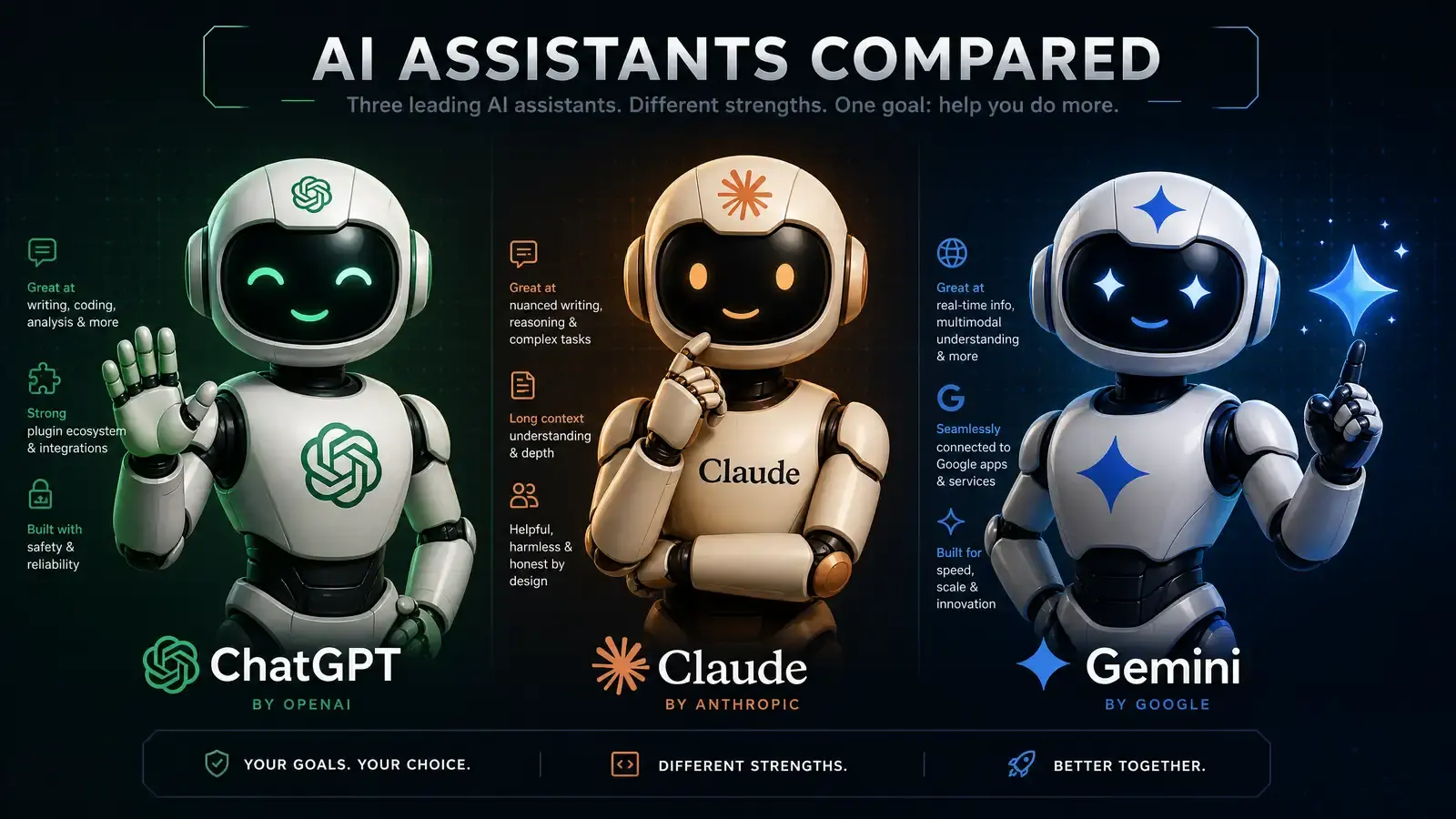
The AI assistant market in 2026 has moved well past the “first to market wins” era. ChatGPT holds its ground through OpenAI’s ecosystem, Claude (Anthropic) leads in reasoning capability, and Google’s Gemini is catching up fast with multimodal integration and a genuinely useful free tier. If you’re still choosing based on impressions from 2024, it’s time for a reality check.
The Quick Verdict
If you don’t have time for the full breakdown:
- Writing and long-form analysis: Claude is still the strongest
- Coding and development: ChatGPT’s Code Interpreter ecosystem is unmatched
- Free daily use: Gemini’s free tier offers the most complete feature set
- Multimodal (images/documents): Gemini leads in understanding
Now let’s dig into the details.
ChatGPT: The Ecosystem Play
OpenAI’s ChatGPT in 2026 derives its biggest advantage not from the model itself, but from everything built around it. Code Interpreter runs Python code, analyzes data, and generates charts — all within the chat window. The GPT Store gives you access to community-trained specialized versions. The plugin ecosystem covers everything from web search to API integrations.
Strengths
- Code Interpreter is a game-changer for developers and data analysts
- Memory features remember your preferences across conversations
- GPT Store offers a wide range of community-built specialized models
Weaknesses
- The free tier (GPT-4o mini) is limited; advanced features require a Plus subscription
- Long-form reasoning trails behind Claude
Best For
Development, data analysis, complex workflows that benefit from plugin integration
Claude: The Reasoning Champion
Anthropic’s Claude continues to lead in 2026 with its exceptional reasoning capabilities. Claude’s sweet spot is tasks that require deep thinking: long-form analysis, logical reasoning, complex instruction following. Its 200K context window lets it process entire books or full codebases.
Strengths
- Best-in-class long-form understanding and reasoning
- 200K context window handles massive documents
- Strong instruction following — less likely to go off on tangents
Weaknesses
- Multimodal capabilities lag behind Gemini
- Smaller ecosystem of plugins and integrations compared to ChatGPT
- Free tier has stricter usage limits
Best For
Deep writing, academic analysis, code review, long document summarization
Gemini: The Free Tier King
Google’s Gemini in 2026 has one standout advantage: its free tier. Compared to ChatGPT’s limited free version, Gemini’s free offering delivers near-premium performance, including file uploads, image analysis, and a generous context window.
Strengths
- Most capable free tier by a significant margin
- Deep Google ecosystem integration (Google Drive, Gmail, Google Docs)
- Excellent multimodal understanding (images, PDFs, documents)
Weaknesses
- Deep reasoning in specialized domains trails Claude
- Code generation is slightly behind ChatGPT
- Occasionally over-cautious in refusing to answer
Best For
Daily use, document analysis, Google ecosystem users, budget-conscious users
How to Decide for Your Own Work
Published comparisons disagree, and model versions change every few months, so a ranking table goes stale quickly. A more reliable approach is to try your own real tasks:
- Pick three to five tasks you do every week (for example, a report draft, a code fix, a PDF summary).
- Run the same prompt in each assistant’s free tier and compare accuracy, tone and how much editing the result needs.
- Check limits that matter to you on the official pages: ChatGPT pricing, Claude plans and Google AI plans.
- Consider where your files already live: Google Workspace users gain most from Gemini, Microsoft and plugin-heavy workflows from ChatGPT, and long-document work is a common reason people choose Claude.
A One-Week Trial Plan
Reviews can narrow the field, but the most reliable way to choose is to test all three on your own work. A simple plan that fits into a normal week:
- Pick five real tasks you did recently: for example, an email reply, a summary of a long document, a spreadsheet question, a piece of code or a formula, and a research question that needs current information.
- Use the free tiers first. All three have free versions. Run the same prompt, with the same files, in each.
- Score each answer on three things: was it correct, how much did you have to edit it, and how long did it take to get there.
- Note friction, not just quality. Usage limits, missing integrations or a confusing interface often matter more over months than small differences in writing style.
- Only then pay for one. If two are close, choose the one that fits the tools you already use (Google Workspace, Microsoft 365 or a coding editor).
Revisit the choice every few months. All three update their models frequently, and rankings on specific tasks shift.
FAQ
Do I need more than one subscription? Most people do not. One paid plan plus the free tier of another covers occasional second opinions.
Is the most expensive plan worth it? Only if you regularly hit usage limits or need features reserved for higher tiers. Start with the standard paid plan.
Can I use these tools for work documents? Check your employer’s policy first. Many companies require a business plan, which offers stronger data protections than personal accounts.
Our Recommendation
If you’re a developer or data analyst: ChatGPT Plus. Code Interpreter’s integration experience has no rival right now.
If you’re a writer, researcher, or deal with heavy text processing: Claude Pro. Its reasoning and long-context capabilities lead the pack.
If you want a solid daily AI assistant without paying: Gemini’s free tier. It offers the most complete feature set for zero cost.
If you need multimodal capabilities: Gemini. Its image and document understanding is the strongest of the three.
The Real Takeaway
The 2026 AI assistant market is mature enough that no single model dominates every category. The smart approach isn’t “pick one and stick with it” — it’s choosing the right tool for each task. A common combination: Gemini free for everyday use, Claude for deep reasoning, ChatGPT for coding. Three tools doing what they do best works better than any single model trying to do everything.
Sources:
Reader Dispatches
No reader responses yet. Share your technical perspective below.
Related Posts
AI Edge Gallery on Mac Review: Local Gemma 4, Zero Setup
Google's AI Edge Gallery hit the Mac on June 4 with five Gemma models on board. Here is the hardware floor, what stands out, and who should install it.
Best AI Tools in 2026: ChatGPT vs Claude vs Gemini In-Depth Comparison
ChatGPT, Claude, and Gemini are the three most prominent AI assistants in 2026, each with unique product positioning and strengths. This article provides an in-depth comparison of their features, pricing, and use cases to help you find the best AI partner.
Cursor IDE Review: The AI Coding Tool SpaceX Bought for $60 Billion
SpaceX's $60 billion acquisition of Cursor's parent company Anysphere sent shockwaves through the dev community. This review tests Cursor's features, pricing, and how it stacks up against Claude Code and GitHub Copilot.