Cursor Launches Composer 2: A Stronger Coding Model That Pushes AI IDEs Toward a Real Multi-Agent Workspace
Cursor officially released Composer 2 on March 19, 2026. This is more than a routine model refresh. It ties together better coding performance, a clearer pricing story, and the multi-agent workflow Cursor has been building toward for months.
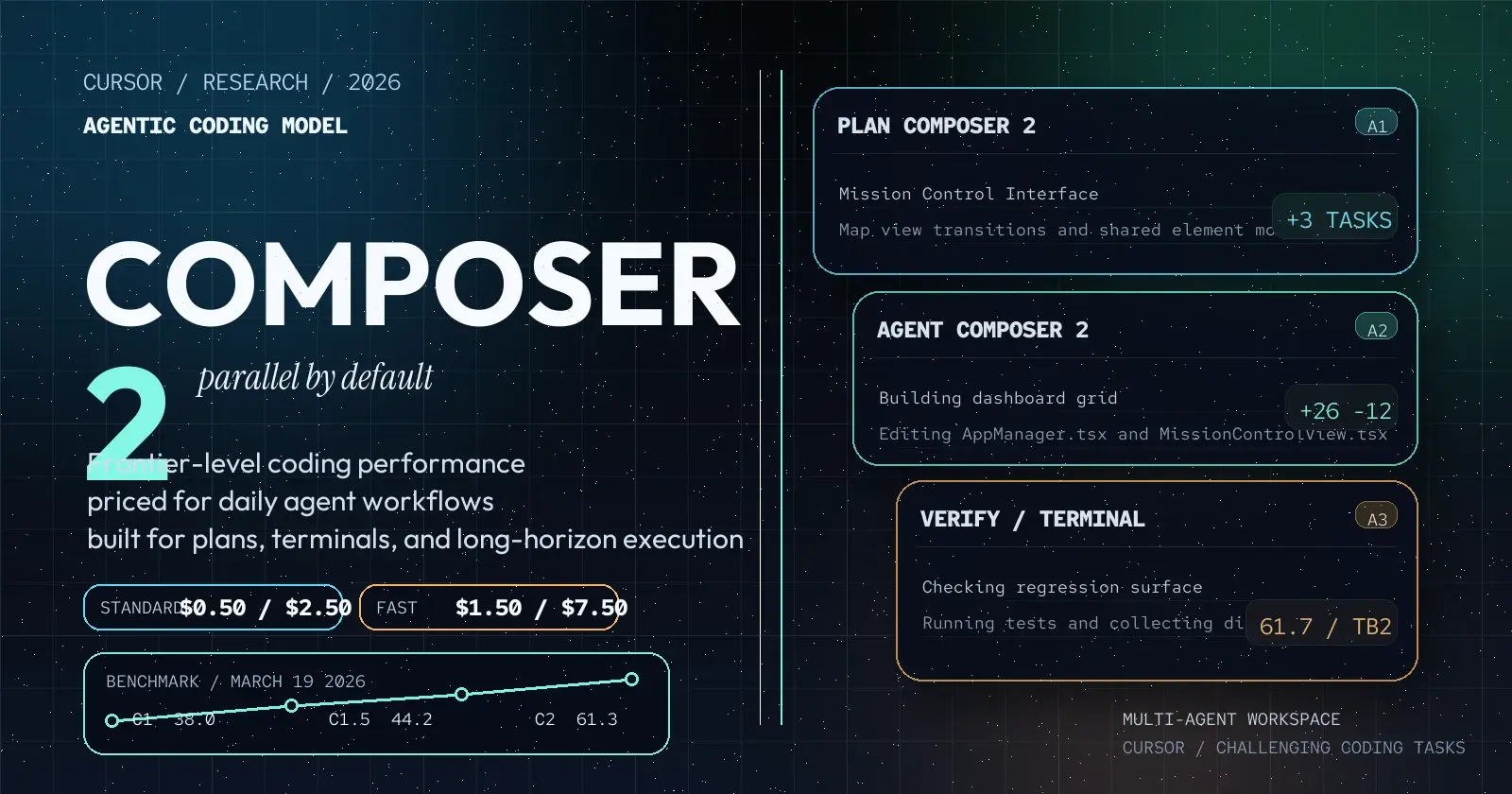
Composer 2 is no longer just a phrase floating around the Cursor community.
According to Cursor’s official blog and changelog, Composer 2 became officially available on March 19, 2026. The announcement was short, almost understated. But the update itself is not small. What matters here is not simply that another coding model scored higher on another benchmark. The bigger story is that Cursor has now connected three things much more tightly than before: its in-house coding model, a workable pricing structure, and the multi-agent interface it has been building into the product.
That is why Composer 2 feels less like an isolated model release and more like the point where Cursor’s recent strategy clicks into place.
What Cursor officially confirmed
As of March 22, 2026, Cursor has clearly confirmed the following:
-
Composer 2 is live inside Cursor
Both the official announcement, Introducing Composer 2, and the changelog entry, Composer 2, say the same thing:Composer 2 is now available in Cursor. -
Pricing is part of the launch story
The standard version is priced at $0.50 per million input tokens and $2.50 per million output tokens.
There is also aFastvariant priced at $1.50 per million input tokens and $7.50 per million output tokens, and Cursor says that fast will become the default option. -
The benchmark jump over earlier Composer models is material
In Cursor’s own published comparison table, Composer 2 scores:61.3onCursorBench61.7onTerminal-Bench 2.073.7onSWE-bench Multilingual
Composer 1.5, by comparison, scored
44.2,47.9, and65.9, while Composer 1 scored38.0,40.0, and56.9. -
Cursor is positioning Composer 2 as a long-horizon coding agent model
The company says Composer 2 can handle difficult software tasks that require hundreds of actions. That wording matters. It suggests Cursor is optimizing for agentic execution over time, not just single-turn code generation.
Why this is more than a routine version bump
If you only read the March 19, 2026 announcement, Composer 2 might look like a straightforward upgrade from Composer 1.5. The broader timeline tells a more interesting story.
Here is the official sequence:
- On October 29, 2025, Cursor shipped
2.0, introducedComposeras its first agentic coding model, and launched a new Agent interface that could run up to eight agents in parallel from a single prompt. - On February 9, 2026, Cursor introduced
Composer 1.5. - On February 11, 2026, Cursor expanded Agent usage and split individual-plan usage into separate
Auto + ComposerandAPIpools. - On March 19, 2026, Cursor launched
Composer 2.
Once you line those dates up, the pattern is hard to miss. Cursor has not simply been swapping one model for another. It has been building a full stack:
- first the agent interface and orchestration layer,
- then a stronger in-house model,
- then a pricing and usage model that makes that stack easier to use every day.
That is why Composer 2 feels important. It signals that the next phase of AI coding competition may not be about who plugs the latest frontier model into an editor fastest. It may be about who can combine model quality, workflow orchestration, and economics into a single coherent product.
The most important detail may be that performance and price appear in the same launch note
A lot of model launches talk about intelligence and skip the economic reality. Others talk about price and leave performance vague. Composer 2 is notable because Cursor made both points at once.
The company’s language is blunt in a good way. Composer 2 is supposed to offer frontier-level coding performance while also being a better balance of intelligence and cost. That sounds simple, but it gets at the question developers actually care about:
Is this model smart enough, fast enough, and affordable enough that I will keep it turned on?
Cursor had already hinted at this direction in its February 11 post about increased Agent usage. At that point, the company said it was seeing a clear shift from autocomplete toward agents, and that users were making different trade-offs between speed, intelligence, and cost. Composer 2 turns that product logic into a more complete default lane.
The bigger shift: AI IDEs are starting to look more like project engines
If you look at Cursor’s current product pages, Plan Composer 2 and Agent Composer 2 already appear directly in the interface demos. That is a revealing detail.
It suggests that Composer 2 is not being treated as just another model in a dropdown. It is becoming part of the operating layer beneath the agent workflow itself.
That fits the trend Cursor has been describing publicly. In The third era of AI software development, the company says Agent usage has grown more than 15x over the last year. It also gives a telling before-and-after comparison: in March 2025, Cursor had roughly 2.5x as many Tab users as Agent users. By the time that later post was published, the ratio had flipped, and Cursor said it now had 2x as many Agent users as Tab users.
Those numbers matter because they describe a deeper product shift. Older AI coding tools felt like autocomplete with better marketing. The newer model is different. The editor increasingly acts like an execution layer that can plan, search the codebase, run terminal commands, write tests, and move work forward.
Composer 2 looks like Cursor’s attempt to place a first-party engine at the center of that system.
What still deserves caution
None of this means Composer 2 should be taken at face value without scrutiny.
First, a meaningful part of the evidence still comes from Cursor’s own evaluation setup or infrastructure. To Cursor’s credit, the company provides real methodological notes. That is better than vague benchmark bragging. Still, internal and semi-internal evaluations are not the same thing as broad, independent validation over time.
Second, the launch highlights performance and price, but not every real-world variable developers care about. Plan limits, reliability under load, behavior on large repositories, and day-to-day consistency across workflows will still need to be tested in practice.
Third, Composer 2’s value is tightly tied to the Cursor product experience around it. The browser tools, terminal harness, multi-agent orchestration, and agent UI all shape how the model feels. If you tried to evaluate the model in isolation, outside that product context, you might reach a very different conclusion.
Bottom line
Composer 2 matters for a simple reason: it shows Cursor no longer thinks of AI coding as a chat box that happens to edit files.
What the company is building now is more ambitious. It is trying to turn model performance, tool use, planning, parallel agents, and pricing into a unified product. If that works, the AI IDE stops being a thin assistant layered on top of an editor and starts looking more like a real workspace for moving software projects forward.
As of March 22, 2026, Composer 2 has at least made one thing clear: Cursor does not want to be merely a distributor of other labs’ models. It wants its own coding agent to be a core strategic asset.
Sources
Reader Dispatches
No reader responses yet. Share your technical perspective below.
Related Posts
Alibaba Unveils Qwen3.5-Max-Preview: A New Flagship Preview Lands on Arena Before Full Release
On March 19, 2026, the Qwen team said Qwen3.5-Max-Preview had been deployed to LMSys Arena and would undergo roughly two more weeks of optimization before formal release. Here is what is confirmed, what is still missing, and why the launch matters.
Claude Code Source Leak: Anthropic Didn’t Lose Customer Data, But It Did Expose Its Engineering Blueprint
On March 31, 2026, Anthropic accidentally shipped internal Claude Code source material in a public package update. The company says no customer data or credentials were exposed, but the incident still revealed Claude Code’s architecture, roadmap clues, and product tradeoffs.
ByteDance Seedance 2.0: 90% Usability Rate Changes the AI Video Game
ByteDance quietly dropped Seedance 2.0 over the weekend. First-generation usability hits 90%, supports 9 images + 3 videos + 3 audio inputs simultaneously. Native audio-visual sync at 1/10,000th the cost of traditional VFX. But is it really as good as advertised?