Claude Code Source Leak: Anthropic Didn’t Lose Customer Data, But It Did Expose Its Engineering Blueprint
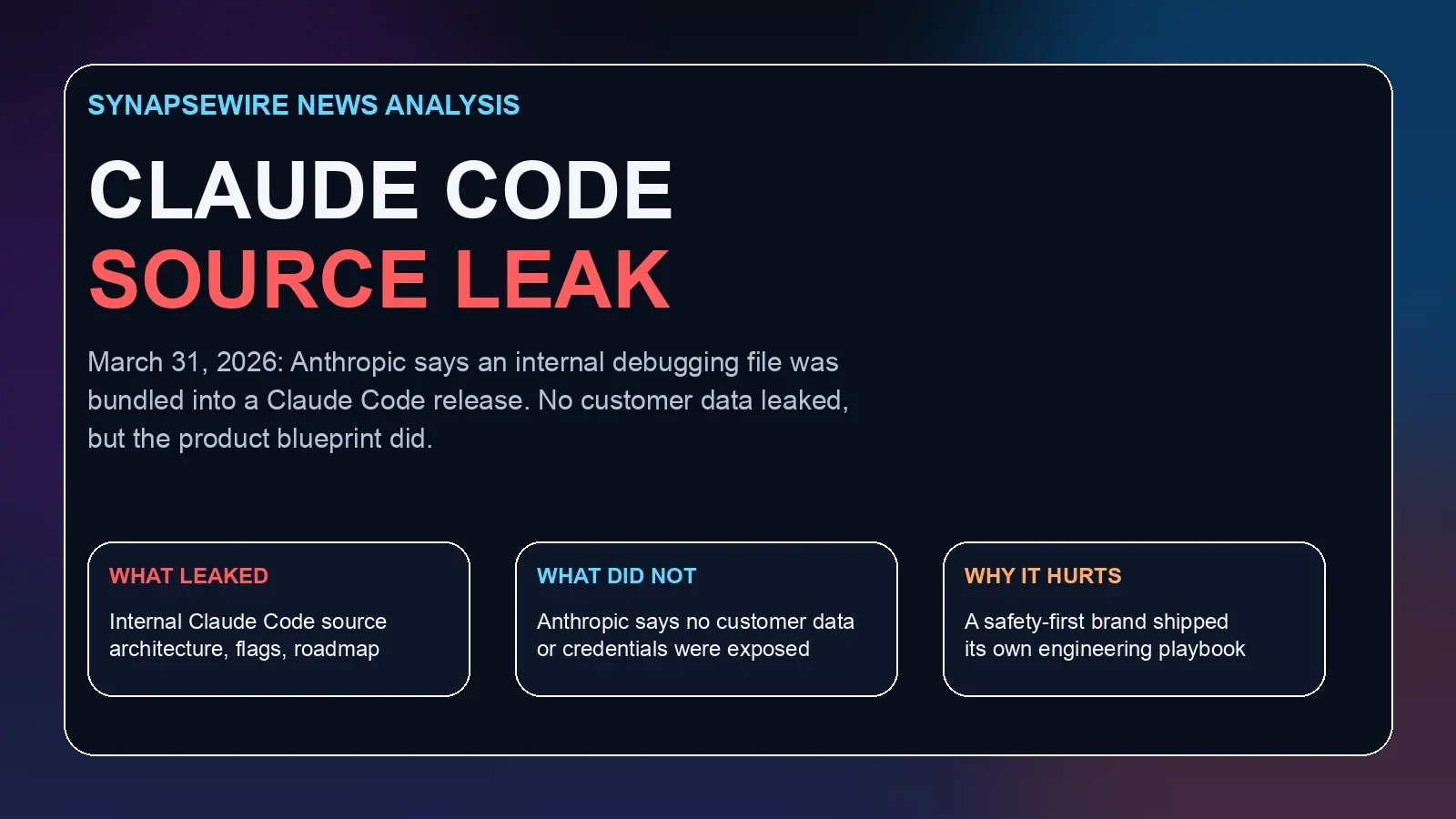
On March 31, 2026, Anthropic accidentally shipped internal Claude Code source material in a public package update. The company says no customer data or credentials were exposed, but the incident still revealed Claude Code’s architecture, roadmap clues, and product tradeoffs.
Some leaks should make ordinary users panic. Some are more interesting to competitors. This Claude Code source leak is much closer to the second category.
According to Axios on March 31, 2026, Anthropic accidentally bundled an internal debugging file into a routine Claude Code release, allowing outsiders to reconstruct large portions of the product’s source, feature flags, and parts of its internal performance data. Anthropic’s response to Axios was also very clear: no sensitive customer data or credentials were exposed, and this was a release packaging issue caused by human error rather than an outside breach.
That distinction matters, because it helps set the boundary first. This was not a database dump. It was not an account-system compromise. But it would also be a mistake to wave it away as a minor embarrassment. Claude Code is one of Anthropic’s most important product surfaces, and what leaked is exactly the part the company least wanted the market to see.
Start With What Can Actually Be Verified
As of April 1, 2026, the most solid facts are these:
- Axios reports that the exposure came from a debugging artifact accidentally bundled into a public release and points to source material covering roughly 2,000 files and more than 500,000 lines of code.
- Anthropic told Axios that no customer data or credentials were involved or exposed, and that the issue was a release packaging issue caused by human error.
- Anthropic’s own docs consistently describe Claude Code as a tool installed from npm, running locally, while sending prompts and outputs over the network to Anthropic’s APIs.
- I checked npm package metadata locally on April 1, 2026. The current latest public version is
2.1.89, and the visible version list currently jumps from2.1.87to2.1.89. - I also unpacked
@anthropic-ai/claude-code@2.1.89locally. The package containscli.js, but nocli.js.map.
That last point does not erase the leak. It just suggests Anthropic has already done the first obvious cleanup step on the public package side.
What Leaked, and What Did Not
Start with what did not leak.
Anthropic’s central public line so far is still this: no customer data and no credentials. If that claim holds, then this should not be written up as a traditional mass customer-data breach.
But what leaked is still important enough to matter a lot.
Axios describes the exposed material as including Claude Code’s:
- source structure
- unreleased feature flags
- product-roadmap signals
- internal model performance data
That may feel less alarming to a normal user than “your account was compromised,” but to competitors it is extremely valuable. AI coding tools are no longer competing only on chat quality. They are competing on packaging, orchestration, memory, long-task handling, and agent collaboration. Exposing that layer gives the rest of the market a shortcut into lessons that would otherwise take time, money, and repeated product mistakes to learn.

Why This Is Especially Awkward for Anthropic
If this had happened to a company that did not lead with safety messaging, the story would probably be treated as a routine software blunder. Anthropic is different.
In its own Claude Code security documentation, the company emphasizes:
- strict read-only permissions by default
- explicit approval for additional actions
- folder-boundary restrictions
- protections and guidance around prompt injection and MCP risk
None of that is fake, and much of it is useful in actual day-to-day use. But this incident did not come from the interaction layer, the permission layer, or the prompt-injection layer. It came from the release and distribution layer. Put more bluntly: Claude Code is designed to help developers use agents safely, while Anthropic itself appears to have stumbled on a packaging step.
That contrast lands harder than an ordinary bug.
Because it pushes the market to ask a sharper question: when a company sells “safety-first AI,” is it talking only about model behavior, or about the discipline of the full product chain?
The Leak Also Breaks a Useful Myth
Another point worth being honest about is this: Claude Code’s moat probably was never entirely hidden inside secret source code.
Anthropic’s own Claude Code overview has always been fairly explicit. Claude Code is a terminal-native agentic coding tool that can edit files, run commands, connect to MCP, help in CI, and sit on top of Anthropic’s APIs and model stack.
That means even if outsiders now have a much better view of the implementation details, they still do not magically have an equivalent Claude Code the next morning. Real product advantage in this category also comes from:
- model quality
- latency and reliability
- context management
- default product decisions
- billing and account infrastructure
- the speed of internal iteration
Still, seeing more of the code changes two things in very practical ways.
First, competitors get to skip some detours.
Second, outside developers get a clearer read on where Anthropic wants Claude Code to go next.
So the most interesting effect of this incident may not be a direct hit to Claude Code’s current product quality. It may be a hit to Anthropic’s control over its own timing and narrative.
There Is Also a Larger Irony Here
Back on April 25, 2025, TechCrunch reported that Anthropic sent a DMCA takedown notice to a developer who tried to reverse-engineer Claude Code. At the time, the context was clear: Anthropic treated Claude Code as a more closed, more commercial product and did not want the ecosystem to handle it like an open-source tool.
That makes this week’s episode unusually ironic.
A year ago, Anthropic was trying to stop outsiders from reverse-engineering Claude Code.
A year later, it effectively shipped much richer engineering material on its own.
These are not the same kind of event. DMCA enforcement is a licensing issue; this is a release accident. But placed side by side, they illuminate an uncomfortable truth: you can control the license, and still fail to control what actually gets distributed.
What Developers Should Actually Watch Now
For most developers, the most useful takeaway is not whatever amusing unreleased feature got screenshotted from a mirrored repo. It is what comes next.
1. Will Anthropic publish a real postmortem?
If the company only pushes 2.1.89 and says little else, the incident will linger longer than it needs to. For infrastructure-style products, fixing a mistake and explaining a mistake are not the same thing.
2. Will release hygiene get much stricter?
This looks a lot like a classic software-engineering failure mode: an artifact that should have been excluded was not excluded, and a file that should have been blocked was not blocked. What matters now is whether Anthropic hardens:
- publish allowlists
- source-map stripping rules
- pre-publish audits
- automated artifact inspection
Those changes would say more than any PR line.
3. Will Claude Code’s roadmap become more visible, faster?
Axios says the leak exposed unreleased capabilities and a clearer long-term agent direction. That is not entirely bad for the ecosystem. A lot of educated guesses about Claude Code will now become firmer expectations much sooner. The downside is that Anthropic loses timing control. The upside is that the market gets a better sense of where the tool is heading.
My Take
This Claude Code source leak is not the kind of incident that should send ordinary users rushing to reset passwords. But it is also far too consequential to dismiss with a single sentence about customer data.
What it really exposed was a weak point in Anthropic’s supply chain discipline and release discipline. Put even more directly: you can build impressive model-safety messaging, but if your public distribution process slips, the “safety-first” story still takes damage.
I do not think this will knock Claude Code off its perch. The product is too strong, and its user pull is already too real. But it does change the way people will evaluate Anthropic from here.
From now on, the market will not judge Anthropic’s idea of safety only by whether the model behaves well. It will also judge whether the company can package its own product without handing out the blueprint.
Sources
- Axios: Anthropic leaked 500,000 lines of its own source code
- Anthropic Docs: Claude Code overview
- Anthropic Docs: Claude Code security
- Anthropic Docs: Claude Code data usage
- TechCrunch: Anthropic sent a takedown notice to a dev trying to reverse-engineer its coding tool
- npm: @anthropic-ai/claude-code
Reader Dispatches
No reader responses yet. Share your technical perspective below.
Related Posts
Anthropic Ships Opus 4.7 and a Design Tool in the Same Week — The Model Isn't the Story
The Information broke on April 15, 2026 that Anthropic would launch Claude Opus 4.7 alongside a new AI design tool this same week. The 4.6-to-4.7 bump is incremental. The design tool is Anthropic's first serious move from 'model API vendor' toward a full-stack AI studio — and that's the shift worth watching.
Claude Mythos Preview: Anthropic Just Chose Not to Sell Its Strongest Model
On April 7, 2026, Anthropic released Claude Mythos Preview, scoring 93.9% on SWE-bench Verified. Then they said it won't be generally available — only about 40 vetted Project Glasswing partners get access. This is a reversal of how frontier-model economics has worked.
OpenClaw Latest News as of March 16, 2026: Rapid Releases, a Recovery Build, and Two Fresh Security PRs
As of March 16, 2026, OpenClaw has shipped v2026.3.11, v2026.3.12, and v2026.3.13-1 within seven days, while a Telegram SecretRef update issue and two new security PRs reveal where the platform is still tightening up.