Google D4RT: Why 4D Perception is the Missing Link to True World Models
DeepMind's new D4RT model processes video 300x faster than previous methods, unifying tracking and reconstruction. Here is why this query-based architecture changes the game for Robotics and AR.
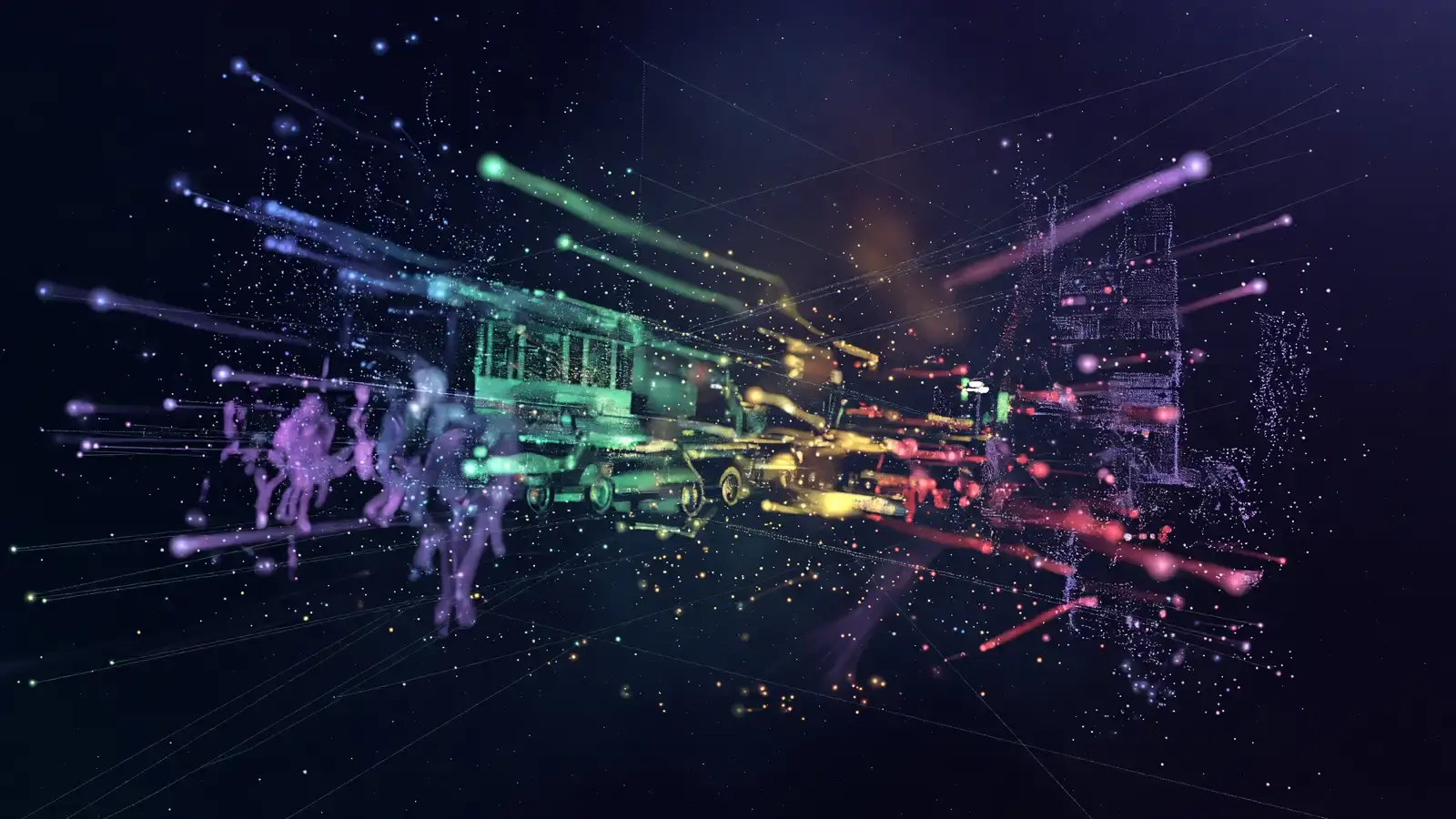
If you look at a coffee cup sliding across a table, your brain doesn’t just see a series of 2D images. You understand the cup’s 3D shape, its position in space, its velocity, and—crucially—you know it’s the same cup even if your hand briefly blocks your view. You have a mental model of the world that persists through time.
For decades, computers have struggled to replicate this. We’ve had algorithms that are good at estimating depth (3D) and algorithms that are good at tracking movement (Optical Flow), but combining them into a coherent “4D” understanding (3D space + Time) has been a computational nightmare. It usually involves stitching together disparate models—one for the camera, one for the object, one for the background—resulting in a fragile, slow Frankenstein of a system.
Enter D4RT (Dynamic 4D Reconstruction and Tracking), Google DeepMind’s latest architecture.
D4RT isn’t just an incremental speed bump; it’s a fundamental architectural shift. By unifying reconstruction and tracking into a single Transformer-based framework, it achieves speeds up to 300x faster than current state-of-the-art methods.
But the real story isn’t just the speed—it’s how it achieves it. Let’s dive into the architecture, the “Query” paradigm, and why this brings us one step closer to AGI World Models.
The “Inverse Problem” of Vision
To understand why D4RT is significant, we first need to appreciate the difficulty of the problem it solves.
Computer vision is essentially an inverse problem.
- Forward Problem (Rendering): You have a 3D model of a scene, lights, and a camera trajectory. You calculate what the 2D image looks like. This is what video game engines do. It is mathematically well-defined.
- Inverse Problem (Vision): You have a flat 2D video. You need to hallucinate the 3D geometry, the lighting, the camera movement, and the object motion that caused those pixels.
Traditionally, solving this for dynamic scenes (where things move) required heavy optimization. You might use SLAM (Simultaneous Localization and Mapping) for the camera, and separate flow networks for the objects.
The Old Way vs. The D4RT Way
| Feature | Traditional Dynamic Reconstruction | D4RT (Unified Transformer) |
|---|---|---|
| Architecture | Modular pipeline (Depth Net + Flow Net + Pose Net) | Single Encoder-Decoder Transformer |
| Processing | Iterative optimization (slow) | Feed-forward prediction (fast) |
| Data Flow | Dense reconstruction (calculates everything) | Query-based (calculates only what is asked) |
| Occlusion | Often fails or creates “ghost” artifacts | Handles occlusion via global context |
| Speed | Minutes per video clip | Seconds (Real-time potential) |
The Core Innovation: The “Query” Mechanism
The genius of D4RT lies in its laziness.
Most reconstruction models try to build the entire world at once. They generate a dense voxel grid or a massive point cloud for every frame, regardless of whether that data is needed immediately. This is computationally expensive.
D4RT flips this logic. It uses a Query-Based Approach.
Instead of outputting a full 3D model by default, D4RT processes the video into a compressed latent representation (via the Encoder). Then, a lightweight Decoder waits for a specific question.
The fundamental question D4RT answers is:
“Where is the pixel $(u, v)$ from source frame $t_{src}$ located in 3D space at target time $t_{tgt}$, as viewed from camera $C$?”
Because these queries are independent, they can be parallelized massively on GPUs or TPUs.
Conceptualizing the Architecture
While the official source code is proprietary, we can reconstruct the logical flow for developers trying to understand the system design.
Here is a conceptual Python representation of how D4RT’s interface differs from traditional reconstruction loops:
# ❌ Traditional Approach: The "Heavy Lift" Loop
# Requires processing the entire volume for every frame
class TraditionalReconstructor:
    def process_video(self, video_frames):
        full_scene_mesh = []
        for frame in video_frames:
            depth_map = self.estimate_depth(frame)
            camera_pose = self.estimate_pose(frame)
            # Expensive volumetric fusion
            mesh = self.fuse_volume(depth_map, camera_pose)
            full_scene_mesh.append(mesh)
        return full_scene_mesh

# ✅ D4RT Approach: The "Lazy Query" Pattern
# Encodes once, queries infinitely
class D4RT_Model:
    def __init__(self, encoder, decoder):
        self.encoder = encoder
        self.decoder = decoder
        self.latent_representation = None

    def encode_scene(self, video_frames):
        """
        Step 1: Compress the entire video context into a
        latent geometric-temporal representation.
        """
        self.latent_representation = self.encoder(video_frames)
        print("Scene encoded. Ready for queries.")

    def query_point(self, pixel_u, pixel_v, source_time, target_time):
        """
        Step 2: Ask specific questions.
        Returns the 3D coordinate of a specific pixel at a future time.
        """
        if not self.latent_representation:
            raise Exception("Scene not encoded")

        # The decoder is lightweight and highly parallelizable
        prediction = self.decoder(
            self.latent_representation,
            query={
                'u': pixel_u,
                'v': pixel_v,
                't_src': source_time,
                't_tgt': target_time
            }
        )
        return prediction.xyz_coordinates

# Usage Scenario
model = D4RT_Model(encoder, decoder)
model.encode_scene(video_stream) # Fast pass

# We only care about the robot arm's tip, not the background wall
robot_tip_pos = model.query_point(u=320, v=240, source_time=0, target_time=1.5)
This architecture allows D4RT to be task-agnostic.
- Need Point Tracking? Query the same pixel across $t_0$ to $t_n$.
- Need Depth Estimation? Query a grid of pixels at $t_{current}$.
- Need Camera Pose? Query static background points and solve for the camera movement.
Performance: The 300x Leap
DeepMind claims an efficiency improvement of 18x to 300x compared to previous state-of-the-art (SOTA) methods.
To put this in perspective:
- Previous SOTA: Processing a 1-minute video might take 10 minutes. This makes it useless for a robot that needs to decide now whether to brake or turn.
- D4RT: Processes the same video in ~5 seconds on a single TPU.
This speed is the threshold for real-time deployment. It moves 4D reconstruction from “offline post-processing for movies” to “online perception for autonomous agents.”
Benchmark Dominance
The model was tested on the MPI Sintel benchmark, a notorious dataset featuring:
- Fast motion blur (which confuses optical flow).
- Non-rigid deformation (dragons, bending characters).
- Atmospheric effects.
D4RT outperformed baselines by maintaining “object permanence.” When an object moves rapidly or is occluded, D4RT doesn’t just guess; its global encoder context allows it to “remember” the object’s trajectory, preventing the common issue where objects disappear or duplicate when they move too fast.
Why This Matters: Beyond Better Video
The implications of D4RT extend far beyond just making better 3D videos. It touches on the core of Spatial Computing and AGI.
1. The “World Model” for AGI
Yann LeCun and other AI pioneers have long argued that for AI to reach human-level intelligence, it needs a World Model—an internal simulation of how physics works.
Current LLMs (Large Language Models) understand text, but they don’t understand space or causality. They don’t know that if you drop a glass, it falls. D4RT provides the visual grounding for such a model. By disentangling Camera Motion (ego-motion) from Object Motion (independent agency), D4RT learns the physics of the scene.
2. Robotics: From “Blind” to “Predictive”
Robots today are surprisingly clumsy in dynamic environments. A warehouse robot works fine if the shelves are static. But throw a ball at it, or have a human walk in front of it, and it freezes.
D4RT allows a robot to:
- Perceive: See the human walking.
- Predict: Use the temporal aspect of D4RT to query where the human will be in 0.5 seconds.
- Act: Plan a path around the future location of the human.
3. Augmented Reality (AR)
Current AR (like Apple Vision Pro or Meta Quest) relies heavily on SLAM to lock virtual objects to the real world. However, this often breaks when things move. If you place a virtual pet on a real dog, and the real dog runs away, the virtual pet usually stays floating in mid-air.
D4RT’s ability to track dynamic geometry means the virtual pet could actually run with the real dog, respecting the changing geometry of the animal in real-time.
Critical Analysis: The Hardware Question
While the results are impressive, we must look at the infrastructure. The blog post mentions performance on a single TPU.
TPUs (Tensor Processing Units) are Google’s specialized hardware. The question for the broader developer community is: How does this translate to NVIDIA GPUs?
- Transformer Overhead: Transformers are memory-hungry. Encoding a high-resolution video into a latent representation requires significant VRAM.
- Consumer Viability: Can D4RT run on an RTX 4090? Or is this strictly a data-center class model?
For D4RT to truly revolutionize robotics (which often relies on edge compute like NVIDIA Jetson), the model will likely need to be distilled or quantized. The “300x speedup” is fantastic, but if the base memory requirement is 80GB of VRAM, it won’t be running on your AR glasses just yet.
Conclusion: The Fourth Dimension is Solved (Almost)
D4RT represents a maturation of computer vision. We are moving away from the era of “hand-crafted features” and “patchwork pipelines” into the era of Unified Neural Representations.
By treating space and time as a queryable database, Google DeepMind has solved the efficiency bottleneck that kept 4D perception in the lab. The next step is seeing this integrated into Gemini or robotic foundation models, giving our AI agents not just eyes, but the ability to understand the flow of time itself.
References:
Reader Dispatches
No reader responses yet. Share your technical perspective below.
Related Posts
Google's Project Genie: The $250/Month 'Matrix' Simulator That Isn't a Game Engine
Google DeepMind's Genie 3 allows you to generate playable worlds from a single image, but the hardware constraints and the steep 'AI Ultra' subscription price raise questions about its viability. Here is a technical deep dive into the future of generative environments.
Qwen3-TTS: Alibaba's 12Hz Gamble to Redefine Open Source Speech Synthesis
Alibaba's Qwen team just dropped Qwen3-TTS, featuring a radical 12Hz tokenizer and a 'Dual-Track' architecture. Is this the open-source ElevenLabs killer we've been waiting for? We analyze the tech, the code, and the reality.
DeepSeek's 'MODEL1' Leaked: A Code-Level Deep Dive into the Next Architecture Shift
Hidden within the FlashMLA repository lies a new identifier: 'MODEL1'. We analyze the code clues, the shift in KV cache design, and the potential integration of 'Engram' memory modules to predict what DeepSeek V4 will look like.