Qwen3-TTS: Alibaba's 12Hz Gamble to Redefine Open Source Speech Synthesis
Alibaba's Qwen team just dropped Qwen3-TTS, featuring a radical 12Hz tokenizer and a 'Dual-Track' architecture. Is this the open-source ElevenLabs killer we've been waiting for? We analyze the tech, the code, and the reality.
The text-to-speech (TTS) landscape has been stuck in a binary trap for the last two years. You either pay a premium for closed-source APIs like ElevenLabs to get “human-like” emotion, or you struggle with open-source models that sound robotic or take three seconds to generate a simple “Hello.”
Alibaba’s Qwen team just threw a wrench into that dynamic.
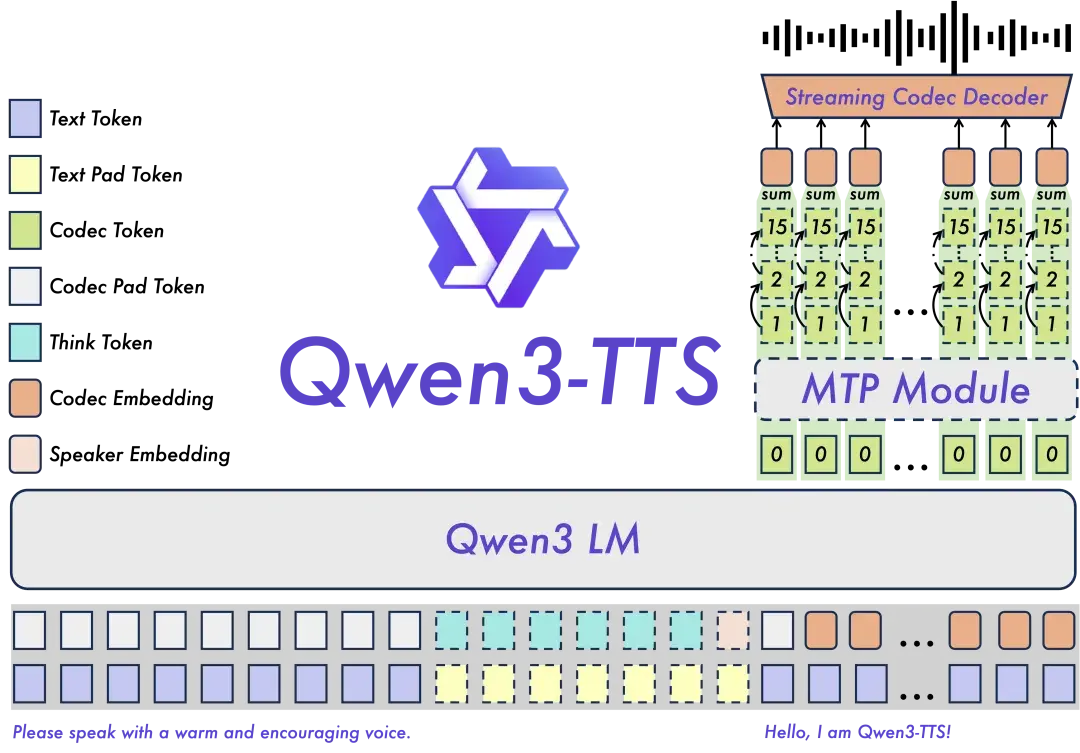
On January 22, 2026, they released Qwen3-TTS, a family of models (1.7B and 0.6B) that claims to solve the “latency vs. quality” trade-off. But the real story isn’t just the model size; it’s the engineering choices under the hood—specifically a 12Hz tokenizer and a Dual-Track architecture.
If you are building voice agents, NPCs, or content creation tools, here is why you need to pay attention to this release, and how to actually use it.
The Core Innovation: Why “12Hz” Matters
To understand why Qwen3-TTS is significant, we have to talk about compression.
Most modern TTS models (like VALL-E or Tortoise) treat speech synthesis as a language modeling problem. They convert audio into discrete “tokens” (codes) and predict the next token, just like ChatGPT predicts the next word.
The problem? Audio is dense. A standard audio tokenizer might run at 50Hz or 75Hz, meaning the model has to predict 50 to 75 tokens for every second of audio. That is computationally expensive and slow.
The Qwen3-TTS-Tokenizer-12Hz
Qwen has managed to compress speech representation down to 12Hz. This is an incredibly low bitrate.
- Standard Approach: High frequency (50Hz+) = High fidelity, Slow generation.
- Qwen Approach: Ultra-low frequency (12Hz) = Extreme speed, usually low fidelity.
However, Qwen claims their tokenizer retains “paralinguistic information” (breath, tone, emotion) and acoustic environment features despite this compression. If true, this allows the model to generate audio roughly 4x to 6x faster than competitors simply because it has fewer tokens to predict.
Dual-Track Streaming
The second bottleneck in TTS is streaming. Usually, you have to wait for the model to process a chunk of text before you hear audio. Qwen3 introduces a “Dual-Track” architecture.
- Result: The first packet of audio is generated after waiting for just one character.
- Latency: End-to-end latency is clocked at 97ms. For context, human conversational pause tolerance is around 200ms. This makes it viable for real-time voice bots.
Feature Breakdown: More Than Just Reading Text
Qwen3-TTS isn’t just a “reader”; it’s a “performer.” The release covers three distinct capabilities:
1. Voice Design (Prompt-to-Voice)
Instead of cloning a specific file, you can describe the voice you want. This is massive for game developers who need distinct NPC voices without hiring hundreds of actors.
Prompt: “A raspy, elderly wizard, speaking in a whisper, sounding terrified of what is coming next.”
The model interprets the semantics of the description and generates a unique speaker embedding.
2. Fine-Grained Control
You can direct the performance using natural language instructions. This separates the content (what is said) from the style (how it is said).
| Feature | Description | Use Case |
|---|---|---|
| Emotion Control | ”Speak with suppressed anger” | Audiobooks, Drama |
| Pacing | ”Fast, urgent rhythm” | Emergency alerts, Sports commentary |
| Prosody | ”Rising intonation at the end” | Question answering |
3. Zero-Shot Voice Cloning
The 1.7B model supports cross-lingual cloning. You can take a 5-second clip of a Chinese speaker and have them speak English (or 9 other languages) while retaining their timbre.
Technical Deep Dive & Implementation
Let’s get our hands dirty. How do you actually run this? The models are open-sourced on HuggingFace and ModelScope.
Prerequisites
You will need a GPU. While the 0.6B model is lightweight, the 1.7B model (which offers the best instruction following) will require decent VRAM (likely 8GB+ for inference, more for training).
Inference Code Example
Note: The following is a reconstructed usage pattern based on the Qwen audio ecosystem. Always check the official GitHub for the latest dependency versions.
import torch
from transformers import AutoModelForTextToSpeech, AutoTokenizer
# Note: You might need specific Qwen libraries if not fully merged into transformers yet
# pip install git+https://github.com/QwenLM/Qwen3-TTS.git

device = "cuda" if torch.cuda.is_available() else "cpu"

# Load the 1.7B Instruct Model
model_id = "Qwen/Qwen3-TTS-1.7B-Instruct"
model = AutoModelForTextToSpeech.from_pretrained(model_id, trust_remote_code=True).to(device)
tokenizer = AutoTokenizer.from_pretrained(model_id, trust_remote_code=True)

# 1. Basic Generation
text = "Hello world! This is the new Qwen3 TTS model."
inputs = tokenizer(text, return_tensors="pt").to(device)

with torch.no_grad():
    output_audio = model.generate(**inputs)

# 2. Instruction-Based Generation (The Killer Feature)
# We wrap the text with a system prompt or instruction tag
instruction = "Speak in a deep, cinematic trailer voice, very slow and epic."
content = "In a world where AI speaks... silence is no longer an option."

# Format depends on the specific prompt template of Qwen3
prompt = f"<|instruction|>{instruction}<|text|>{content}"
inputs = tokenizer(prompt, return_tensors="pt").to(device)

with torch.no_grad():
    # The 'streaming=True' flag would be used here for the Dual-Track feature
    output_audio = model.generate(**inputs)

# Save to file
import scipy.io.wavfile
scipy.io.wavfile.write("epic_trailer.wav", rate=24000, data=output_audio.cpu().numpy())
The “Dual-Track” Streaming
For developers building conversational bots (like a customer service agent), the streaming capability is the most critical part.
# Pseudo-code for streaming implementation
streamer = TextIteratorStreamer(tokenizer)
generation_kwargs = dict(inputs, streamer=streamer, max_new_tokens=2000)
thread = Thread(target=model.generate, kwargs=generation_kwargs)
thread.start()

for audio_chunk in streamer:
    # Play audio_chunk immediately
    # This is where the 97ms latency shines
    player.feed(audio_chunk)
Critical Analysis: Is It Actually SOTA?
Alibaba claims State-of-the-Art (SOTA) performance against MiniMax and ElevenLabs. Let’s break down the reality versus the hype.
✅ The Good
- The 12Hz Efficiency: If the audio quality holds up, a 12Hz tokenizer is a breakthrough. It drastically reduces the compute cost of generation. This makes self-hosting high-quality TTS much cheaper.
- Semantic Understanding: Because Qwen is fundamentally a Large Language Model company, their TTS understands context. It knows that “I am… so sad” requires a pause and a tonal shift, rather than just reading the punctuation.
- Language Coverage: 10 languages (CN, EN, JP, KR, DE, FR, RU, PT, ES, IT) covers the vast majority of commercial use cases.
⚠️ The Concerns
- Hardware Requirements: A 1.7B parameter model for TTS is large. For comparison, many edge TTS models are under 100M parameters. This isn’t something you run on a Raspberry Pi. It’s designed for server-side deployment (A10, A100, or consumer RTX cards).
- Hallucinations: Like all LM-based TTS (and unlike traditional parametric TTS), there is a risk of “babbling”—where the model repeats a word or skips text. The “Dual-Track” mechanism needs to be stress-tested to see if it degrades stability.
- The “Uncanny Valley” of Emotion: While “Voice Design” is cool, generated emotions can sometimes sound caricatured (over-acting). The prompt “sad voice” might result in comical sobbing rather than subtle melancholy.
Comparison: Qwen3-TTS vs. The Rest
| Feature | Qwen3-TTS (1.7B) | ChatTTS | CosyVoice | ElevenLabs (API) |
|---|---|---|---|---|
| Architecture | Discrete LM + 12Hz Tokenizer | Discrete LM | Flow Matching / LLM | Proprietary |
| Latency | Ultra Low (97ms) | Medium | Medium | Low |
| Voice Control | Natural Language Prompts | Tokens/Seeds | Reference Audio | Settings Sliders |
| Cost | Free (Self-hosted) | Free | Free | Expensive |
| Stability | High (Claimed) | Low (Prone to laughter bug) | High | Very High |
Verdict: Should You Switch?
If you are currently using ChatTTS or older versions of CosyVoice, Qwen3-TTS is an immediate upgrade. The instruction-following capability alone makes it superior for dynamic applications.
If you are using ElevenLabs, Qwen3-TTS offers a compelling reason to consider self-hosting, especially if costs are eating your margins. You might not get quite the same level of polish out of the box, but the gap is closing rapidly.
The Bottom Line: The 12Hz tokenizer
Reader Dispatches
No reader responses yet. Share your technical perspective below.
Related Posts
Qwen3-Max-Thinking Explained: Adaptive Tool Use, Experience-Based Test-Time Scaling and API Access
Alibaba's Qwen3-Max-Thinking explained: built-in Search, Memory and Code Interpreter, the experience-cumulative test-time scaling behind its 58.3 HLE (with tools) score, OpenAI- and Anthropic-compatible API access, and trade-offs.
The Lobster Molts: Why Anthropic Crushed 'Clawdbot' and the Dangerous Game of Building on APIs
The viral AI agent Clawdbot has been forced to rebrand to Moltbot after a trademark dispute with Anthropic. Beyond the name change lies a deeper story about platform risk, the 'vibe coding' craze, and why open-source developers are walking a legal tightrope.
Google's Project Genie: The $250/Month 'Matrix' Simulator That Isn't a Game Engine
Google DeepMind's Genie 3 allows you to generate playable worlds from a single image, but the hardware constraints and the steep 'AI Ultra' subscription price raise questions about its viability. Here is a technical deep dive into the future of generative environments.