Epic Games Confirms Generative AI in Fortnite Art Pipeline — and the Gaming Industry Is Watching
Epic Games breaks the silence on AI-generated assets in Fortnite, revealing a hybrid human-AI workflow for character skin and concept art design. The disclosure comes amid a wave of generative AI controversies across major game studios.
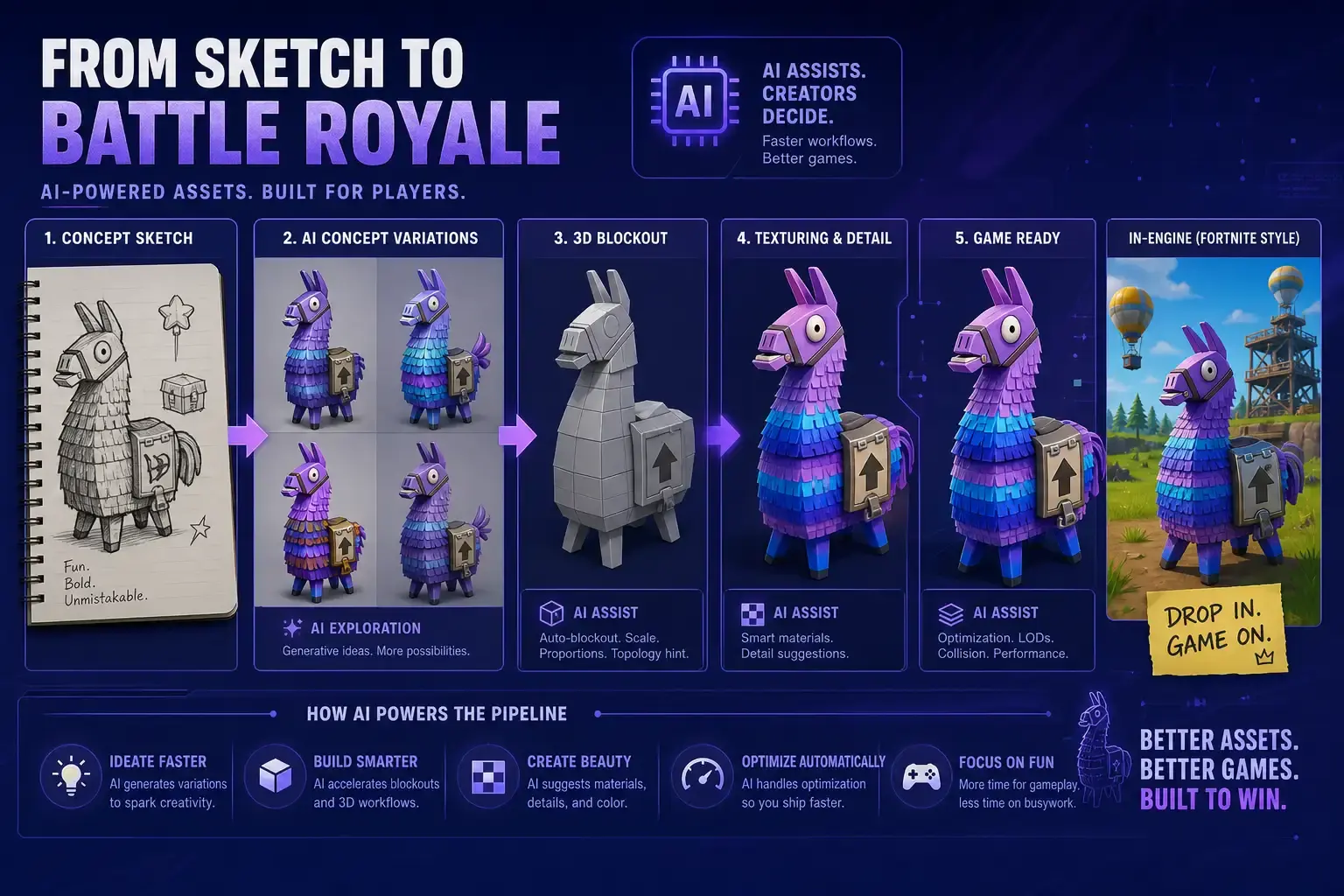
On June 16, 2026, Epic Games did something no major game publisher had done before: it published a behind-the-scenes video openly detailing how generative AI fits into the creative pipeline for Fortnite character skins and in-game environments. The video, posted to the official Unreal Engine YouTube channel, doesn’t just acknowledge AI usage — it walks viewers through the exact stages where AI tools are deployed, what they’re used for, and where human artists step back in.
The Workflow, Revealed
The video follows the design process for a new Fortnite character from start to finish. Here’s the pipeline as Epic presents it:
Stage 1 — Human ideation. Artists sketch character concepts by hand, iterating on silhouettes, color palettes, and proportions. This stage is entirely human-driven.
Stage 2 — AI-assisted visualization. The hand-drawn concept is fed into AI tools with prompts asking the system to render it in a style closer to a 3D model. The video specifically names “Nano Banana” and “GPT Image” as the generative AI tools in use.
Stage 3 — Human refinement. The AI output inevitably introduces errors — extra fingers, illogical clothing details, artifacts — and human artists go back in to fix every mistake.
An Epic staff member on camera summed up the company’s philosophy:
An Epic staff member in the video describes design as the priority: AI can produce generic material, but its role in this workflow is to move the artist further along the timeline so they can concentrate on refining the design.
Translation: AI speeds up early visualization, but humans still steer the creative direction and do the quality checks.
Why Go Public Now?
The timing is not accidental. Fortnite players had been raising questions about potential AI use in game assets for months — most famously pointing to a poster that depicted a character with nine toes lounging in a hammock. Epic had stayed silent on these accusations until now.
Smart move, honestly. Instead of letting the community play detective — screenshot by screenshot, detail by detail — Epic decided to just show the full pipeline.
Epic’s AI Track Record
Epic isn’t new to generative AI in its products. The company previously used AI voice synthesis to recreate James Earl Jones’s performance as Darth Vader. Even with Disney’s authorization and Jones’s personal approval, the decision sparked a fierce player backlash. Fans quickly exploited the AI-processed voice to make Vader say things wildly out of character, compounding the controversy.
Then there’s CEO Tim Sweeney’s public stance. Last year, Sweeney suggested that Valve should drop Steam’s “AI Generated Content Disclosure” label, arguing that AI use would become so ubiquitous that warnings would be pointless. “Why stop at AI use?” he wrote on social media. “We could have mandatory disclosures for what shampoo brand the developer uses. Customers deserve to know lol.”
Viewed through that lens, this video reads less as a reactive damage-control exercise and more as an extension of Sweeney’s philosophy: if AI is going to be everywhere anyway, might as well show what responsible usage looks like.
An Industry-Wide Reckoning
June 2026 has turned into a flashpoint for generative AI in game development. Epic’s disclosure is just one chapter in a much larger story:
1666: Amsterdam — Caught in the Prologue
On June 9, Panache Digital Games — led by Assassin’s Creed creator Patrice Desilets — released a free prologue for its upcoming title 1666: Amsterdam at Summer Game Fest. Players almost immediately spotted AI-generated assets in both in-game portraits and marketing materials: jackets with impossible button counts, unnaturally stacked vegetables, and other telltale artifacts.
The studio’s response came via X:
In summary, the studio said it has a team of more than a dozen artists, that a review found some early versions of assets, including some in-game portraits and marketing assets, had made it into the prologue, and that it was replacing them with human-made versions in an update.
Tomb Raider: Legacy of Atlantis — The “Ideation” Label
Crystal Dynamics and Flying Wild Hog’s Tomb Raider remake carries a Steam disclosure noting that generative AI was used for “ideation.” In an interview with Polygon, experience director Jeff Adams elaborated:
In short, Adams said generative AI is used early in level development to visualize whether an object idea is worth building; if it is, the object goes through the traditional pipeline and the finished content is made by people.
There’s a pattern here: every studio facing AI controversy lands on the exact same framing. AI for early-stage work, human hands for what ships.
The Player Response
Reaction to Epic’s video has been sharply divided. Defenders argue this is simply the natural evolution of creative tools — the same way Photoshop was once accused of replacing traditional painting, AI will eventually become a standard part of the artist’s toolkit. Critics counter that when AI-assisted character skins are sold to players for up to £15 each, the conversation shifts from “tools” to commercial ethics.
British outlet Metro captured this tension in its headline: “Fortnite is using AI to help make skins and then charging up to £15 for them.” The implicit question is straightforward — if AI reduces production costs, why aren’t prices reflecting that?
What Happens When AI Makes Mistakes
Here’s the ironic part: the AI-generated outputs in Epic’s video contain errors that human artists need to fix. So AI hasn’t actually saved time — it just shifted time from “creating from scratch” to “correcting AI mistakes.”
The nine-toed character is the perfect example. AI still struggles with hands, feet, fine details. Artists spend time hunting down and fixing those errors. Whether the net result is a time saving depends on whether skipping the initial visualization phase saves more hours than fixing AI artifacts costs.
Where This Goes
Epic publishing this pipeline is significant because it signals the end of stealth AI adoption in gaming. A few things are clear:
Disclosure is becoming normal. Developers would rather explain AI usage themselves than have players find it.
“AI-assisted, human-finished” is the industry script. Epic, Crystal Dynamics, Panache — same core argument from every studio.
Acceptance comes down to pricing. If AI cuts costs and prices don’t move, players will notice. If efficiency gains go into richer content or lower prices, the conversation changes.
Generative AI in game development is happening regardless. The real questions are how it’s used, whether studios are honest about it, and where the cost savings go. Epic’s approach might well become the template others follow.
Sources
Reader Dispatches
No reader responses yet. Share your technical perspective below.
Related Posts
Epic Games Shows How Generative AI Fits Into Fortnite's Concept Art Process
In a June 2026 video, Epic Games showed how Fortnite artists start from hand-drawn designs and 3D block-outs, then use its internal GenMedia Bridge tool with Nano Banana and GPT Image for rendering and variations. Here is what the video shows, what Epic said, and what remains unanswered.
Snap Spins Off Its Generative AI Video Team Into Dotmo: Deal Structure, Reasons and What to Watch
Snap is spinning off a generative AI video team into Dotmo, a company building AI models for interactive gaming. How the licence-and-equity deal works, Bobby Murphy's role, and why AI spin-offs are used to manage cost.
Krea 2 Goes Open Source: What the RAW and Turbo Split Means for Image Generation
Krea AI has open-sourced Krea 2, its aesthetic-first image model, as two checkpoints: RAW for LoRA training and Turbo for 8-step inference. Here's how the architecture, the license, and the day-one ecosystem stack up.