Epic Games Shows How Generative AI Fits Into Fortnite's Concept Art Process
In a June 2026 video, Epic Games showed how Fortnite artists start from hand-drawn designs and 3D block-outs, then use its internal GenMedia Bridge tool with Nano Banana and GPT Image for rendering and variations. Here is what the video shows, what Epic said, and what remains unanswered.
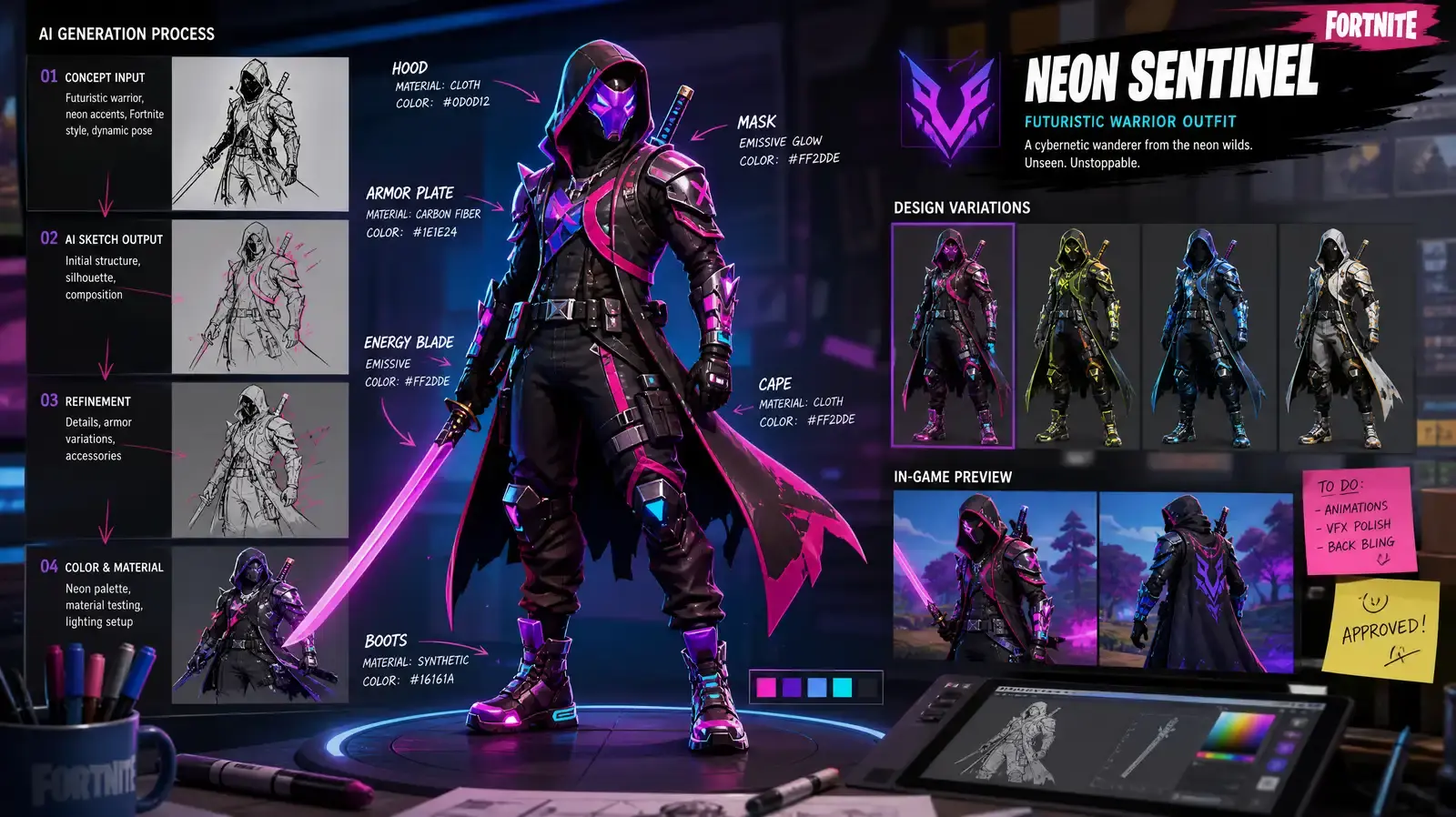
In June 2026, Epic Games published a video on the Unreal Engine YouTube channel, A Look At Epic’s Art Concepting Process, showing how its artists design Fortnite characters and locations, and where generative AI enters that process. It is one of the most detailed public accounts from a major studio of how AI is used in day-to-day game art. IGN, GameSpot, The Verge and TweakTown all covered it.
This article sets out what the video shows, what Epic said about it, and what remains open.
What Epic showed
The video walks through three real concepting workflows. In each, the starting point is human work, and AI is used in a later step.
A character concept. An artist draws a falconer character from a blank canvas: base pose, then a bird to reinforce the identity, then colour blocking and line work for the jacket. Only then does he use GenMedia Bridge, an internal Epic tool built into Photoshop, prompting it “with some guardrails” to push the 2D rendering further. Epic compares this to a 3D artist sending a model to a renderer. On the third pass the tool adds a skull to a pouch and other details he did not ask for, and he paints them out.
Key art for a location. A concept artist building a “Yarn Barn” scene with a cat character blocks it out in Blender, using assets exported from Unreal Engine source data, does quick basic modelling, then paints over the result in Photoshop and uses GenMedia to speed up rendering. Once the base artwork exists, the team uses AI to try variations quickly: a different character style, different times of day, even a meteor shower over the location.
An environment piece. An environment artist designs a 1960s-style drive-thru diner on a grid in Photoshop so it fits Fortnite’s modular building system, working orthographically for control.
In the video, Epic names the outside models it uses inside its own interface: Google’s Nano Banana and OpenAI’s GPT Image.
What Epic said about control and review
The video repeatedly stresses that design decisions stay with the artist. “The design is king. AI can generate generic stuff all day, but that’s not what we’re doing here,” one Epic employee says. The tool “skips ahead in the timeline” so the artist can focus on refining the design.
Epic also describes its checks, as quoted by IGN: “All along the way there are continual reviews, before anything makes it into our games, and artists are careful to respect originality, track provenance of their work, and ensure the finished product meets Epic’s high quality standards.”
The pipeline after concepting, as described in the video, is unchanged: modelling, texturing and rigging, then materials in the editor before an asset ships.
Why it was published now
The video did not appear in a vacuum. IGN and GameSpot both note that Fortnite players had asked repeatedly about possible AI use in certain in-game assets, citing a poster showing a character with nine toes, and that Epic had not answered those questions directly. The video was released around the State of Unreal showcase, where Epic also said AI will play a bigger role in Unreal Engine 6 (GameSpot).
IGN adds a fair caveat: the video makes clear AI is not used to design characters from scratch, but it also shows that generated output can introduce unrequested details, which means mistakes could still slip past later human checks.
What we still do not know
The video answers “how” for concept art but leaves several questions open:
- Scope: it shows concepting. It does not say whether, or how, generative AI is used in final textures, marketing art or other assets.
- Model terms: Nano Banana and GPT Image are third-party services. The video does not explain what data from Epic’s projects is sent to them or how it is handled.
- Staffing effects: Epic presents the tools as giving artists more time to explore. It does not give figures on headcount or time saved.
What this means for other studios and AI tool makers
For studios, Epic’s approach offers a concrete reference: start from human design, use AI for rendering and variations, and keep review and provenance tracking in the process. Publishing the workflow openly also shows one way to respond to player suspicion, though it will not settle every concern.
For companies building AI art tools, the video points to where demand is: tools that sit inside existing software such as Photoshop and Blender, take an artist’s own sketch or block-out as input, and leave final decisions to the artist. “One-click asset” generation is notably absent from the workflow Epic chose to show.
For players, the practical change is transparency. Studios that explain where AI is and is not used give their communities something concrete to evaluate, rather than leaving them to guess from odd details in finished art.
FAQ
Are Fortnite characters designed by AI? According to Epic’s video, character designs start as hand drawings by artists. AI is used later for rendering and trying variations, and design decisions stay with people.
Which AI tools does Epic use? The video names GenMedia Bridge, an internal tool built into Photoshop, and the Nano Banana and GPT Image models used through Epic’s own interface.
Does AI output go straight into the game? Epic says everything goes through continual review before it ships, and concept art is still followed by human modelling, texturing and rigging.
Reader Dispatches
No reader responses yet. Share your technical perspective below.
Related Posts
Epic Games Confirms Generative AI in Fortnite Art Pipeline — and the Gaming Industry Is Watching
Epic Games breaks the silence on AI-generated assets in Fortnite, revealing a hybrid human-AI workflow for character skin and concept art design. The disclosure comes amid a wave of generative AI controversies across major game studios.
Snap Spins Off Its Generative AI Video Team Into Dotmo: Deal Structure, Reasons and What to Watch
Snap is spinning off a generative AI video team into Dotmo, a company building AI models for interactive gaming. How the licence-and-equity deal works, Bobby Murphy's role, and why AI spin-offs are used to manage cost.
Krea 2 Goes Open Source: What the RAW and Turbo Split Means for Image Generation
Krea AI has open-sourced Krea 2, its aesthetic-first image model, as two checkpoints: RAW for LoRA training and Turbo for 8-step inference. Here's how the architecture, the license, and the day-one ecosystem stack up.