From “GLM-Claw” to QClaw, MaxClaw, and CoPaw: Why China's AI Scene Is Suddenly Full of Lobsters
China's AI agent market is filling up with products named QClaw, AutoClaw, MaxClaw, and CoPaw. That is not just a naming joke. It is a sign that multiple companies are trying to turn OpenClaw-style execution agents into real products with stronger distribution and lower friction.
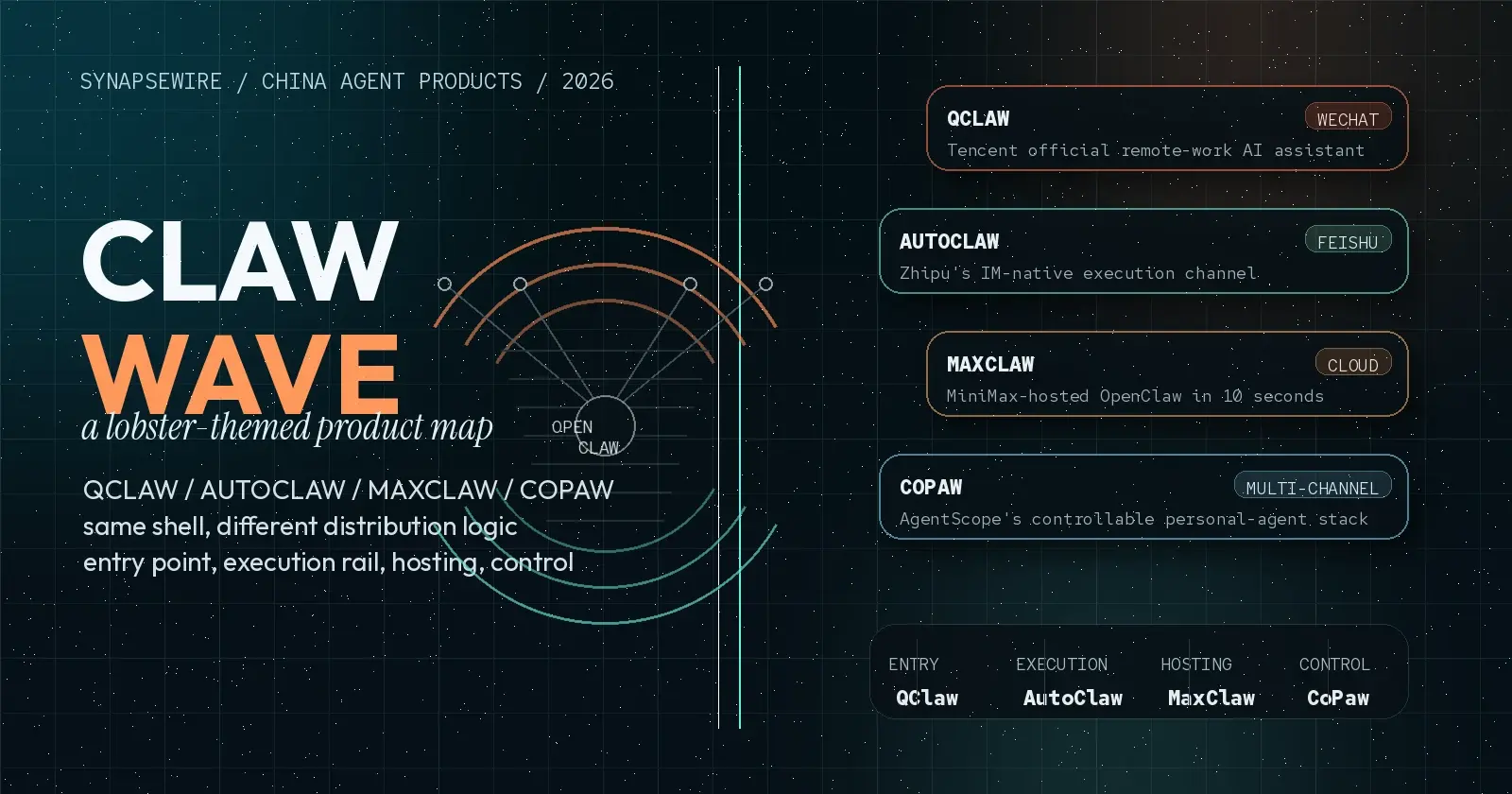
If you have been watching China’s AI agent market lately, you may have noticed something slightly absurd: everyone suddenly seems to be raising lobsters.
There is Tencent’s QClaw, Zhipu’s AutoClaw / AutoGLM-OpenClaw line that many users casually call “GLM-Claw,” MiniMax’s MaxClaw, and AgentScope’s CoPaw. Put those names side by side and the whole market starts to look like a crustacean shared universe.
But this is not just a branding gag.
Look more closely and a deeper pattern shows up. These products are all competing around the same question: who gets to turn an OpenClaw-style execution agent into a real mainstream product with lower friction, better distribution, and a clearer daily-use entry point.
First, the naming is messier than people assume
It is worth clearing up one thing right away.
What many users call GLM-Claw is not the most precise official product name on Zhipu’s own pages. As of March 23, 2026, the clearer official naming on Zhipu-owned pages is:
AutoClawAutoGLM-OpenClaw
The AutoClaw page itself describes the product in a revealing way: it puts agent execution power into an IM entry point. The pitch is not “here is another chatbot.” It is closer to “here is an execution channel inside your communication flow.”
That distinction matters because it helps explain the broader wave. The real competition here is not about who can stuff claw into a product name. It is about who can combine chat entry points, tool use, memory, and task execution into something people actually keep using.
What these lobster-flavored products are actually doing
At a glance, they can look interchangeable. They are not.
1. QClaw: Tencent is trying to own the WeChat control surface
Tencent’s official positioning for QClaw is a WeChat-based remote work AI assistant. The homepage leans hard on a few ideas: direct WeChat interaction, automatic deployment, long-term memory, local execution, and a skills ecosystem.
That means QClaw is not primarily selling itself as a developer tool. It is selling itself as a product that already lives inside the communication surface many Chinese users touch all day.
You send a WeChat message. It opens files, organizes documents, browses the web, drafts email, or even sets up GitHub projects for you. That is a very Tencent move: own the entry point first, then connect more capability layers underneath it.
If OpenClaw started as something closer to a technically inclined personal agent framework, QClaw is an attempt to repackage that power into a more mainstream office-assistant form.
2. AutoClaw / AutoGLM-OpenClaw: Zhipu is betting on IM as an execution rail
Zhipu’s version has a different flavor.
The official AutoClaw page says it looks like chat, but is really an execution channel. A user sends a goal in a single conversation thread, the system decomposes the task, runs local tools, and pushes progress plus results back into Feishu.
That framing is more ambitious than “AI assistant.” It is really about workflow movement.
If QClaw feels like “put an agent inside WeChat,” AutoClaw feels more like “upgrade the Feishu conversation window into an execution surface.” That fits Zhipu’s broader instinct well. The model layer matters, but the bigger prize is how agent behavior plugs into enterprise collaboration habits.
3. MaxClaw: MiniMax is selling a zero-friction cloud OpenClaw
MiniMax’s MaxClaw is the most commercially explicit of the bunch.
Its official page says, in plain terms: “Build Your Own OpenClaw with Zero Barriers.” The core promises are equally blunt:
- one-click deployment in 10 seconds,
- no server, Docker, or API key required,
- a 50GB cloud workspace,
- a 24/7 AI expert team,
- and a product designed for non-technical users.
This is the cleanest SaaS packaging of the OpenClaw idea. MiniMax is not just trying to provide a model. It is trying to remove the operational hassle around self-hosted personal agents.
Put simply, MaxClaw’s pitch is this: OpenClaw is powerful, but it is still too much work for many people, so let us absorb that complexity for you.
4. CoPaw: AgentScope is taking the controllable, extensible engineering path
CoPaw does not use the word Claw, but it clearly belongs in the same family.
Its official GitHub page describes it as a personal AI assistant that supports DingTalk, Feishu, QQ, Discord, iMessage, and more. It can run locally or in the cloud, supports cron, custom skills, and auto-loaded capabilities, and is clearly built with extensibility in mind.
The release cadence tells the same story. CoPaw released v0.1.0 on March 18, 2026, and its release notes emphasize multi-workspace architecture, skill security scanning, destructive shell command detection, more model providers, and broader channel support.
That is not the language of a lightweight chat wrapper. It is the language of a system trying to become a durable personal-agent foundation with real governance and real engineering structure.
Why are so many Chinese companies moving in this direction now
I think there are three reasons.
First, OpenClaw already proved the interaction model works
OpenClaw describes itself as a personal AI assistant that answers on the channels you already use. That point matters more than it might seem.
It tells the market that the next-wave agent does not necessarily need to live inside a new standalone app or inside a narrow developer IDE workflow. It can live directly inside WhatsApp, Telegram, Slack, Discord, Feishu, WeChat, and similar communication layers.
Once that interaction model makes sense to users, local players no longer need to invent the category from zero. They can start racing to build the most usable branded version of it.
Second, Chinese vendors each control different distribution territory
The interesting part is that they are not all fighting on exactly the same ground.
- Tencent is anchored in WeChat.
- Zhipu is leaning into Feishu-based execution.
- MiniMax is pushing one-click cloud hosting.
- AgentScope / CoPaw is emphasizing channel breadth and engineering flexibility.
That means they may share the same OpenClaw shadow, but they are unlikely to converge into the exact same product.
Third, what matters now is no longer just the model, but the right to execute
This may be the core shift.
At this point, “we also have a model” is not enough. The real differentiation comes from who can let an agent actually touch files, browsers, schedules, messaging systems, and workflows, while also managing memory, permissions, and safety.
In other words, AI assistants are moving from answer engines to execution systems. That is the real reason so many Chinese products are wrapping themselves around claw, paw, and lobster-like identities.
What this wave is really competing over is product philosophy, not naming
From a distance, this looks like a copycat naming trend. Up close, each product is answering the same strategic question in a different way:
QClawis entry-point first. Put the agent inside WeChat.AutoClawis collaboration first. Turn an IM thread into an execution rail.MaxClawis hosting first. Package OpenClaw as a low-friction cloud product.CoPawis control first. Build multi-channel, skill-driven agent infrastructure with stronger engineering guardrails.
That is why this trend matters more than the meme suggests. It is not really about who has the funniest lobster branding. It is about a much more practical question:
If personal agents are going mainstream, should you win on entry point, execution, hosting, or control?
Bottom line
“Domestic AI lobster products” sounds like a joke topic until you actually look at the underlying market behavior.
This is not just a branding echo. It is the rapid localization, channelization, and productization of the OpenClaw-style agent model. Whoever gets that layer right first has a decent shot at owning the default entry point for the next phase of personal AI agents.
As of March 23, 2026, the better way to read the trend is this:
China’s AI market is not suddenly obsessed with lobsters. It is finally taking the fight over execution surfaces seriously.
If you want the surrounding context, our earlier pieces on the March 16 OpenClaw update and practical OpenClaw use cases are useful companion reads.
Sources
Reader Dispatches
No reader responses yet. Share your technical perspective below.
Related Posts
GLM-5 Is Public, GLM-5.1 Is Already in Coding Agents: Zhipu Is Pushing from Coding to Engineering
As of March 28, 2026, Zhipu’s official release notes clearly list GLM-5 on February 12 and GLM-5-Turbo on March 15. At the same time, its developer docs already position GLM-5.1 as the latest model inside Coding Agent workflows. That mismatch is the story: Zhipu is shifting the value of its models from one-shot code generation toward agent engineering, long task chains, and tool-heavy work.
2026 AI Industry Deep Dive: Investment Surge and Market Trends Under CEO Leadership
2026 AI industry analysis: How CEOs are driving AI strategy, corporate investments are doubling, and agentic AI is rising. The global market surpasses $375B with 26.6% CAGR.
Beyond the Hype: Deconstructing Zhou Hongyi’s '10 Billion Agents' Prophecy for 2026
360 Group founder Zhou Hongyi predicts 10 billion AI agents by 2026, marking the end of the 'Chatbot Era' and the rise of inference-focused computing. Here's how to prepare your infrastructure for the Agent Economy.