GLM-5 Is Public, GLM-5.1 Is Already in Coding Agents: Zhipu Is Pushing from Coding to Engineering
As of March 28, 2026, Zhipu’s official release notes clearly list GLM-5 on February 12 and GLM-5-Turbo on March 15. At the same time, its developer docs already position GLM-5.1 as the latest model inside Coding Agent workflows. That mismatch is the story: Zhipu is shifting the value of its models from one-shot code generation toward agent engineering, long task chains, and tool-heavy work.
If you only skim Zhipu’s docs from the past month and a half, the naming gets messy fast.
The official release notes clearly talk about GLM-5 and GLM-5-Turbo. But once you move into the Coding Plan and Coding Agent documentation, the model standing at the front of the room is suddenly GLM-5.1. That looks like a versioning detail at first. I do not think it is. I think it is a product signal.
As of March 28, 2026, the cleanest reading is this: GLM-5 is the public release anchor, while GLM-5.1 is already being positioned as the practical model inside Zhipu’s coding-agent workflows. That suggests Zhipu is no longer just trying to prove that its model can write code. It is trying to prove that the model can live inside engineering systems.
First, Clear Up the Timeline
Here are the official dates that line up cleanly:
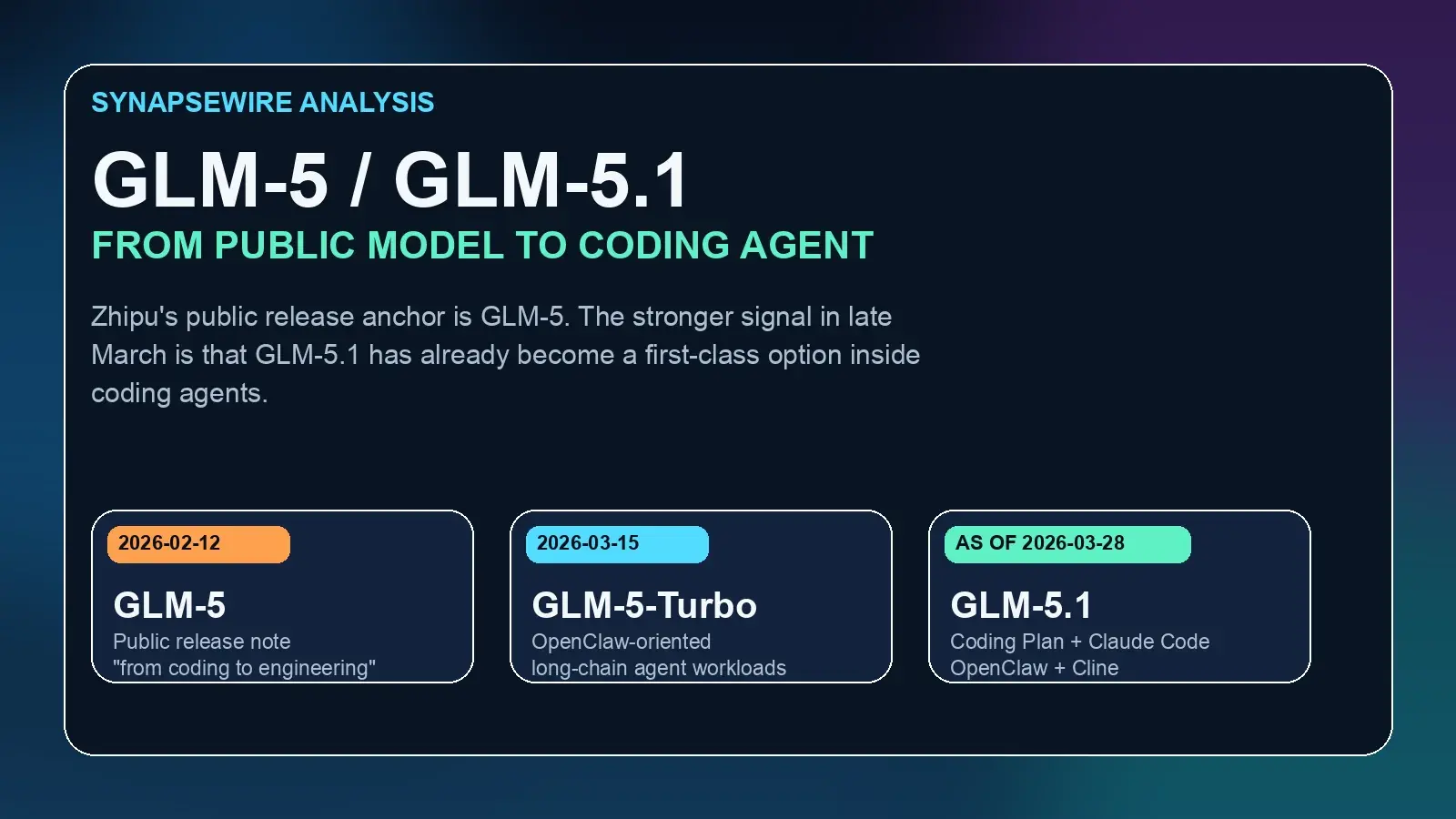
- On February 12, 2026, Zhipu added GLM-5 to its official release notes and described it as a model for complex systems engineering and long-range agent tasks. The phrase that matters most is right there in the copy: “from coding to engineering.”
- On March 15, 2026, the same release notes page added GLM-5-Turbo, positioning it for high-throughput OpenClaw workloads and long-chain agent execution.
- By March 28, 2026, Zhipu’s Using GLM-5.1 in Coding Agent page explicitly says that the GLM Coding Plan now supports the latest GLM-5.1 for Max, Pro, and Lite users.
What stands out is not just the dates. It is where each model appears.
GLM-5appears in the public release notes, public API docs, migration guides, and pricing docs.GLM-5.1appears in the Coding Plan and Coding Agent setup docs.
As of March 28, 2026, I have not found a standalone GLM-5.1 release note at the same level as GLM-5 or GLM-5-Turbo. That detail matters because it changes how we should talk about the model. It is not enough to say “GLM-5.1 exists.” The more useful question is where it exists first.

What the Public GLM-5 Foundation Actually Gives You
If you want the most complete and least ambiguous public documentation right now, you still have to start with GLM-5.
Across Zhipu’s GLM-5 guide and its Migrate to GLM-5 guide, you can directly verify the following:
- 200K context
- 128K maximum output
- support for
thinking={ type: "enabled" } - support for streamed tool calls through
tool_stream=true - support for Structured Output, Function Calling, and Context Caching
That capability mix tells you what Zhipu wants GLM-5 to be used for. This is not a model aimed only at chat-style interaction. It is clearly built for longer, messier, tool-heavy engineering tasks where the model needs to reason, call tools, and stay useful over a bigger working window.
The pricing reinforces that framing. On Zhipu’s official Pricing page, GLM-5 is listed at $1 per million input tokens and $3.2 per million output tokens. That is not ultra-cheap infrastructure pricing. It reads more like a model you use when the task is valuable enough to justify a stronger engineering-focused base.
Zhipu’s Chinese GLM model page pushes the message even further. There, the company describes GLM-5 as a flagship base model for agent engineering and says it reaches open-source SOTA on benchmarks like SWE-bench Verified and Terminal Bench 2.0, while standing shoulder to shoulder with Claude Opus 4.5. That is a company claim, not a neutral benchmark roundup, but it tells you exactly where Zhipu wants people to place GLM-5 in the market.
The More Interesting Story Is Where GLM-5.1 Shows Up
If GLM-5 is the public foundation, GLM-5.1 looks more like the operating layer.
In the Using GLM-5.1 in Coding Agent page, Zhipu is not speaking in abstractions. It is showing developers where to put the model in real tools:
- In Claude Code, the docs tell users to map both
ANTHROPIC_DEFAULT_SONNET_MODELandANTHROPIC_DEFAULT_OPUS_MODELtoglm-5.1 - In OpenClaw, the docs provide an explicit
glm-5.1config example withcontextWindow: 204800andmaxTokens: 131072 - In tools like Cline, the docs say you can directly enter
glm-5.1orglm-5as a custom model name
The Coding Plan Overview page makes the intended division of labor even clearer:
- all plans support GLM-5.1, GLM-5-Turbo, GLM-4.7, GLM-4.6, GLM-4.5, and GLM-4.5-Air
- Max and Pro plans support GLM-5
- the docs explicitly recommend GLM-5.1 for complex tasks and GLM-4.7 for routine work
That line matters. A lot.
Because that is no longer “here is our strongest model.” It is closer to “here is how we expect you to route work inside a real engineering stack.”
Put differently, Zhipu is already suggesting a default operational pattern:
- use GLM-5.1 for high-value, complex, long-chain coding-agent work
- keep GLM-4.7 around for routine and cost-sensitive tasks
That is a very different tone from a normal model launch. It sounds more like infrastructure strategy than benchmark theater.

My Read on GLM-5.1
This next part is my interpretation, not a direct Zhipu quote.
Based on the official material that is publicly visible right now, GLM-5.1 looks less like a fully separate public flagship launch and more like an engineering-facing distribution of the GLM-5 family for coding-agent workflows.
The reason I read it that way is pretty simple:
- the public API docs, migration guides, and pricing docs are still centered on GLM-5
- the Coding Plan and Coding Agent setup docs move the practical entry point to GLM-5.1
- GLM-5-Turbo is framed on yet another track, one that leans toward throughput and OpenClaw-style workloads
Put those together and a family pattern starts to show:
- GLM-5 as the public anchor and documentation center
- GLM-5.1 as the preferred coding-agent upgrade path
- GLM-5-Turbo as the throughput-oriented long-chain variant
I would not write this as “GLM-5.1 has fully replaced GLM-5,” because the public docs do not say that. But I also would not dismiss it as a trivial minor version bump. It is already sitting in the part of the product stack that shapes what developers actually configure and use every day.
That is the real story.
The Practical Takeaway for Developers
If you are evaluating the Zhipu stack right now, this is the most useful way to read it:
- If you need the clearest public API docs, pricing, and migration guidance, start with GLM-5
- If you are actively configuring models inside Claude Code, OpenClaw, or Cline, GLM-5.1 is the newer option you should test first
- If you care about task routing and cost control, Zhipu’s own guidance is already pretty explicit: use 5.1 for complex work, keep 4.7 for routine work
The next things worth watching are not another decimal point. They are much more concrete:
- whether Zhipu publishes a dedicated public model page or API guide for GLM-5.1
- whether 5.1 gets fuller benchmark and pricing disclosure
- whether this split between a public base model, a coding-agent version, and a throughput-oriented variant becomes Zhipu’s standard model-family pattern
If that happens, then the deeper point of this story is not the 5.1 label. It is that Zhipu is trying to move the value of its models from “can it code?” to “can it do engineering?”
Sources
Reader Dispatches
No reader responses yet. Share your technical perspective below.
Related Posts
From “GLM-Claw” to QClaw, MaxClaw, and CoPaw: Why China's AI Scene Is Suddenly Full of Lobsters
China's AI agent market is filling up with products named QClaw, AutoClaw, MaxClaw, and CoPaw. That is not just a naming joke. It is a sign that multiple companies are trying to turn OpenClaw-style execution agents into real products with stronger distribution and lower friction.
Beyond the Hype: Deconstructing Zhou Hongyi’s '10 Billion Agents' Prophecy for 2026
360 Group founder Zhou Hongyi predicts 10 billion AI agents by 2026, marking the end of the 'Chatbot Era' and the rise of inference-focused computing. Here's how to prepare your infrastructure for the Agent Economy.
NVIDIA at CES 2026 Isn’t Just Shipping Chips—It’s Rewriting the Rules: A Three-Step “Own the Stack” Play
Rubin as a full-system product, inference as an architecture war, and Physical AI as the next platform shift: a clear breakdown of what Jensen Huang’s CES 2026 strategy is really aiming for.