NVIDIA at CES 2026 Isn’t Just Shipping Chips—It’s Rewriting the Rules: A Three-Step “Own the Stack” Play
Rubin as a full-system product, inference as an architecture war, and Physical AI as the next platform shift: a clear breakdown of what Jensen Huang’s CES 2026 strategy is really aiming for.
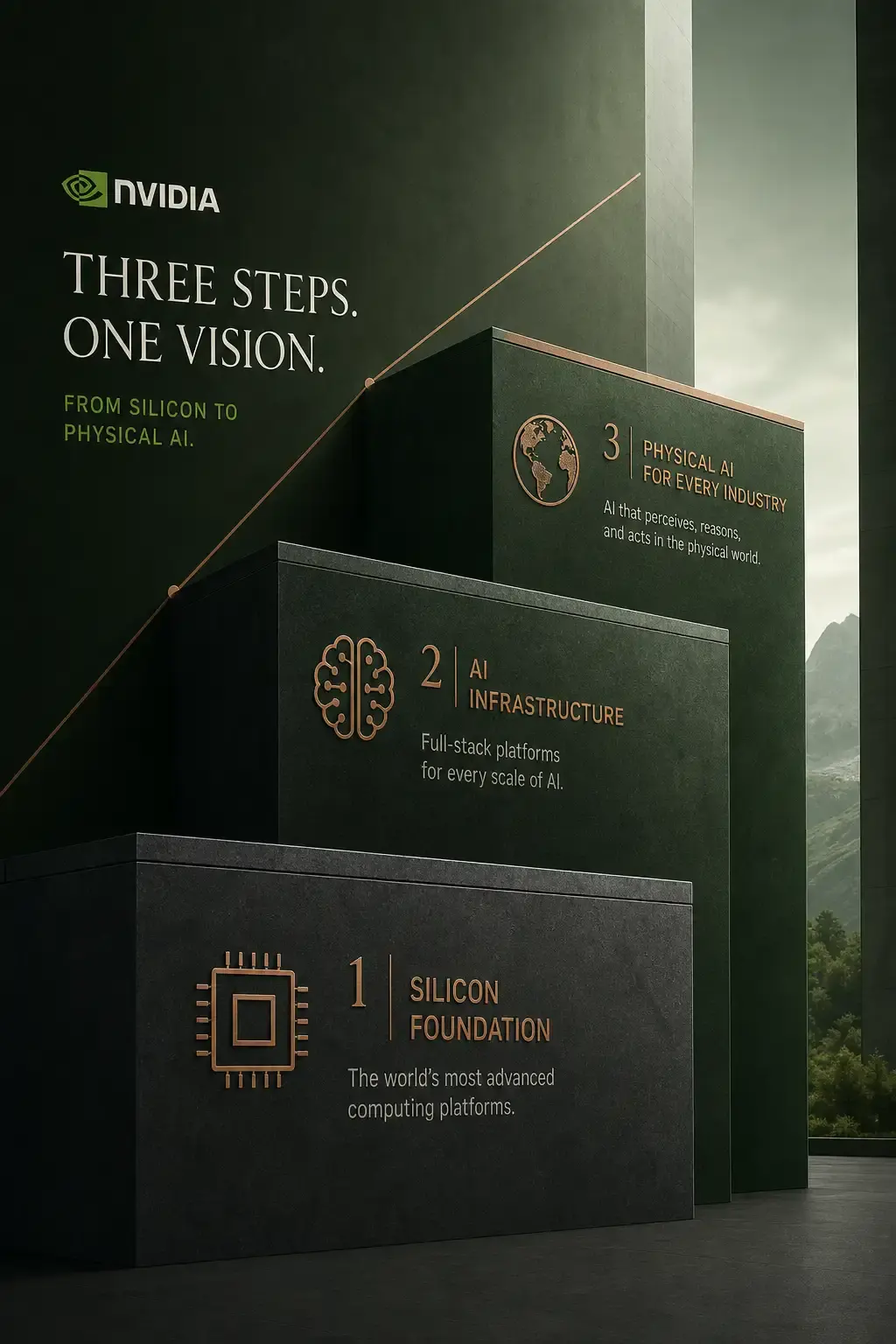
If you think Jensen Huang’s CES 2026 keynote was “just” NVIDIA shipping a faster chip, you’re looking at it through the wrong lens.
This wasn’t a product launch in the ordinary sense. It was a statement about where NVIDIA believes the next decade of computing is heading—and how aggressively it plans to position itself at the center of that shift.
The simplest way to summarize the vibe is two words: own everything.
Not “own everything” as a conspiracy theory or a meme, but as a coherent business and engineering posture: move up the stack, tighten integration, define the platform, and turn what used to be a component decision into an infrastructure decision.
Below is a practical three-step model for reading this strategy. You don’t need to agree with the rhetoric to see the structure.
First, the context: why go “full-stack” now?
A key detail in one CES recap is that NVIDIA effectively broke its own internal rhythm of iteration—moving beyond a typical “one or two major chip changes per generation” to redesign multiple major components in concert, arguing that traditional scaling is no longer enough given model growth and token demand pressure. See the recap here: Techwalker CES 2026 transcript/summary.
Whether you love NVIDIA or hate it, the underlying claim is credible at a systems level:
- Moore’s Law doesn’t deliver effortless gains like it used to.
- AI workloads amplify bottlenecks that “benchmark culture” tends to ignore: memory bandwidth, interconnect, data movement, and power/thermal constraints.
In that world, the easiest lever isn’t a slightly better GPU. The lever is system design—and system design is also a lever for control.
That’s the entry point to step one.
Why power and cooling quietly decide the winners
Most AI debates still sound like gamer culture: FPS, benchmarks, top-line speed. In a data center, the real scoreboard is different:
- How many useful tokens or training steps do you produce per rack?
- How much power do you draw to do it?
- How expensive is it to keep it cool, stable, and operable at scale?
At small scale, you can brute-force inefficiency. At large scale, inefficiency becomes a tax you pay every hour. That’s why “infrastructure packaging” is not just a sales tactic. It’s a way to control the variables that dominate lifetime cost: networking topology, thermal design, serviceability, and utilization.
This is also why it’s hard for a pure component competitor to win a “system economics” conversation. Even if their chip is cheaper, the buyer still asks: who guarantees the full stack will behave predictably under my workload for years?
In that framing, NVIDIA is trying to become the vendor you call when you want an outcome, not a part.
Step 1: Lock the infrastructure — “Stop selling parts, start selling power plants”
For years, buying NVIDIA compute felt like building a PC at industrial scale:
- You bought GPUs from NVIDIA
- You chose CPUs elsewhere
- You stitched together networking, switching, storage, cooling, orchestration, and observability across vendors
That approach has real advantages: flexibility, vendor leverage, and the ability to swap parts.
But it also has familiar pain: slow deployment, unpredictable integration issues, and suboptimal end-to-end efficiency—especially at the scale where AI infrastructure becomes a line item big enough to get a CFO’s full attention.
The modern NVIDIA move is to turn a buyer’s choice into a buyer’s package:
- You’re not buying “GPUs,” you’re buying a deployable compute factory
- The CPU, interconnect, DPU, switching, and networking assumptions are baked into the product
- Optimization is done for the system, not for a spec sheet
This changes the competition. The procurement question stops being “Which card is faster?” and becomes:
Which stack gets me the most usable AI output per dollar, per watt, per rack, with the least operational headache?
That’s a brutal battlefield for component vendors, because the winner can win even with higher per-part pricing if the total economics look better.
It’s also “sticky.” Once customers build operational muscle around a specific integrated stack—tooling, workflows, deployment patterns, failure playbooks—switching becomes expensive even if the alternative is cheaper on paper.
What “lock-in” looks like in practice (without the drama)
Lock-in doesn’t always mean a contract clause or an API trap. Sometimes it’s simply organizational gravity:
- Your teams standardize on a deployment pattern that assumes a specific interconnect and topology.
- Your observability stack is tuned to one vendor’s health metrics and failure modes.
- Your incident response playbooks assume the same service architecture across fleets.
- Your procurement and finance teams learn one vendor’s lifecycle model (warranty, support, spares, replacements).
When those habits are in place, changing vendors isn’t just swapping hardware. It’s retraining an organization.
That’s why the “power plant” metaphor is useful. You don’t buy a power plant the way you buy a light bulb. You buy it as a long-term operational commitment.
Step 2: Crush rivals in inference — win by changing the architecture
Training is expensive. But inference is the long game: recurring demand, persistent workloads, and an addressable market that expands as AI becomes “a feature in everything.”
Inference, however, has a tension:
- You want it cheap enough to run everywhere.
- Yet top-tier GPUs are premium hardware.
That’s why “cheaper inference chips” have always looked like an opening for competitors and startups. If you can deliver “good enough” inference at a much lower cost, you can steal massive volume.
The more interesting NVIDIA angle is a reframing:
Inference isn’t expensive only because compute is expensive—often it’s expensive because memory and data movement are expensive.
Once you accept that, the path forward is not simply “cheaper chips.” It’s “different systems”:
- Separate where “compute” lives from where “memory and orchestration” pressure lives
- Push data movement, networking, and scheduling into dedicated components
- Optimize for throughput and total cost, not single-card hero numbers
That’s why this feels like a “dimensionality reduction” move. Instead of competing on the same axis as rivals (price/performance of one chip), NVIDIA shifts the axis to system architecture, where incumbency and ecosystem matter more.
This step also reinforces step one:
- The more your inference story depends on an integrated stack, the less room there is for plug-in replacement parts.
- The more your customers depend on your software and interconnect patterns, the higher the switching cost.
Inference becomes not just a market—it becomes an economic moat.
Why memory and data movement are the real inference tax
If you’ve deployed LLM inference, you’ve felt this pain even if you don’t use the vocabulary:
- Model weights are huge.
- Activations can be huge.
- Serving at low latency requires careful batching and scheduling.
- Moving data between memory tiers (or across nodes) is not free.
So you can have plenty of “raw FLOPS” and still get disappointing throughput because the system spends too much time waiting on memory and transport.
That’s why the architecture conversation matters. If a vendor can reduce the amount of expensive memory per unit of useful inference, or reduce data movement overhead, it can win on total cost even if its compute is not the cheapest in isolation.
Competing “chip-only” products often get dragged back into unit economics: price per card, watts per card, tokens per second per card. NVIDIA’s play is to make the meaningful metric “tokens per dollar per fleet,” where architecture and software orchestration can dominate.
Step 3: Invade the physical world — Physical AI as the next platform shift
The first two steps are about compute capacity and control. The third step is about the next frontier for AI value: the physical economy.
There’s a ceiling to “AI in the screen.” The bigger prize is AI in:
- factories and warehouses,
- logistics and robotics,
- vehicles and mobility,
- industrial inspection and maintenance,
- infrastructure and smart cities.
The bottleneck here isn’t only model intelligence. It’s trial-and-error cost.
Software can crash and restart. A robot can break expensive hardware or injure people. A vehicle can cause accidents. Real-world failure is costly.
So the most valuable unlock is not “a slightly smarter robot brain.” It’s a pipeline that makes real-world learning scalable:
- realistic simulation,
- massive synthetic data generation,
- safe iteration at high volume,
- and then deployment back into the real world.
This is where “platform thinking” is most obvious: if the industry standardizes on your simulation environment, your toolchain, and your data formats, your hardware becomes the default runtime.
In other words, you can “give away the soul” (tools, environments, developer access) and sell the body (hardware, runtime, cloud capacity). It’s not moral commentary. It’s a business model pattern that shows up whenever a platform wins.
Physical AI is also a data business
Robots and vehicles don’t only need models. They need data that reflects reality: edge cases, lighting conditions, materials, friction, partial failures, unusual human behavior, rare-but-critical events.
Collecting that data in the real world is slow and expensive. Simulated worlds and synthetic data generation are attractive because they let you manufacture rare scenarios on demand.
But there’s a catch: synthetic data is only as good as the simulator and the assumptions behind it. So the “platform” advantage isn’t just that you can generate data. It’s that you can generate data with a physics model and a toolchain that the industry trusts enough to build on top of.
If NVIDIA can make its simulation and tooling the default environment where developers test and train Physical AI, it can become the “operating system layer” of the physical economy. That’s a much bigger ambition than “selling more GPUs.”
What “own the stack” really means: the competition moves from products to platforms
At the product level, competition is straightforward:
- price,
- performance,
- supply,
- compatibility.
At the platform level, competition becomes asymmetrical:
- developer mindshare,
- deployment friction,
- operational reliability,
- ecosystem gravity,
- switching costs,
- total economics (especially power and cooling).
Platforms don’t need to be perfect to win. They need to be “good enough” and easier to adopt than alternatives.
That’s why this CES storyline matters. It isn’t about one GPU generation. It’s about pushing the market to treat NVIDIA as infrastructure.
What to watch next (if you’re a builder, not a spectator)
If you run engineering for a company that uses AI, you don’t need to pick a side in the fan-war. You need a checklist. Here are practical signals that matter more than hype:
1) Standardization pressure
Are your teams converging on a single deployment standard because it reduces operational drag? If yes, that standard will become your de-facto lock-in, regardless of what procurement wants.
2) The “total economics” pivot
If your leadership starts asking for:
- cost per 1M tokens,
- cost per training step,
- power per unit throughput,
- time-to-deploy for a new cluster,
then component-level arguments (“this chip is cheaper”) will lose influence, because they don’t map cleanly to the scoreboard executives actually care about.
3) Ecosystem gravity
The question is not “can we run on alternative hardware?” It’s “how much do we lose if we do?”
Loss can mean:
- missing optimizations and kernels,
- weaker tooling and profiling,
- fewer engineers in the market who know the stack,
- slower incident recovery due to unfamiliarity.
4) How inference is structured
If your inference is lightweight and mostly single-node, you can optimize for different constraints than if your inference is a multi-node, high-throughput serving system.
The more distributed and production-critical inference becomes, the more architecture and orchestration matter—and the more platform vendors can extract value.
5) Physical AI readiness
If you’re in robotics, logistics, manufacturing, or mobility, the key question is whether simulation and synthetic data become a core part of your loop. If the answer is yes, your platform decisions move earlier in your product lifecycle, not later.
Closing: GPUs aren’t disappearing—“GPU-only thinking” is
The uncomfortable part: this strategy has real risks
To make this analysis useful, it’s worth stating what could go wrong.
- Supply chain and delivery risk: the tighter the integration, the more a single missing component can delay the entire system shipment.
- Regulatory and customer pushback: “full-stack lock-in” increases anti-monopoly sensitivity and can make large buyers uncomfortable over time.
- Paradigm shifts: a major shift in inference/training architectures could weaken the advantage of an integrated GPU-centric approach—though it would likely require a genuinely discontinuous leap.
NVIDIA appears to be choosing a high-leverage approach: maximum control and maximum capture, with corresponding systemic risk.
Closing: GPUs aren’t disappearing—“GPU-only thinking” is
If you watched CES 2026 looking only for “a faster GPU,” you were asking an old question.
The newer question is: who becomes the default platform for AI infrastructure, AI inference economics, and the tooling that moves AI from screens into physical systems?
NVIDIA’s implied answer is blunt: “We do.”
You don’t have to like that answer. But if you build in AI—training, inference, robotics, vehicles—you should at least understand why the company is pushing so hard to be less like a component vendor and more like an energy grid for the intelligence era.
References:
Reader Dispatches
No reader responses yet. Share your technical perspective below.
Related Posts
Beyond the Hype: Deconstructing Zhou Hongyi’s '10 Billion Agents' Prophecy for 2026
360 Group founder Zhou Hongyi predicts 10 billion AI agents by 2026, marking the end of the 'Chatbot Era' and the rise of inference-focused computing. Here's how to prepare your infrastructure for the Agent Economy.
Apple’s $2B Bet on Silence: Why the Q.ai Acquisition Signals the End of 'Hey Siri'
Apple acquired Q.ai for $2B, specializing in 'Silent Speech.' Here's why your future AirPods will read your lips, not your voice, and what this means for ambient computing.
The Trillion-Dollar Race Begins: IFR Report Reveals AI Robotics' Critical Shift from Lab to Industry
IFR's latest report reveals AI robotics is shifting from supporting technology to core enabler. Logistics and manufacturing lead, but skills gaps remain.