The Trillion-Dollar Race Begins: IFR Report Reveals AI Robotics' Critical Shift from Lab to Industry
IFR's latest report reveals AI robotics is shifting from supporting technology to core enabler. Logistics and manufacturing lead, but skills gaps remain.
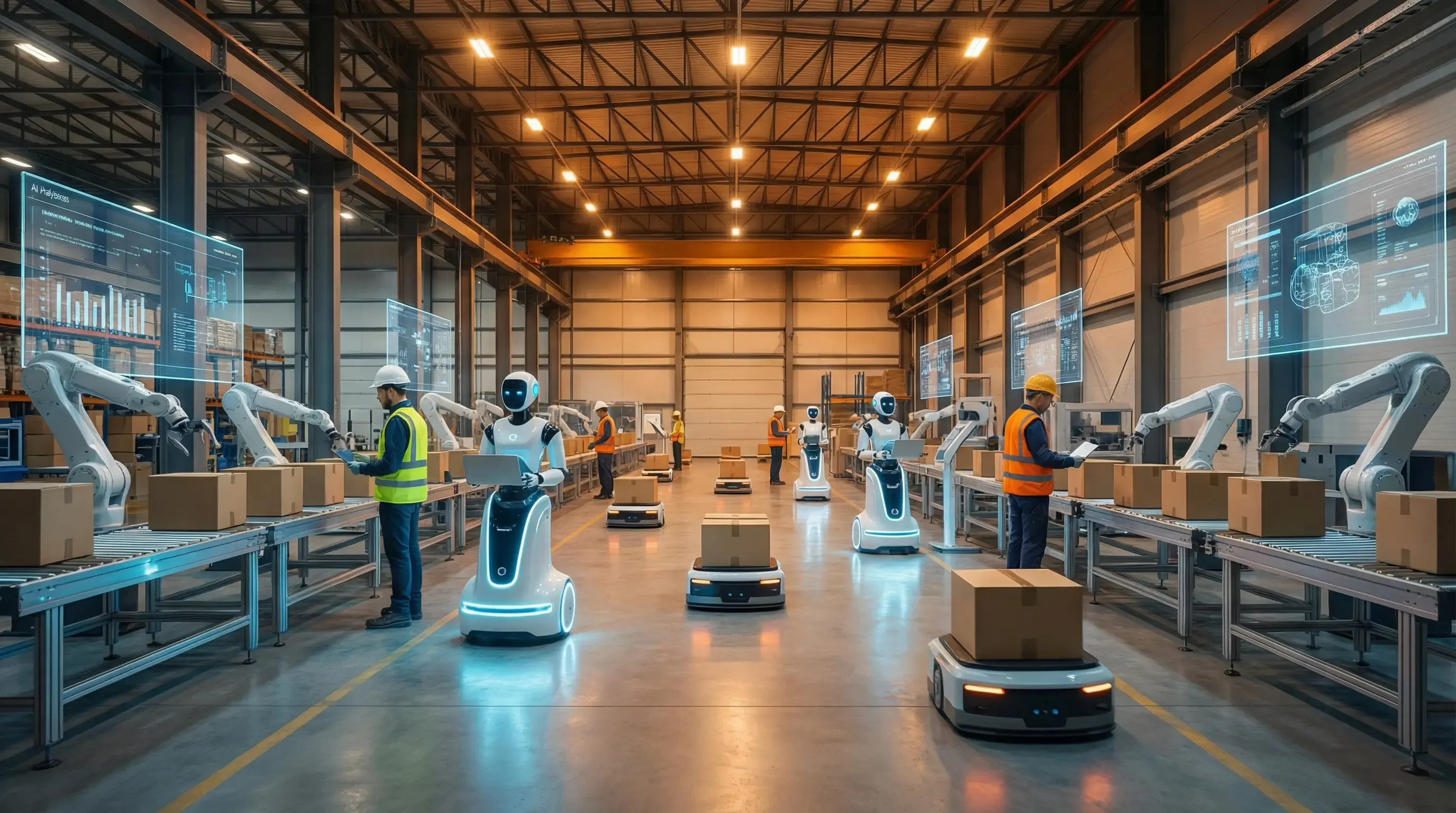
Multiple trillions of dollars. That’s the latest analyst forecast for the AI robotics market. On February 10, 2026, the International Federation of Robotics (IFR) released a new report that not only substantiates this figure with industry evidence but reveals a deeper transformation: AI-powered robots are rapidly evolving from laboratory demonstrations into real-world productivity tools.
The timing of this report is telling. On the same day, Cisco announced major AI infrastructure innovations, and IBM launched an Agentic AI-powered autonomous storage system. Three industry giants moving simultaneously paint a clear picture: from foundational computing infrastructure to intelligent decision-making systems to physical execution — the AI robotics supply chain is taking shape at unprecedented speed.
Paradigm Shift: From Support Tool to Core Driver
IFR President Takayuki Ito’s statement deserves careful reading: “AI is transforming the field of robotics at a rapid pace.” The key isn’t “pace” — it’s the nature of the “transformation.”
Over the past decade, AI’s role in robotics was largely supplementary — improving visual recognition accuracy, optimizing path planning, enhancing human-robot interaction. Now, AI is becoming the robot’s “brain reconstruction.” This shift manifests across three layers:
Perception breakthrough: Traditional robots relied on preset programs and structured environments. AI-driven robots can understand unstructured scenes. A logistics warehouse robot no longer needs standardized shelving and precise coordinates — it can identify arbitrarily placed packages, determine grasp points, and even predict weight distribution.
Decision evolution: From “if-then” rules to autonomous learning. Manufacturing robots are beginning to adjust action sequences based on real-time production line conditions rather than rigidly executing preset workflows. This flexibility is critical in high-precision industries like automotive, electronics, and pharmaceuticals.
Execution adaptation: “Giving AI its own robot body” — the report’s most visionary statement. It suggests a future where robots aren’t designed hardware-first with software adapted afterward, but where AI systems “choose” or “customize” the most suitable physical form for each task.
Logistics and Warehousing: The First Battlefield
The report explicitly identifies logistics and warehousing as the most closely watched sector. This isn’t coincidental.
E-commerce’s explosive growth created a perfect application scenario: high frequency, high repetition, high standardization, yet requiring flexibility. Amazon’s warehouse robots, Ocado’s automated distribution centers, JD.com’s unmanned warehouses — these cases have proven AI robotics’ commercial viability in logistics.
More importantly, the industry’s pain points align perfectly with AI robot capabilities. Rising labor costs, workforce shortages, 24/7 operational demands, seasonal fluctuations — problems that traditional automation struggles with but AI robots can address through dynamic scheduling, exception handling, and collaborative operations.
According to ABI Research, the warehouse robotics market will reach $51 billion by 2030, with AI-driven autonomous mobile robots (AMRs) dominating.
Manufacturing’s Dilemma: Desire Meets Hesitation
Manufacturing and industrial automation is another key area, but the story here is more complex.
On one hand, manufacturing’s need for AI robots is urgent. Global manufacturing faces a “three highs, one low” dilemma: high customization demands, high quality requirements, high labor costs, and low margins. Traditional industrial robots are precise but inflexible; human workers are flexible but expensive and hard to standardize. AI robots fill this gap.
Tesla’s Optimus humanoid robot is already testing in factories. BMW and Mercedes-Benz are collaborating with robotics companies on AI-driven flexible production lines. Electronics manufacturing is even more pressing — iPhone assembly involves hundreds of processes, and Foxconn has deployed tens of thousands of robots but still relies heavily on human labor.
On the other hand, manufacturing approaches AI robots with extreme caution. Uncertain ROI, technology maturity concerns, and the skills gap reality mean large enterprises are piloting while SMEs watch from the sidelines.
Supply Chain Restructuring: Who’s Positioning for Trillions
The trillion-dollar forecast has attracted diverse players, but the competitive landscape differs fundamentally from traditional robotics.
Traditional robotics giants’ transformation anxiety: ABB, FANUC, KUKA have hardware advantages and customer bases but lag in AI technology. Their strategy: acquire AI companies or partner with tech giants.
Tech giants’ dimensional advantage: Google, Amazon, Tesla enter from AI and data strengths, directly developing robot products. Tesla’s Optimus, Amazon’s Proteus — all share one trait: AI-first, hardware serving AI.
Startups’ agile breakthrough: Figure AI, 1X Technologies, Agility Robotics focus on humanoid robots or scenario-specific AI robots. Figure AI recently received investment from OpenAI and Microsoft, reaching a $2.6 billion valuation.
Chinese manufacturers’ rapid catch-up: UBTech, CloudMinds, Yunji Technology are rapidly positioning in service and industrial robotics. China’s advantages: abundant application scenarios, rich data accumulation, complete supply chains.
On the infrastructure side, Cisco’s AI infrastructure innovations target AI robotics’ computing and networking needs. IBM’s autonomous storage system addresses the massive data management challenge robots generate.
Skills Gap: The Biggest Bottleneck
The “skills gap” repeatedly emphasized in the report is key to understanding AI robotics’ industrialization timeline.
This gap isn’t just talent quantity — it’s knowledge structure mismatch. Traditional robotics engineers excel at mechanical design, control systems, and PLC programming but have limited understanding of deep learning, reinforcement learning, and computer vision. AI engineers master algorithms but lack knowledge of robots’ physical constraints, safety standards, and industrial environments.
This mismatch leads to extended development cycles, high deployment failure rates, and uncontrolled maintenance costs. Resolution requires time — universities adjusting curricula, companies building training systems, industries establishing standards and certifications. This process may take 5-10 years.
Investment Perspective: Bubble or Opportunity
The trillion-dollar forecast inevitably raises bubble concerns. But AI robotics fundamentally differs from metaverse or Web3 concepts: it solves real, massive, well-funded needs.
Labor shortages are a global problem — robots aren’t optional, they’re necessary. Cost curves are declining rapidly — Tesla claims Optimus’ target cost is $20,000. Application scenarios are validated — successful cases in logistics, manufacturing, and services prove commercial viability.
From an investment perspective, different supply chain segments carry vastly different risk-reward profiles. Upstream core components have high barriers but monopolized markets. Midstream body manufacturing faces the fiercest competition and highest bubble risk. Downstream application integration offers SME opportunities. Infrastructure-layer “shovel selling” may be more robust than “gold digging.”
Forward-Looking Judgments: Key Milestones Within Three Years
2026-2027: Logistics robotics’ scaling inflection point. AI-driven AMRs will deploy at scale in e-commerce, express delivery, and retail, potentially exceeding $10 billion in market size.
2027-2028: Manufacturing pilot expansion. Pilot projects in automotive, electronics, and pharmaceuticals will begin scaling to production-line and factory levels, primarily among large enterprises.
2028-2029: Humanoid robotics’ commercialization year one. If costs drop below $50,000, humanoid robots may achieve commercialization in specific scenarios. General-purpose humanoid robots will need more time.
The trillion-dollar market isn’t myth, but it won’t materialize short-term. A more realistic projection: by 2030, the global AI robotics market reaches $200-300 billion, with logistics and manufacturing each accounting for roughly 40% and service robots 20%.
The IFR report’s vision of “giving AI its own robot body” reveals this transformation’s essence: AI is no longer just virtual intelligence — it’s gaining physical-world execution capability. The past decade saw AI change how we access information, consume content, and interact socially. The next decade will see AI transform physical-world production, logistics, and services, with robots as its hands and feet.
For industry participants, now is the optimal positioning window: technology routes aren’t locked, market structures aren’t solidified, application scenarios are still being explored. But maintain clarity: bubbles and opportunities coexist, and patience with judgment matters more than speed.
Reader Dispatches
No reader responses yet. Share your technical perspective below.
Related Posts
Apple’s $2B Bet on Silence: Why the Q.ai Acquisition Signals the End of 'Hey Siri'
Apple acquired Q.ai for $2B, specializing in 'Silent Speech.' Here's why your future AirPods will read your lips, not your voice, and what this means for ambient computing.
NVIDIA at CES 2026 Isn’t Just Shipping Chips—It’s Rewriting the Rules: A Three-Step “Own the Stack” Play
Rubin as a full-system product, inference as an architecture war, and Physical AI as the next platform shift: a clear breakdown of what Jensen Huang’s CES 2026 strategy is really aiming for.
Beyond the Hype: Deconstructing Zhou Hongyi’s '10 Billion Agents' Prophecy for 2026
360 Group founder Zhou Hongyi predicts 10 billion AI agents by 2026, marking the end of the 'Chatbot Era' and the rise of inference-focused computing. Here's how to prepare your infrastructure for the Agent Economy.