Open Source AI vs Cloud APIs: The 2026 Cost and Performance Equation
Local inference has gotten cheap enough to challenge cloud APIs. Here's the real math behind the shift.
Open Source AI vs Cloud APIs: The 2026 Cost and Performance Equation
Two years ago, the idea of running a competitive AI model on your own hardware was a fantasy. Today, it’s a budget line item. The shift from cloud-based AI APIs to locally hosted open-source models has accelerated faster than most industry analysts predicted, and the reasons go beyond just cost savings.
The numbers tell the story. Meta’s Llama 3.1 matched GPT-4 level performance on major benchmarks. Mistral’s Large 2 sits comfortably alongside Claude 3.5 Sonnet. And tools like Ollama have made deployment trivial. But cost and performance are only part of the equation. Privacy, latency, customization, and control are driving adoption in ways that cloud providers didn’t anticipate.
The cost breakdown nobody talks about
Let’s start with the obvious comparison. GPT-4o charges $2.50 per million input tokens. Claude 3.5 Sonnet charges $3 per million input tokens. Those prices sound reasonable until you start scaling.
A medium-sized company processing 50 million tokens per month on GPT-4o pays roughly $125,000 per year. That’s just for input. Add output tokens and you’re looking at $150,000-$200,000 annually. For a single model. And that’s assuming consistent pricing, which cloud providers have not guaranteed. OpenAI has adjusted pricing multiple times since GPT-4’s launch, and there’s no reason to expect stability going forward.
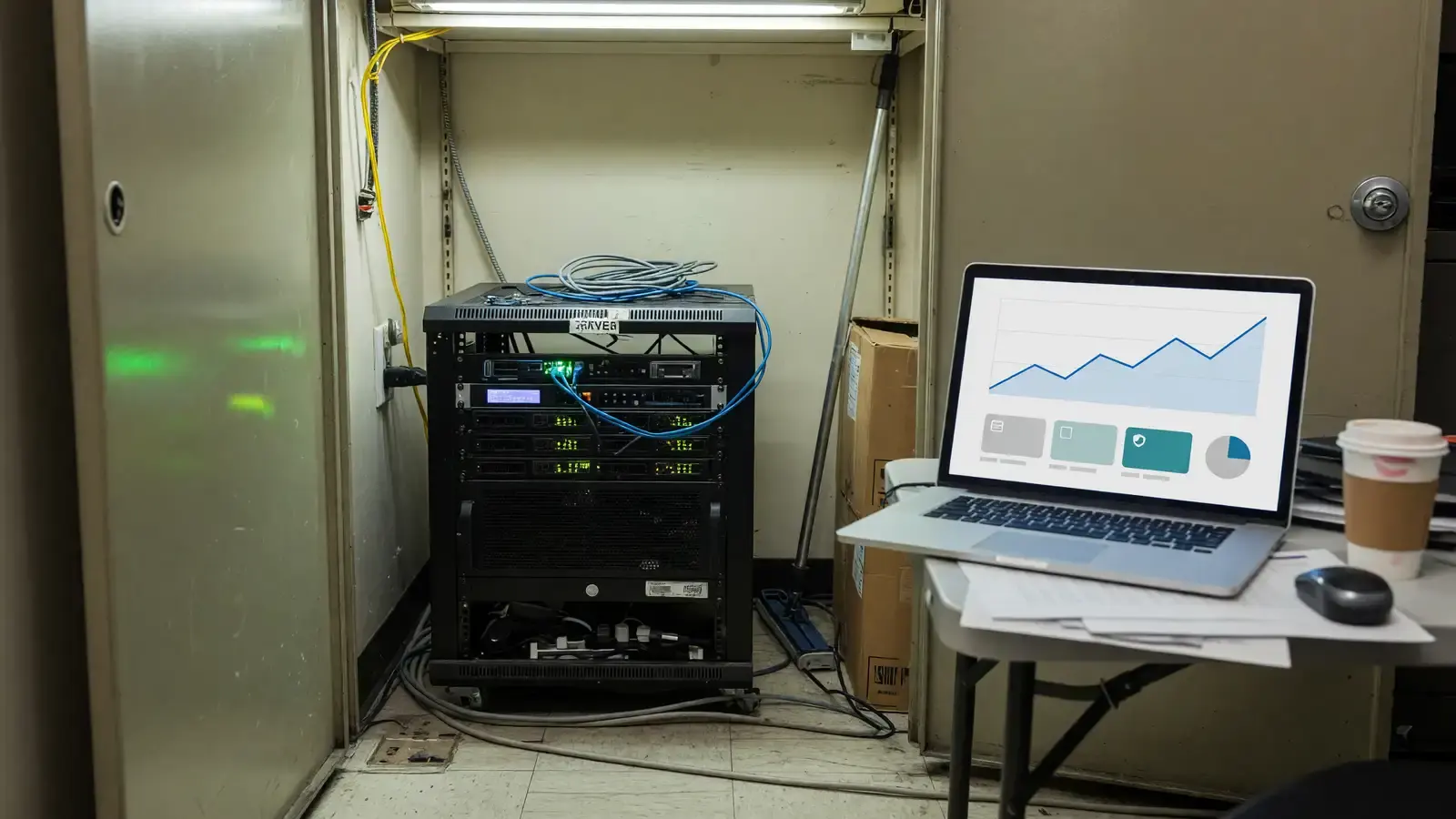
Now run the numbers on a self-hosted setup. A single NVIDIA RTX 4090 running Llama 3.1 70B with 4-bit quantization handles roughly 30 tokens per second on input. The hardware cost is around $1,800 upfront. Electricity adds maybe $20-30 per month. If you need more throughput, add a second GPU. The effective cost per million tokens drops to roughly $0.10-$0.50 depending on utilization.
The break-even point depends on volume, but for most organizations processing more than 10 million tokens per month, self-hosting becomes cheaper within 6-12 months. Below that threshold, cloud APIs still make more sense for most use cases. But the threshold keeps dropping as open-source tooling improves and hardware gets cheaper. Two years ago, you needed a dedicated server room. Today, a single workstation under a desk handles most workloads.
There’s also a hidden cost in cloud APIs that rarely gets mentioned: vendor lock-in. Once your application is built around a specific API’s quirks, quirks, response format, and rate limits, switching to a different provider or to self-hosted models becomes a significant engineering project. The longer you stay on a cloud API, the more expensive it becomes to leave.
Performance has caught up faster than expected
The benchmark gap between open-source and proprietary models has narrowed dramatically. Llama 3.1 405B matches or exceeds GPT-4 on most standard benchmarks. Mistral Large 2 performs comparably to Claude 3.5 Sonnet on reasoning tasks. And smaller models like Llama 3.1 70B and Qwen 2.5 72B handle the majority of real-world tasks without noticeable quality loss.
The key insight is that most AI applications don’t need frontier-level intelligence. A customer service chatbot, a document summarizer, a code completion tool, these tasks are well within the capabilities of 70B-class models. The marginal quality improvement from using a $3/million token API versus a $0.10/million token self-hosted model is often imperceptible in production.
The quality gap matters most in creative and open-ended tasks. If you’re asking a model to write a novel, analyze complex legal documents, or solve novel mathematical problems, the frontier models still have a meaningful edge. But for the repetitive, structured tasks that make up the bulk of enterprise AI usage, the open-source alternatives are more than adequate.
Where cloud APIs still maintain an edge is in the very largest models and the most complex reasoning tasks. But that edge is shrinking with each release, and the cost differential makes it increasingly difficult to justify for routine workloads. The open-source community has also gotten better at packaging models for specific use cases, releasing fine-tuned variants that outperform general-purpose APIs on targeted tasks.
Privacy and compliance drive adoption beyond cost
GDPR compliance in Europe has become a significant driver of local model adoption. Companies processing personal data through cloud APIs face complex questions about data residency, processing agreements, and cross-border transfers. Running inference locally eliminates most of these concerns entirely.
Healthcare, finance, and legal industries have been early adopters for exactly this reason. When you’re analyzing patient records, financial statements, or privileged legal documents, the compliance overhead of sending that data to a third-party API often exceeds the cost savings. Local inference with on-premises hardware sidesteps the entire issue.
The trend is accelerating as regulations tighten globally. China’s data localization requirements, Brazil’s LGPD, and California’s CCPA all create friction for cloud-based AI processing of sensitive data. For organizations subject to multiple regulatory frameworks, local deployment is becoming the default rather than the exception.
Beyond formal regulations, there’s a growing concern about data leaking into model training. When you send data to a cloud API, there’s no guarantee it won’t be used to train future models. Cloud providers have made various commitments about this, but the technical ability remains, and trust erodes with each policy change. Local inference eliminates this concern entirely. Your data stays on your hardware, and you control exactly what happens to it.
The customization advantage
Cloud APIs give you a model. Local deployment gives you a model you can modify. Fine-tuning on domain-specific data, adjusting system prompts without API rate limits, running multiple model variants simultaneously for A/B testing, these capabilities are trivial with local infrastructure and impossible with most cloud APIs.
The open-source model ecosystem has made fine-tuning accessible. Tools like Axolotl, Unsloth, and MLX allow fine-tuning 70B-class models on a single GPU in hours rather than days. The resulting specialized models often outperform general-purpose frontier models on narrow tasks while running at a fraction of the cost.
This matters most in production environments where the cost of error is high. A fine-tuned model trained on your company’s specific data and edge cases will consistently outperform a generic API for your particular use case. The ability to iterate on model behavior without waiting for API updates or new model releases gives engineering teams significantly more control.
Latency and reliability matter more than benchmarks
Cloud API latency varies with demand. During peak hours, response times can double or triple. For applications where consistency matters more than peak performance, local inference provides deterministic latency that cloud providers can’t match.
Self-hosted models also eliminate the dependency on external service availability. Cloud APIs have outages. When OpenAI or Anthropic experiences downtime, every application depending on their API stops working. A self-hosted model runs on your infrastructure with your reliability guarantees.
The practical impact is significant for real-time applications. Voice assistants, code completion tools, and interactive chatbots all benefit from the consistent, low-latency responses that local inference provides. A 50ms response time difference might not matter for a batch processing pipeline, but it matters enormously for a user-facing product.
There’s also a bandwidth consideration. Every token you send to a cloud API traverses the internet, adding latency and creating a potential point of failure. Local inference keeps the entire data path within your network. For organizations with strict network security requirements, this can be a deciding factor.
The hardware landscape is evolving
The availability of consumer and prosumer hardware capable of running large models has expanded rapidly. NVIDIA’s RTX 4090 and 5090 series, AMD’s MI300X, and Apple’s M4 Ultra all provide sufficient memory and compute for running 70B-class models locally. Prices continue to drop as supply increases and competition intensifies.
The NPU (Neural Processing Unit) market is also maturing. Qualcomm’s latest Snapdragon chips include dedicated AI accelerators that can run smaller models efficiently. AMD’s upcoming EPYC processors include integrated NPU cores. These developments will make local inference accessible on standard office hardware within the next two years.
Cloud providers are responding by offering dedicated instances for AI workloads, but the pricing rarely matches the economics of owned hardware for consistent usage patterns. The pay-per-token model makes sense for bursty, unpredictable workloads. For steady, high-volume usage, owning the hardware almost always wins on a multi-year basis.
When cloud APIs still make sense
Despite all these trends, cloud APIs remain the right choice for many scenarios. Prototyping and exploration benefit from zero upfront investment. Teams that don’t have infrastructure expertise or don’t want to manage servers are better off paying the API premium. And for applications that need access to the absolute latest and most capable models, cloud APIs offer capabilities that haven’t been open-sourced yet.
The hybrid approach is increasingly common. Run routine, high-volume workloads locally for cost and privacy. Use cloud APIs for tasks that require frontier intelligence or for development and testing. This gives you the best of both worlds while keeping costs manageable.
Cloud APIs also make sense for small teams that need to move fast. When you’re a five-person startup trying to validate a product idea, spending weeks setting up GPU infrastructure isn’t the best use of your time. Get the product working with an API, prove the concept, then optimize the infrastructure once you know the product has traction. The flexibility to switch between approaches as your needs evolve is one of the most valuable aspects of the current ecosystem.
The bottom line
The open-source AI ecosystem has reached a tipping point. For the first time, self-hosted models offer competitive performance at a fraction of the cost, with better privacy guarantees, lower latency, and more customization options. Cloud APIs still have their place, but that place is narrower than it was two years ago.
The organizations that figure out the right balance between local and cloud deployment will have a significant advantage in the coming years. The ones that don’t will keep paying $3 per million tokens for tasks that a $0.10 self-hosted model handles just as well.
The shift isn’t happening because open-source models are “good enough.” It’s happening because they’re genuinely better for a growing number of use cases. When you combine lower cost, better privacy, faster inference, and full customization control, the value proposition of cloud APIs weakens considerably. The question for most organizations in 2026 isn’t whether to adopt local inference. It’s how quickly they can make the transition without disrupting existing workflows.
Reader Dispatches
No reader responses yet. Share your technical perspective below.
Related Posts
The Open Source AI Price War: How Competition Is Rewriting the Rules in 2026
GPT-4 pricing dropped from $30 to $1-2 per million tokens. What's driving the collapse, and what does it mean for developers building with AI?
K2 Horizon Is the First Truly Open Frontier AI Model
IFM released K2 Horizon with weights, code, and training data, spanning a 0.9B watch model to a 375B enterprise system. Here's what 'fully open' actually changes.
AI's Carbon Problem Is Bigger Than Anyone Admits
Training a single AI model now emits more CO₂ than some countries produce in a year. Stanford's 2026 AI Index reveals the environmental cost of the compute arms race.