OpenAI vs Google vs Anthropic: In-Depth Analysis of AI Giants' Competitive Landscape
The AI competitive landscape heats up. From product launches to funding battles, we analyze the strategic positioning, product advantages, and future trajectories of OpenAI, Google, and Anthropic.
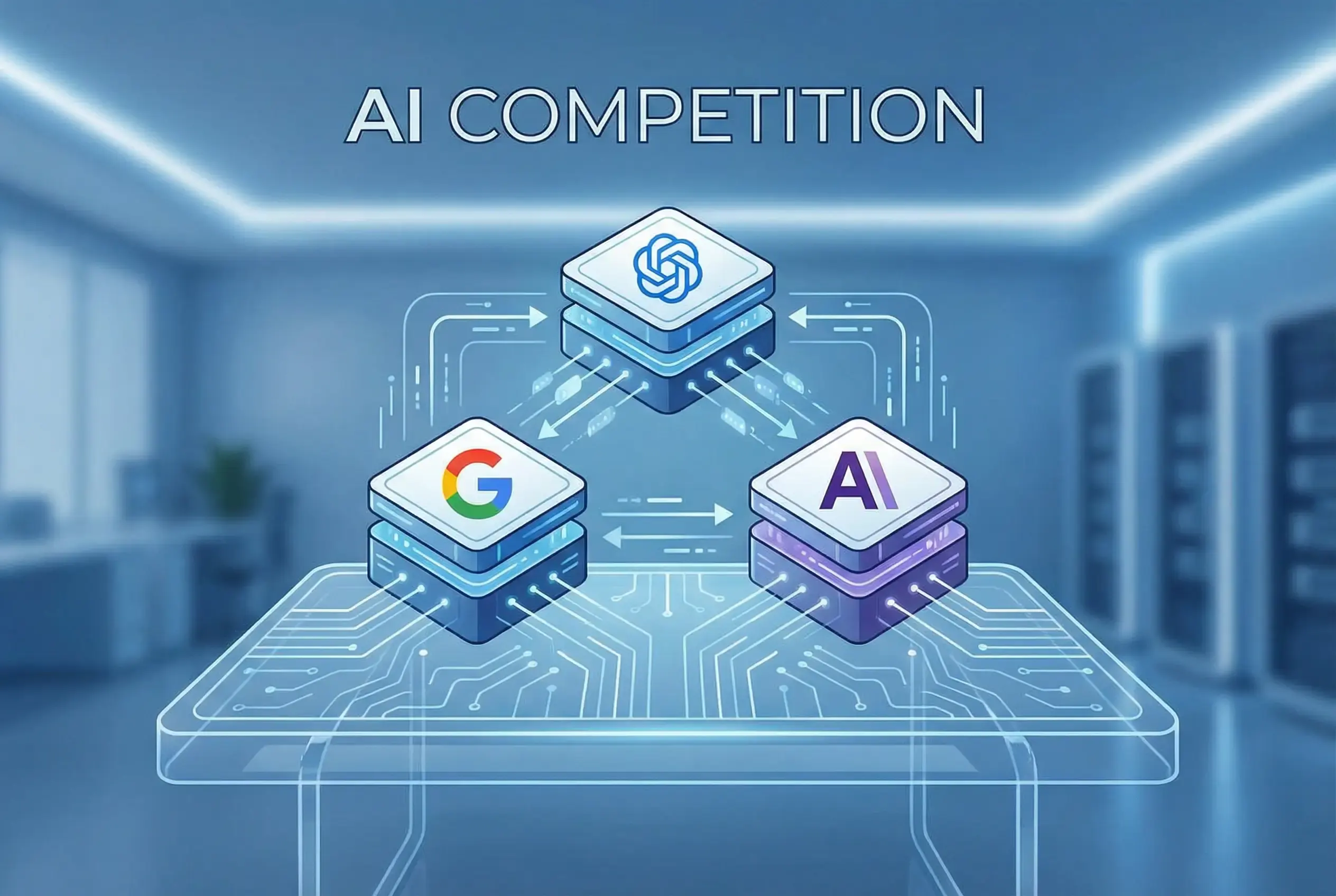
The AI industry has developed rapidly in recent years, and the competitive landscape among OpenAI, Google, and Anthropic has evolved from technological competition to comprehensive market warfare. In 2026, this competition has become even more intense—from product launches to funding battles and marketing offensives, all parties are pulling out all the stops to consolidate their market position. This article provides an in-depth analysis of the strategic positioning, product advantages, and financial status of these three AI leaders, exploring their future development trajectories.
OpenAI: The IPO Sprint Leader
OpenAI is undoubtedly the most prominent focus in the current AI industry. Led by Sam Altman, the company is currently valued at $500 billion and is actively preparing for an IPO in Q4 2026, becoming the first AI giant to go public. According to the Wall Street Journal, OpenAI has begun informal talks with Wall Street banks, aiming to beat competitor Anthropic to the capital markets.
However, OpenAI’s financial pressure cannot be ignored. Although the company projects revenues reaching $213 billion by 2030, HSBC predicts that from now until 2030, OpenAI will face a gap of up to $207 billion between revenue and expenses. The company is still in a high-speed burn phase, with substantial funds invested in data center construction to support AI model training and operations.
On the product side, OpenAI’s ChatGPT remains the most popular AI chatbot globally. The company recently launched the new Codex model (GPT-5.3-Codex), actively competing in the AI code generation market, attempting to compete with Anthropic’s Claude Code.
Anthropic: Enterprise Market Cultivator
Anthropic completed a $3 billion financing round in early 2026, with its valuation surging to $380 billion—more than doubling from its previous financing in September 2025. This is the second-largest private financing case after OpenAI’s $40 billion round, with investors including Coatue, Singapore’s sovereign wealth fund GIC, Microsoft, and Nvidia, among other heavyweight institutions.
Anthropic’s business model differs significantly from OpenAI. About 80% of the company’s revenue comes from enterprise clients, providing relative stability amid consumer market fluctuations. Its AI coding tool, Claude Code, has performed impressively, with annualized revenue reaching $2.5 billion and enterprise subscriptions quadrupling since the beginning of the year—enterprise users account for more than half of the product’s revenue.
Anthropic’s 2025 revenue was approximately $10 billion, with annualized revenue climbing to $14 billion. CEO Dario Amodei stated: “Whether it’s entrepreneurs, startups, or the world’s largest enterprises, the message from customers is the same: Claude is increasingly becoming a key tool for business operations.”
Notably, Anthropic’s creative advertisement during the 2026 Super Bowl was a huge success. According to CNBC, after the advertisement aired, Anthropic’s user visits increased by 11%—the largest increase among all AI companies. Anthropic cleverly used “AI shouldn’t have advertisements” as its theme, promoting Claude’s positioning while implicitly mocking competitors—killing two birds with one stone.
Google DeepMind: Basic Research Guardian
Compared to the high-profile competition between OpenAI and Anthropic, Google DeepMind has chosen a different path—focusing on basic scientific research. The company’s recently released Gemini 3 Deep Think achieved major breakthroughs in mathematics and scientific discovery, with the summer 2025 version reaching gold medal level in the International Mathematical Olympiad (IMO).
Google has shown staggering capital expenditure, planning to invest up to $185 billion in AI infrastructure in 2026. This figure far exceeds its competitors, reflecting Google’s attempt to maintain leadership in AI through scale advantages. The Google I/O developer conference is scheduled for May 19-20, with more AI product updates expected.
However, Google faces equally formidable challenges. With increasing competition in the AI coding tool market, software stocks have continued to plummet recently, with investors beginning to worry that AI technology might disrupt the traditional software industry. How Google balances the consumer and enterprise markets will be key to its future development.
Competitive Relationships and Market Impact
The competitive dynamics among these three companies are reshaping the AI industry landscape. The rivalry between OpenAI and Anthropic is particularly intense—Anthropic’s founding team consists of researchers who left OpenAI, and the two have fundamental differences in development philosophy. Anthropic emphasizes AI safety and controllability, while OpenAI leans more toward rapid commercialization.
This competition also reflects the enormous capital requirements of the AI industry. From OpenAI’s billion-dollar financing rounds to Anthropic’s tens of billions, to Google’s hundred-billion-dollar capital expenditure, AI has become the most capital-intensive technology sector. Analysts warn that if AI companies cannot achieve profitability in the short term, market concerns about an AI bubble may further intensify.
Conclusion: Who Will Laugh Last?
Overall, each company has its own advantages and challenges. OpenAI has the highest recognition and broadest user base—successful IPO would set a new milestone for the AI industry; Anthropic has secured a firm position in the enterprise market, and Claude Code’s success demonstrates its technological prowess; Google maintains leadership in basic research and hardware investment.
With the IPO battle about to unfold, 2026 will become a critical turning point for the AI industry. Who can ultimately emerge in this marathon-style competition depends not only on technological strength but also on commercialization capabilities and capital efficiency. The battle among these AI giants is just entering its climax.
Reader Dispatches
No reader responses yet. Share your technical perspective below.
Related Posts
Google's Project Genie: The $250/Month 'Matrix' Simulator That Isn't a Game Engine
Google DeepMind's Genie 3 allows you to generate playable worlds from a single image, but the hardware constraints and the steep 'AI Ultra' subscription price raise questions about its viability. Here is a technical deep dive into the future of generative environments.
The AI Industry Is Embracing a Slowdown. Here's What That Actually Means.
OpenAI, Anthropic, and 1,200 AI workers are calling for government-led development pacing. The prisoner's dilemma at the heart of AI safety.
The End of the Affair: Why OpenAI is Killing GPT-4o Right Before Valentine's Day
OpenAI has announced the retirement of GPT-4o and legacy models on February 13, 2026. We analyze the technical shift from 'emotional' AI to 'logical' AI, the backlash from users who lost their digital companions, and how to replicate the GPT-4o personality using system prompts in the new GPT-5.2 era.