China's Two Sessions Introduce 'Smart Economy' Push, Set $1.4 Trillion AI Target for 2030
China's 2026 Two Sessions introduced the 'smart economy' concept for the first time. NDRC announced AI industry target of 10 trillion yuan by 2030. Policy evolved from 'AI Plus' to 'smart economy,' with 15th Five-Year Plan focusing on multimodal systems, AI agents, embodied AI, and AGI exploration.
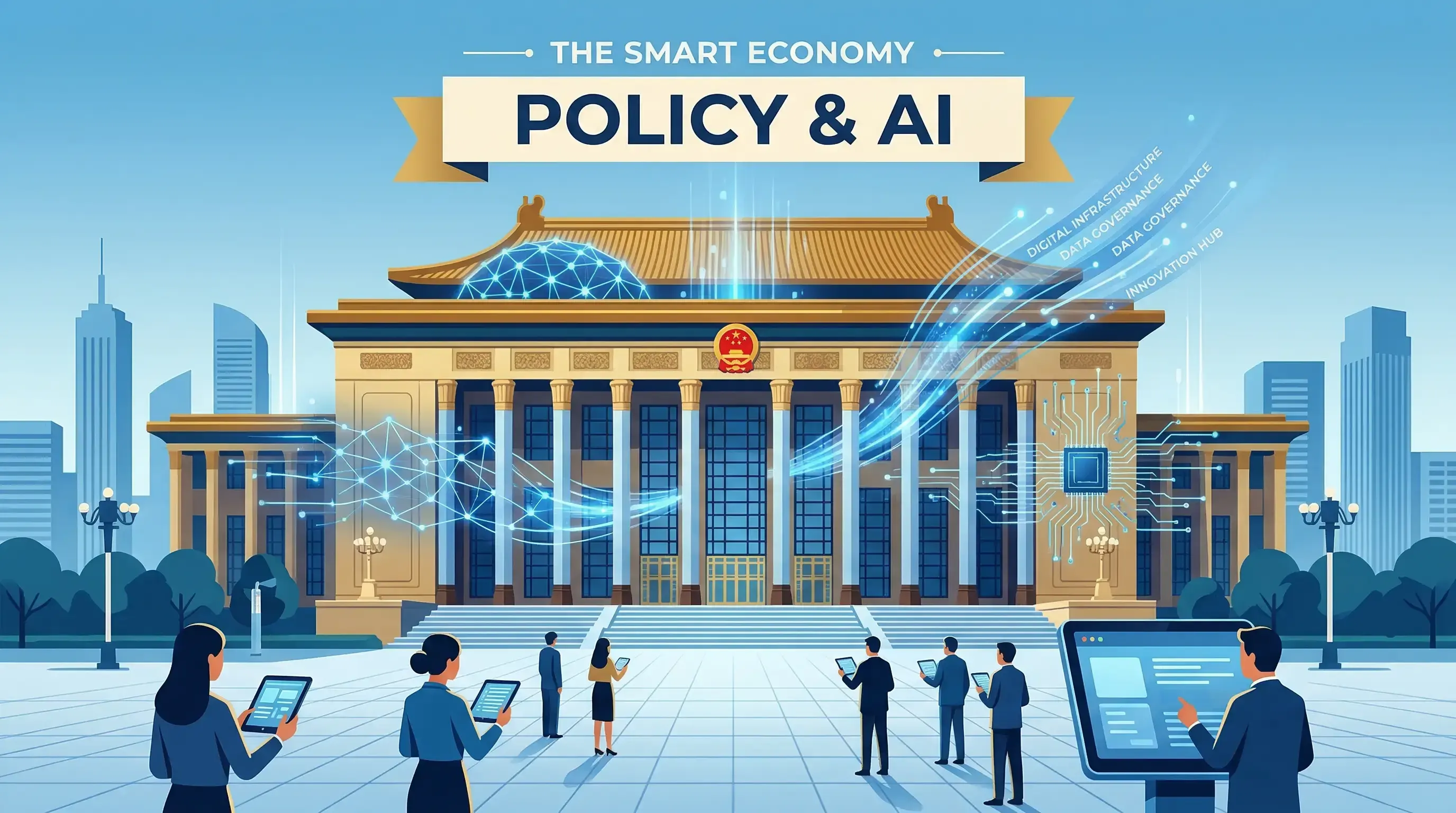
China’s National People’s Congress wrapped up March 12, approving the 15th Five-Year Plan. The government work report introduced a new term: “smart economy.”
Zheng Shanjie, head of the National Development and Reform Commission, put a number on it at a March 6 press conference: by the end of the 15th Five-Year Plan period (2026–2030), AI-related industries should exceed 10 trillion yuan, about $1.45 trillion, according to Xinhua. That compares with about 1.2 trillion yuan in 2025. Big jump. Whether it happens is another story.
Policy evolution
2024: “AI Plus.” 2025: more “AI Plus.” 2026: “smart economy.”
Zhou Li’an at Peking University told Xinhua this is a real shift. AI used to be a tool, now it’s supposed to be infrastructure. He used the nervous system/brain analogy.
The government work report lists specifics: intelligent terminals, AI agents, industry applications, new business models.
What’s in the plan
Four technical directions: multimodal systems, AI agents, embodied AI, swarm intelligence. Plus exploring AGI.
Multimodal means processing text, images, voice at once. AI agents go further—understand tasks, complete them autonomously. Sounds good. How well it works, the report doesn’t say.
Humanoid robots are getting attention. Ministry of Industry and Information Technology says Chinese companies launched over 300 types, more than half the global total. Morgan Stanley predicts 2.6 million units shipped annually by 2035.
Lei Jun called humanoid robots a potential “disruptive product.” He also admitted the problems: high costs, stability issues, not enough factory use cases. Lab to production line isn’t easy.
How companies use it
Ministry data: by end of 2025, over 30% of large manufacturing enterprises “adopted” AI. What that means—full deployment or pilots—unclear.
Qian Gang at CITIC Pacific Special Steel said his company built over 100 AI models and turned one factory into the world’s first “lighthouse factory” in special steel. That’s a World Economic Forum certification, top tier for manufacturing digitalization.
Hisense chairman Jia Shaoqian: AI went from “copilot” to “agent,” handling entire workflows. In theory. Reality varies by company.
Ma Kui at China Mobile’s Sichuan branch mentioned southwest opportunities. Lots of energy, fits “East Data, West Computing.” But he was realistic: resources alone don’t work. Need applications, real economy integration.
Infrastructure
AI eats computing power and electricity. The report talks about hyper-scale computing clusters and coordinating power systems.
Logic: eastern areas need computing, western areas have renewable energy. Put centers out west, costs drop. Question is whether western infrastructure and talent keep up.
Satellite internet and industrial network upgrades also mentioned. Lower latency, expand coverage. But construction timelines and costs are big.
Governance
As AI gets more capable, governance matters more. Report mentions data security, privacy, algorithm oversight.
Minister Li: AI should “serve people, benefit people, remain under human control.” That’s the principle. Implementation details, we’ll see. 2025: 1.2 trillion yuan AI industry, 6,200+ companies.
The plan talks about international dialogue, open-source ecosystems, cooperation on e-commerce, payments, smart cities.
Deputy Zhou Di was direct: tech barriers, cross-border data, ethics—one country can’t solve these.
What the government work report actually says
The relevant passage of the 2026 government work report sits under the heading “building new forms of the smart economy” (打造智能經濟新形態). In summary, it commits to:
- Deepening “AI Plus”: faster adoption of new-generation smart devices and AI agents, and commercial, large-scale AI applications in key industries.
- “AI-native” business models: cultivating new formats and models built around AI from the start.
- Open source: supporting AI open-source communities and their ecosystems.
- Infrastructure: hyper-scale intelligent computing clusters, coordination between computing and power supply, national monitoring and scheduling of computing capacity, and support for public cloud.
- Networks and data: satellite internet, an upgraded “5G + industrial internet”, stronger data-resource rules and high-quality datasets.
- Governance: improving AI governance.
Elsewhere, the report lists embodied intelligence, alongside quantum technology, brain-computer interfaces and 6G, among “future industries” to cultivate. In its review of 2025, it reports that the core digital-economy industries’ value added exceeded 10.5% of GDP and that the number of newly established foreign-invested enterprises grew 19.1%.
How to read the 10-trillion-yuan target
A few points help put the headline number in context:
- Definition. “AI-related industries” is broader than AI software. It typically includes hardware, devices, computing infrastructure and AI-enabled products, so it is not comparable with narrower estimates of AI software markets.
- Growth rate. Going from about 1.2 trillion yuan in 2025 to more than 10 trillion by 2030 implies average growth above 50% a year, which would be very fast for an industry of that size.
- Policy versus forecast. Five-Year Plan targets signal priorities and guide local governments and state-owned enterprises; they are not independent market forecasts.
What to watch
- Local implementation plans that turn “AI Plus” into specific subsidies, procurement and pilot zones.
- Progress on computing infrastructure in western provinces under the “East Data, West Computing” programme.
- Whether industrial AI adoption moves from pilots to measurable productivity gains.
- How governance rules on data, algorithms and generative AI evolve alongside the push for scale.
What it means
“Smart economy” isn’t just rebranding. Policy shifted from tech breakthroughs to industry integration. Manufacturing, agriculture, services, consumer markets—all supposed to use AI.
China’s advantage: manufacturing capacity, data, application scenarios. But tech advances translating to industry value depends on actual company use.
Nancy Wang at LinkedIn China: foreign-invested enterprises in China grew 19.1% in 2025. Chinese companies’ outbound recruitment on LinkedIn grew 30%+ year-on-year, focused on smart hardware, robotics, healthcare, new energy.
The Two Sessions set the direction. Whether smart economy becomes China’s new engine, 2030 will tell.
Sources
Reader Dispatches
No reader responses yet. Share your technical perspective below.
Related Posts
MiniMax M2.7, GPT-5.4 mini / nano, and Midjourney V8 Alpha Arrive in the Same Week: AI Is Starting to Split Into Roles
Between March 17 and March 18, 2026, OpenAI, Midjourney, and MiniMax all shipped notable model updates. Taken together, they show AI moving away from one-model-does-everything and toward cheaper subagents, self-improving agent stacks, and faster creative engines.
OpenAI GPT-5.4: Native Computer Use, 1M Context, Benchmarks and API Pricing
OpenAI's GPT-5.4, released March 5, 2026: native computer use, 1M-token context, tool search, published benchmarks versus GPT-5.2, ChatGPT availability and API pricing, with practical notes and limitations.
AI News Roundup: The 5 Official Updates That Mattered Most in the Second Week of March 2026
As of March 15, 2026, the clearest AI trend is not just better models. This week's official updates from OpenAI, Google, Microsoft, NVIDIA, and Anthropic show the race shifting toward safety, multimodal retrieval, agent governance, and enterprise deployment.