AI News Roundup: The 5 Official Updates That Mattered Most in the Second Week of March 2026
As of March 15, 2026, the clearest AI trend is not just better models. This week's official updates from OpenAI, Google, Microsoft, NVIDIA, and Anthropic show the race shifting toward safety, multimodal retrieval, agent governance, and enterprise deployment.
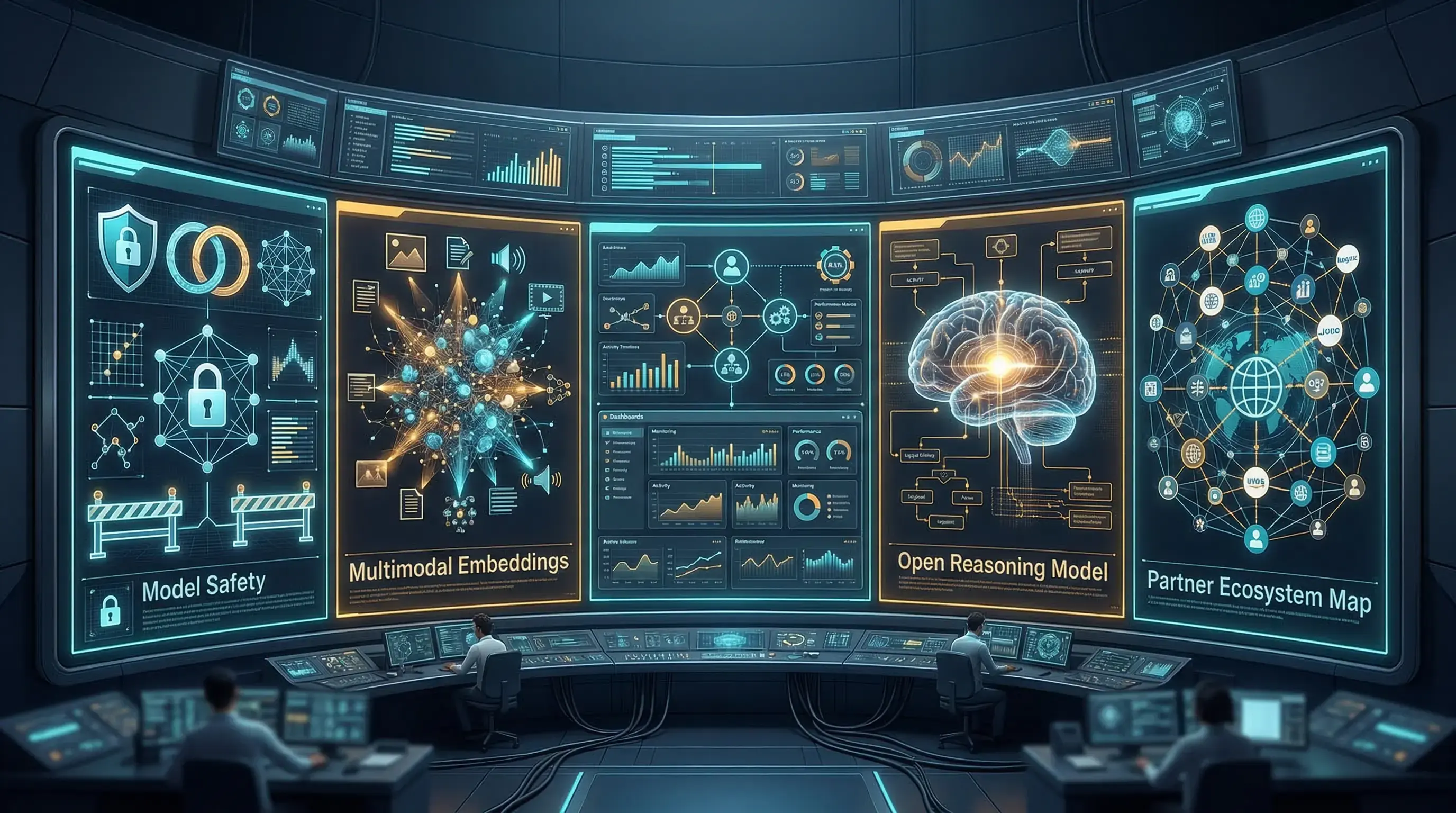
As of March 15, 2026, if you line up the most important official AI updates from this week, the direction is hard to miss. Yes, companies are still shipping models, features, and platforms. But the center of gravity no longer feels like a simple race for bigger numbers or cleaner benchmark charts. The bigger story is that the leading labs and platforms are all pushing toward the same destination: safer systems, better workflow integration, and AI that can survive contact with real production environments.
That is why I did not turn this into a single-item breaking story. Instead, this is a bilingual weekly roundup covering the strict window from March 8, 2026 to March 15, 2026. The five items below all come from official source pages: OpenAI on instruction hierarchy and prompt-injection resistance, Google on Gemini Embedding 2, Microsoft on Frontier Suite and Agent 365, NVIDIA on Nemotron 3 Super, and Anthropic on its $100 million Claude Partner Network push.
What happened this week
- OpenAI published IH-Challenge on March 10 and pushed instruction hierarchy and prompt-injection resistance further into the spotlight
- Google launched Gemini Embedding 2 in public preview on March 10, making multimodal embeddings a much more direct developer story
- Microsoft announced Frontier Suite and Agent 365 plans on March 9, with a clear push to sell agent governance into enterprise IT
- NVIDIA launched Nemotron 3 Super on March 11, continuing to compete for the model and infrastructure layer of agentic AI
- Anthropic announced a $100 million investment in the Claude Partner Network on March 12, pulling more implementation partners into its enterprise motion
At first glance, these updates sit in different buckets: safety, embeddings, office software, open models, and partner ecosystems. Put together, though, they tell one much cleaner story. AI companies are getting more serious about winning the production layer.
The five official updates worth watching
1. OpenAI is treating instruction priority as a real product and safety problem
On March 10, OpenAI published Improving instruction hierarchy in frontier LLMs. This is not a flashy new model launch, but I would still count it as one of the more important AI updates of the week because it goes after a problem that is becoming harder to ignore: when a model receives instructions from the system, the developer, the user, and external tools, which one should it trust first?
OpenAI’s hierarchy is system > developer > user > tool, and the company introduced IH-Challenge as a training dataset for getting that behavior to hold up under conflicting instructions. In OpenAI’s reported results, the IH-trained GPT-5 Mini-R improves on benchmarks such as TensorTrust and RealGuardrails, and also does better on internal prompt-injection evaluations without sliding too far into blanket refusals.
The detail that matters most is not any one benchmark row. It is the fact that OpenAI is now treating prompt injection resistance and instruction hierarchy as a trainable capability layer in its own right. For anyone building agents, MCP-based toolchains, or enterprise workflows, that matters more than a small UI refresh in chat.
2. Google pushed multimodal embeddings closer to mainstream developer use
Google DeepMind launched Gemini Embedding 2 on March 10. It is Google’s first natively multimodal embedding model, and it can map text, images, video, audio, and documents into a shared embedding space. It is already in public preview through the Gemini API and Vertex AI.
This may sound less dramatic than a new frontier model, but it has a lot of practical weight behind it. More AI products now need to retrieve and rank screenshots, clips, voice snippets, PDFs, and structured files alongside text. Gemini Embedding 2 points toward a simpler stack, where developers do not have to glue together separate embedding pipelines for every modality before they can build decent retrieval, classification, or multimodal RAG systems.
Google also says the model supports more than 100 languages, up to 8192 input tokens, up to six images per request, video inputs up to 120 seconds, and PDFs up to six pages. It keeps Matryoshka Representation Learning for flexible output dimensions as well, which matters a lot if your vector storage bill is already starting to hurt.
If you want a broader model-positioning backdrop, our earlier ChatGPT vs. Claude vs. Gemini comparison is a useful companion read.
3. Microsoft is selling a governance layer, not just another Copilot feature set
Microsoft published Introducing the First Frontier Suite built on Intelligence + Trust on March 9. The short version is that this was not a routine feature announcement. It was Microsoft trying to make the “enterprise AI operating layer” story feel more concrete.
The two most tangible pieces are straightforward:
- Agent 365 reaches general availability on May 1 at $15 per user
- Microsoft 365 E7: The Frontier Suite also reaches general availability on May 1 at $99 per user
Microsoft also leaned hard into model diversity, explicitly saying that Claude and next-generation OpenAI models will be available within Microsoft 365 Copilot. That framing matters. Microsoft does not want customers to think they are buying one model. It wants them to think they are buying a governable, observable, enterprise-safe agent platform.
This also connects directly with our earlier Frontier Suite breakdown. That earlier piece focused on product details. This week’s announcement feels more like the point where the sales and deployment motion gets real.
4. NVIDIA keeps pushing agentic AI from both the model side and the infrastructure side
NVIDIA launched Nemotron 3 Super on March 11. On paper, it is a 120B-parameter open model with 12B active parameters and a 1M-token context window. NVIDIA says it can deliver up to 5x higher throughput and up to 2x higher accuracy than the previous Nemotron Super in some scenarios.
What interests me more is the product logic behind it. NVIDIA is not selling this as just another general chat model. It is going directly after two of the most annoying problems in multi-agent systems: context explosion and inference cost. NVIDIA notes that multi-agent workflows can generate 15x the tokens of standard chats, which is exactly why a lot of agent systems feel impressive in a demo and expensive the minute they have to run for real.
If you want the full model-specific breakdown, we already published a dedicated Nemotron 3 Super guide. In this roundup, the main point is simpler. NVIDIA is making its position clearer every week: it wants to own as much of the agent-era stack as possible.
5. Anthropic is pulling its partner ecosystem into the foreground
On March 12, Anthropic announced it would invest $100 million into the Claude Partner Network. This is not the loudest AI headline of the week, but for enterprise readers it is one of the more revealing ones.
Anthropic is not just creating a partner page. It is putting real money behind training, sales enablement, market development, technical support, and certification. The company also launched Claude Certified Architect, Foundations and positioned a code modernization starter kit as one of the first high-demand workloads for partners to take to market.
That tells you Claude is no longer being sold only as “a good model.” Anthropic is building a more traditional and more realistic enterprise adoption path around it. A lot of large buyers do not integrate frontier models from scratch. They rely on consultancies, services firms, systems integrators, and internal solution teams. Anthropic is now investing in that layer much more openly.
What changes when you look at these five stories together
If you spent the week staring at leaderboards, you probably missed the more useful shift. The second week of March 2026 did not mainly look like a story about who launched the strongest model. It looked more like a story about who is making AI easier to deploy, govern, secure, and justify inside real organizations.
OpenAI is working on safety behavior and instruction priority. Google is strengthening multimodal retrieval infrastructure. Microsoft is productizing enterprise agent governance. NVIDIA is pushing the model and inference layer for agentic systems. Anthropic is investing in the partner and delivery channel that helps enterprise customers move from pilots to production.
To me, that is the real signal from this week’s AI news. The competition is shifting from “who answers best” to “who gets bought, integrated, governed, and scaled.” It is less dramatic on the surface, but it is much closer to where the next commercial divide will come from.
What to watch next
Over the next few weeks, I would keep an eye on three things:
- Whether OpenAI moves instruction hierarchy work more directly into developer-facing products and tools
- Whether Gemini Embedding 2 gets picked up quickly by vector databases and RAG frameworks
- Which of Microsoft, NVIDIA, and Anthropic can turn agent deployment from marketing language into repeatable customer wins first
If you are a developer, the two things most worth trying from this week’s batch may be Gemini Embedding 2 and Nemotron 3 Super.
If you are on an enterprise team, Microsoft Agent 365 and the Anthropic Partner Network probably matter more.
And if you care about agent safety, OpenAI’s instruction hierarchy paper is one of the better reads from the week.
Sources
- OpenAI: Improving instruction hierarchy in frontier LLMs
- Google DeepMind: Gemini Embedding 2
- Microsoft: Introducing the First Frontier Suite built on Intelligence + Trust
- NVIDIA: New NVIDIA Nemotron 3 Super Delivers 5x Higher Throughput for Agentic AI
- Anthropic: Anthropic invests $100 million into the Claude Partner Network
Reader Dispatches
No reader responses yet. Share your technical perspective below.
Related Posts
Microsoft Pushes Copilot Into the Agent Era: What Wave 3, Agent 365, and the Frontier Suite Actually Mean
On March 9, 2026, Microsoft unveiled Copilot Wave 3, Agent 365, and the Frontier Suite. Here’s what changed, what it costs, and why the move matters for enterprise AI buyers watching governance, model choice, and lock-in.
NVIDIA Launches Nemotron 3 Super: A 120B Open Model Built for Agentic AI
NVIDIA launched Nemotron 3 Super on March 11, 2026. The new open model combines 120B total parameters, 12B active parameters, a 1M-token context window, and higher inference throughput to target real production-grade agentic AI workloads.
MiniMax M2.7, GPT-5.4 mini / nano, and Midjourney V8 Alpha Arrive in the Same Week: AI Is Starting to Split Into Roles
Between March 17 and March 18, 2026, OpenAI, Midjourney, and MiniMax all shipped notable model updates. Taken together, they show AI moving away from one-model-does-everything and toward cheaper subagents, self-improving agent stacks, and faster creative engines.