MiniMax M2.7, GPT-5.4 mini / nano, and Midjourney V8 Alpha Arrive in the Same Week: AI Is Starting to Split Into Roles
Between March 17 and March 18, 2026, OpenAI, Midjourney, and MiniMax all shipped notable model updates. Taken together, they show AI moving away from one-model-does-everything and toward cheaper subagents, self-improving agent stacks, and faster creative engines.
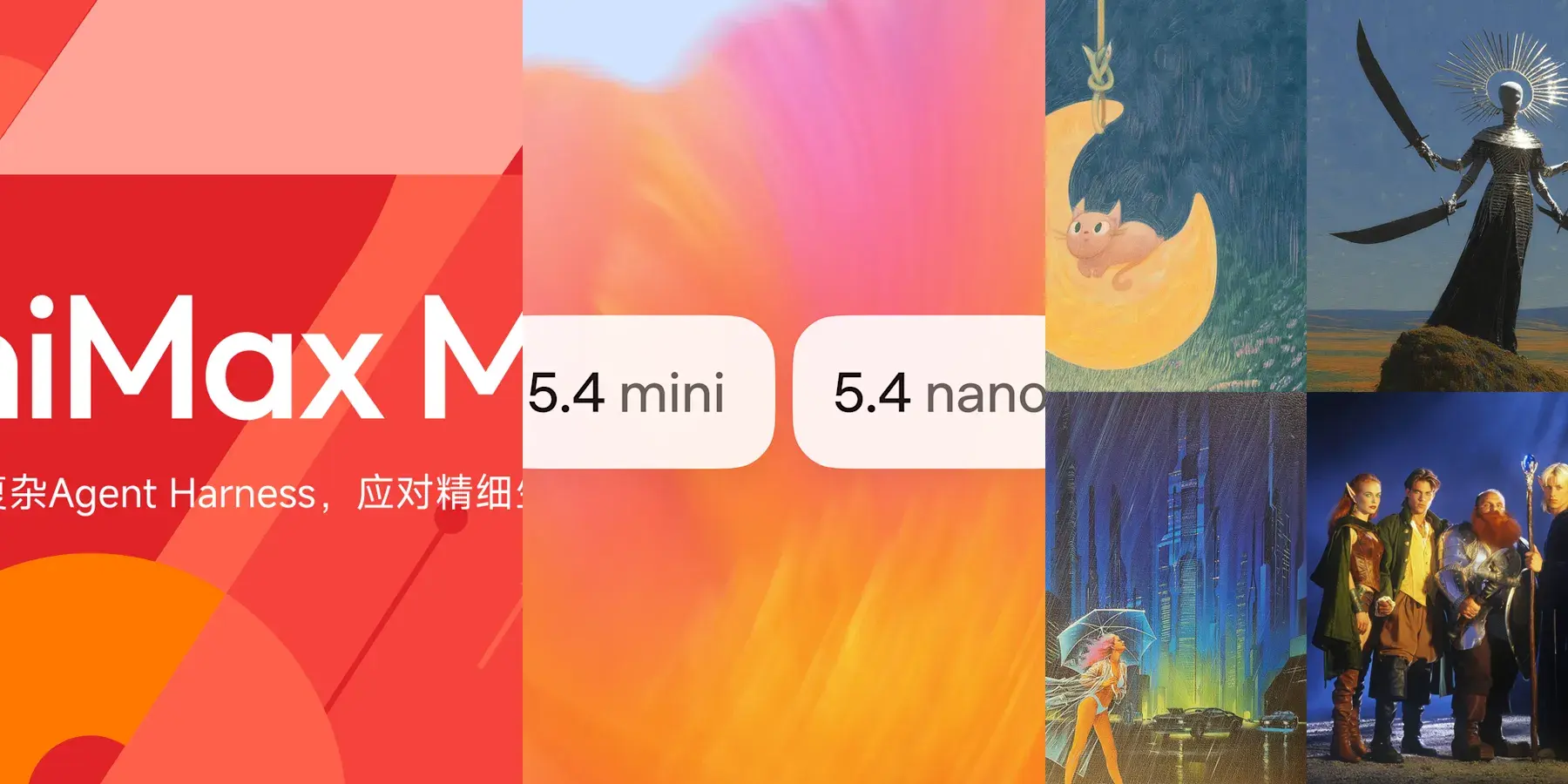
If you read these as separate announcements, they look like normal product cadence: MiniMax shipped M2.7, OpenAI filled out the GPT-5.4 family with mini and nano, and Midjourney opened V8 Alpha to the community.
Put them on a calendar, though, and a clearer pattern shows up.
Between March 17, 2026 and March 18, 2026, these companies were all answering the same question from different angles: what should the next AI system actually look like once people stop assuming one giant model has to do everything?
MiniMax is betting on self-evolving agent workflows. OpenAI is betting on fast, cheap models that can serve as subagents. Midjourney is betting that creative users now care as much about speed, control, and text handling as raw style. Different products, same signal: AI in 2026 is starting to organize itself like a team, not a single brain.
This Launch Wave Is Really About Labor Division
Start with the dates:
- On March 17, 2026, OpenAI released GPT-5.4 mini and nano.
- On March 17, 2026, Midjourney opened V8 Alpha testing on
alpha.midjourney.com. - On March 18, 2026, MiniMax published its official M2.7 announcement and rolled out the M2.7 model page.
That timing matters because it neatly maps to three layers of the emerging AI stack:
- Creative front-end models that need to be fast, steerable, and commercially usable
- Execution-layer small models that can handle lots of low-cost supporting tasks
- Agentic core models that coordinate tools, long workflows, and increasingly complex collaboration

Benchmarks still matter. Pricing still matters. But the bigger story here is architectural. We are moving from “which model wins?” to “which mix of models makes a system feel useful?”
MiniMax M2.7 Is Chasing Something Bigger Than Coding Bragging Rights
MiniMax launched M2.7 on March 18 with a claim that stood out immediately: this is its first model that deeply participates in iterating the next model. That sounds ambitious, and maybe a little audacious, but it is the right kind of ambitious for where agent tooling is headed.
According to MiniMax’s official materials, M2.7 can build complex agent harnesses, operate with Agent Teams, use complex skills and tool search, and slot itself into reinforcement-learning and evaluation loops that help improve the broader system around it. In other words, the pitch is not just “this model completes tasks.” The pitch is “this model can help improve the machinery that produces future tasks and future models.”
The public numbers are also strong enough to keep it in the serious conversation:
- SWE-Pro: 56.22%
- VIBE-Pro: 55.6%
- Terminal Bench 2: 57.0%
- 97% skills adherence across 40 complex skills cases
- MM Claw: 62.7%
- MiniMax’s pricing docs list MiniMax-M2.7 at RMB 2.1 per million tokens and M2.7-highspeed at RMB 4.2 per million tokens
What makes M2.7 interesting, though, is not any single score. It is the way MiniMax keeps framing the model around software engineering, office work, multi-agent collaboration, and workflow self-optimization. That suggests the company is aiming well beyond consumer chat. It wants a model that can sit inside research loops, document workflows, internal tooling, and operator-style productivity tasks.
There is a caveat here. A lot of the most dramatic M2.7 claims still come from MiniMax’s own internal evaluations and internal workflows. So the real test is whether external developers can reproduce even part of that value once they try it in the wild. But the direction is clear. MiniMax is not selling a smarter chatbot. It is selling the beginnings of an AI-native work system.
That also connects naturally to topics we have already covered in our earlier pieces on OpenClaw use cases and building AI agents. Agents are no longer the novelty layer. They are becoming the product layer.
GPT-5.4 mini and nano Make OpenAI’s Model Hierarchy Explicit
OpenAI’s March 17 release matters because it formalizes something many teams were already doing informally: using smaller models for the work that does not need a frontier model every single step of the way.
GPT-5.4 mini is positioned as the strongest mini model OpenAI has shipped so far, with explicit emphasis on coding, tool use, multimodal understanding, computer use, and subagent workflows. According to OpenAI, it runs more than 2x faster than GPT-5 mini, while getting much closer to full GPT-5.4 on several evaluations.
The headline numbers tell the story:
- SWE-Bench Pro: 54.4%
- Terminal-Bench 2.0: 60.0%
- OSWorld-Verified: 72.1%
- 400k context window
- $0.75 per million input tokens and $4.50 per million output tokens
The more revealing detail is what OpenAI says about Codex subagents. The company explicitly describes a workflow where a larger model handles planning and judgment, while GPT-5.4 mini handles narrower parallel subtasks like codebase search, file review, and supporting document processing. That is not a side note. It is a statement of architecture.
Then there is GPT-5.4 nano, which is even more stripped down and even more practical. OpenAI positions it for classification, extraction, ranking, and simpler coding-support tasks. It is API-only, and it is priced aggressively at $0.20 per million input tokens and $1.25 per million output tokens.
That pricing changes behavior. Once a model gets cheap enough, teams stop treating it as a special event and start embedding it everywhere. That is why this launch feels more important than a normal “smaller variant” release. OpenAI is effectively saying: small models are no longer fallback models. They are part of the default production stack.
If you compare that to the earlier GPT-5.4 release, the broader picture becomes easier to read. GPT-5.4 established the high-end brain for professional work and computer use. Mini and nano fill in the operational layer underneath it.

Midjourney V8 Alpha Is About Usability as Much as Aesthetics
Midjourney’s V8 story needs one important qualifier up front: this is V8 Alpha, not a final stable release. The official V8 Alpha page is dated March 17, 2026, and Midjourney is very clear that this is an early model the community is supposed to push, rate, and stress-test.
That said, the release still matters because Midjourney is finally leaning hard into the things creative teams have been asking for beyond pure aesthetic magic.
According to Midjourney’s official notes, V8 Alpha is:
- better at following detailed directions
- better at text rendering, especially when text is placed in quotation marks
- about 5x faster than before
- compatible with existing V7 personalization profiles, moodboards, and srefs
- adding a native
--hdmode for 2K rendering - adding
--q 4for extra coherence
But the company is also being honest about the rough edges. Relax mode is not supported yet, and --hd, --q 4, sref, and Moodboard jobs are currently 4x slower and 4x more expensive than regular jobs. Midjourney also warns that V8 may require new prompting habits because this is a genuinely new model with different strengths and weaknesses.
That honesty is part of why this release matters. Midjourney is no longer pretending the competition is just about who makes the prettiest images. It is responding to the more practical questions creators and teams now ask every day: how fast is it, how controllable is it, can it handle text, and will it fit into an existing workflow without breaking everything?
That makes V8 Alpha feel like a bridge between the older Midjourney identity and a more production-aware future. If V7 was largely about vibe and visual personality, V8 looks like the start of a more disciplined phase where commercial usability matters just as much.
It also fits neatly beside our earlier Midjourney V7 vs. DALL-E 4 comparison. The old critique of Midjourney was never that it lacked beauty. It was that beauty sometimes came with workflow friction. V8 Alpha suggests Midjourney knows that and is now trying to close the gap.
Put Together, These Launches Point to a New Default Stack
The shared takeaway here is pretty simple: AI products are shifting from model competition to workflow competition.
MiniMax M2.7 is pushing toward self-improving agent systems and native multi-agent collaboration. GPT-5.4 mini and nano are turning low-cost subagents into a first-class design pattern. Midjourney V8 Alpha is treating speed, text, and controllability as core features instead of secondary improvements.
That combination points toward a standard setup we will probably see more often through the rest of 2026:
- a stronger top-tier model for planning, coordination, and high-stakes judgment
- one or more cheaper small models for repetitive subtasks and tool-heavy support work
- a specialized creative model for visual output
- a harness layer for memory, evaluation, orchestration, and feedback
That sounds technical, but it changes everyday product experience in a very concrete way. The future interface is probably not “one model answers your prompt.” It is “a small system of models quietly gets the job done.”
What I’d Watch Next
Launch days are noisy. The more useful questions show up a week later.
- Can MiniMax M2.7 translate its self-evolution story into repeatable value for outside developers?
- Will GPT-5.4 mini and nano become the invisible default engines behind coding assistants, ranking systems, and document workflows?
- Can Midjourney V8 Alpha keep its speed gains while improving stability, consistency, and real production control?
If even two of those lines hold, the second half of 2026 is going to look different from the first. Bigger models will still matter, but they will not be the whole story. The system design around them will matter just as much.
Sources
Reader Dispatches
No reader responses yet. Share your technical perspective below.
Related Posts
OpenAI GPT-5.4: Native Computer Use, 1M Context, Benchmarks and API Pricing
OpenAI's GPT-5.4, released March 5, 2026: native computer use, 1M-token context, tool search, published benchmarks versus GPT-5.2, ChatGPT availability and API pricing, with practical notes and limitations.
AI News Roundup: The 5 Official Updates That Mattered Most in the Second Week of March 2026
As of March 15, 2026, the clearest AI trend is not just better models. This week's official updates from OpenAI, Google, Microsoft, NVIDIA, and Anthropic show the race shifting toward safety, multimodal retrieval, agent governance, and enterprise deployment.
China's Two Sessions Introduce 'Smart Economy' Push, Set $1.4 Trillion AI Target for 2030
China's 2026 Two Sessions introduced the 'smart economy' concept for the first time. NDRC announced AI industry target of 10 trillion yuan by 2030. Policy evolved from 'AI Plus' to 'smart economy,' with 15th Five-Year Plan focusing on multimodal systems, AI agents, embodied AI, and AGI exploration.