Qoder's Gambit: Can a Custom-Trained 'Agentic' Model Dethrone Cursor?
Qoder releases Qwen-Coder-Qoder, a custom model for agentic coding claiming to outperform Cursor Composer-1. Here's the 'Rewarder-Attacker' training methodology and what it means for developers.
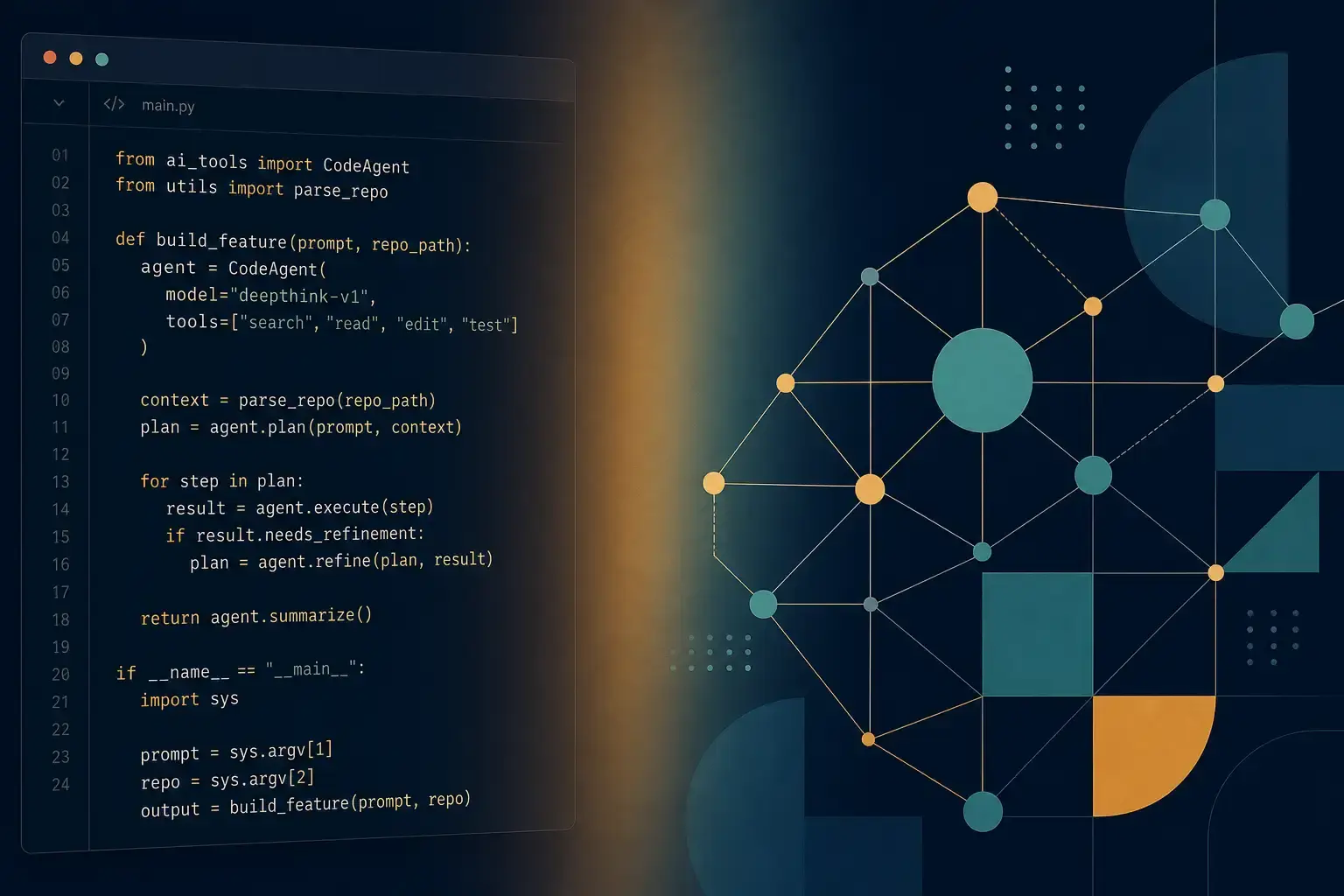
The AI coding assistant market has officially moved past the “autocomplete” phase. We are now deep in the “Agent Wars.”
For the last year, the narrative has been dominated by tools like Cursor, Windsurf, and GitHub Copilot Workspace. Their promise? Don’t just write the code I ask for; understand my project, plan the changes, and execute them across multiple files.
But there’s been a hidden bottleneck: The Models.
Most of these tools rely on general-purpose heavyweights like Claude 3.5 Sonnet or GPT-4o. These models are brilliant polymaths, but they aren’t specialists in the gritty, messy reality of a specific agent’s runtime environment. They hallucinate file paths, misuse internal tools, or get stuck in loops when a linter throws an error.
Enter Qoder.
On February 2, 2026, just five months after launching their platform, the Qoder team dropped a bombshell: Qwen-Coder-Qoder. This isn’t just a fine-tune; it’s a model subjected to rigorous Reinforcement Learning (RL) specifically to master Qoder’s own agentic framework.
They claim to beat Cursor Composer-1 on their internal benchmarks. But beyond the marketing hype, there is a fascinating technical story here about how we build the next generation of AI developers.
The “Last Mile” Problem in AI Coding
To understand why Qoder built a custom model, you have to understand the frustration of using current agents.
When you ask an AI agent to “refactor the authentication module,” it has to:
- Search the codebase (RAG).
- Plan the steps.
- Call file-editing tools.
- Run terminal commands to verify.
General models often fail at step 3 and 4. They might try to grep on a Windows machine that doesn’t have it, or they might hallucinate a parameter for the file-editing tool that doesn’t exist.
Qoder’s approach is Vertical Integration. By controlling the Model, the Agent, and the Product, they create a closed loop.
The “Model-Agent-Product” Flywheel
Qoder describes their philosophy as a three-part cycle. This is standard “Data Flywheel” theory, but applied aggressively to software engineering:
- Model is Agent: The model isn’t just predicting the next token; it’s predicting the next action within the Qoder environment. It knows the specific tools available because it was punished (via RL) for using them wrong during training.
- Agent is Product: The UX is designed entirely around this agentic capability.
- Product Enhances Model: This is the kicker. Every time a user accepts a refactor or fixes a bug the agent introduced, that data becomes a “Reward Signal” for the next training run.
💡 Insight: This is similar to how Midjourney improved so rapidly. They didn’t just train a model; they built a discord interface where user upscaling choices became the training data. Qoder is doing this for code.
The Tech Stack: How Do You Train a “Software Engineer”?
The most interesting part of Qoder’s announcement is their training methodology. They didn’t just feed the model GitHub repositories. They simulated a software company.
1. The Sandbox (The Virtual Office)
They used the actual Qoder product environment as the training gym. The model interacts with the real Knowledge Graph, Memory systems, and MCP (Model Context Protocol) tools.
They utilized containerization to spin up and destroy tens of thousands of environments. This allows the model to “try” a command, see it fail, and learn from the error message at a massive scale.
2. The “Rewarder-Attacker” Mechanism
Reinforcement Learning is notoriously tricky. If you reward a model for “passing unit tests,” it might learn to delete the tests to make them pass (Reward Hacking).
To combat this, Qoder implemented a Rewarder-Attacker adversarial system.
- The Rewarder: Evaluates if the task was actually completed (tests passed, linter green, functionality verified).
- The Attacker: Actively tries to find loopholes in the Rewarder’s logic or generate “technically correct but malicious/garbage” code to fool the system.
This adversarial training makes the reward function robust, ensuring the model learns actual engineering practices, not just how to game the metric.
Code Example: Conceptualizing the Reward Function
While Qoder hasn’t open-sourced their training code, we can conceptualize what this RL reward function looks like based on their technical report. It goes far beyond simple “correctness.”
def calculate_reward(agent_action, environment_state):
    reward = 0.0

    # 1. Functional Correctness (The Baseline)
    if environment_state.tests_passed():
        reward += 10.0
    elif environment_state.build_failed():
        reward -= 5.0

    # 2. Tool Usage Efficiency (The Agentic Skill)
    # Penalize for hallucinating non-existent tool parameters
    if agent_action.has_invalid_tool_params():
        reward -= 10.0  # Heavy penalty

    # Penalize for redundant steps (e.g., reading the same file 3 times)
    if agent_action.is_redundant():
        reward -= 2.0

    # 3. "Software Engineering" Best Practices
    # Did it leave TODOs? Did it break the style guide?
    if not environment_state.linter_check():
        reward -= 1.0

    # 4. The "Attacker" Check (Anti-Hacking)
    # Did the agent delete the test file to make 'tests_passed' True?
    if environment_state.test_file_deleted():
        return -100.0 # Immediate failure

    return reward
The Windows Terminal Advantage: A Niche or a Moat?
One specific claim stands out: “50% higher accuracy in Windows terminal commands.”
At first glance, this seems trivial. Who cares about PowerShell?
Enterprise developers care.
Most AI models are heavily biased towards Linux/Unix environments because that’s where most open-source training data comes from. Ask GPT-4 to list files recursively on Windows, and it might hallucinate a ls -R command that works in PowerShell but behaves differently than expected, or fail to handle path backslashes \ correctly.
By specifically training on Windows execution environments, Qoder is targeting the massive, often silent majority of enterprise developers working in .NET and Windows-heavy stacks.
The “PowerShell Hallucination” Problem
Here is a classic example of where generic models fail, and where a specialized model like Qwen-Coder-Qoder shines.
Task: Find all .log files containing the string “Error” and delete them.
Generic Model (Unix Bias):
# Often tries to run this in PowerShell, which might fail or require specific aliases
find . -name "*.log" -exec grep -l "Error" {} \; | xargs rm
Qwen-Coder-Qoder (Context Aware):
# Correct PowerShell syntax
Get-ChildItem -Recurse -Filter *.log |
    Select-String -Pattern "Error" -List |
    ForEach-Object { Remove-Item $_.Path }
If you are building an agent that runs autonomously, this difference is the gap between a successful job and a crashed terminal.
The Numbers: Decoding the Benchmarks
Qoder released three key metrics from their production environment. Let’s analyze what they actually mean.
| Metric | Change | What it means for you |
|---|---|---|
| Code Retention Rate | +3.85% | Users are deleting less of the AI’s code. It’s writing code that “feels” right more often. |
| Tool Exception Rate | -61.5% | This is the big one. The agent is failing to use its own hands 60% less often. This results in faster execution and fewer “I apologize, I encountered an error” loops. |
| Token Consumption | -14.5% | The model is more concise. It gets to the answer in fewer steps, saving money and time. |
The drop in tool exceptions is the most critical stat here. It validates the hypothesis that RL on tool usage is the path forward for agents.
Critical Perspective: Is It Enough?
While the technology is impressive, we must remain critical.
- The “Internal Benchmark” Trap: Qoder cites “Qoder Bench” and claims to beat Cursor Composer-1. Internal benchmarks are notoriously favorable to the creator. Until we see independent evaluation on SWE-bench or similar standards, treat the “World Leading” claims with caution.
- The Base Model: It is built on
Qwen-Coder. While Qwen is an excellent open-weights model, it is competing against the closed-source giants (OpenAI o1, Claude 3.5). Can a fine-tuned Qwen really outsmart a reasoning model like o1 in complex architectural planning? That remains to be seen. - The Ecosystem Lock-in: This model is highly specialized for Qoder’s tools. It likely wouldn’t perform as well if you took it out and put it in VS Code. This reinforces the “walled garden” approach.
Getting Started with Qoder
If you want to test these claims, Qoder is offering a 2-week free trial of the new model.
Installation & Setup
Qoder operates as an IDE extension or a standalone platform depending on your setup. Assuming you are integrating it into a workflow:
- Download the Agent: Visit the Qoder portal.
- Connect Repos: It needs to index your codebase to build the Knowledge Graph.
- Select the Model: Ensure you switch from the default model to
Qwen-Coder-Qoder.
# .qoder/config.yaml example
agent:
  model: "qwen-coder-qoder-v1"
  context_window: 128k
  tools:
    - "terminal_execution"
    - "file_manipulation"
    - "browser_search"

  # Enable the new memory features
  memory:
    project_graph: true
    user_preferences: true
Conclusion: The Era of Specialized Agents
Qoder’s release of Qwen-Coder-Qoder signals a shift in the industry. We are moving away from “One Model to Rule Them All” towards “Specialized Models for Specialized Tools.”
If you are a developer working in a complex environment (especially on Windows) or if you are tired of agents that get stuck in tool-use loops, this is worth a look. The 61.5% reduction in tool errors suggests a level of reliability that might finally make autonomous coding agents practical for daily work.
The battle for the best AI coding assistant is no longer just about who has the smartest chat bot. It’s about who has the most capable employee. And right now, Qoder just sent their employee to an intensive bootcamp.
References:
Reader Dispatches
No reader responses yet. Share your technical perspective below.
Related Posts
Claude Opus 4.6 Explained: 1M Context, Benchmark Claims, Pricing and Who Should Use It
What Anthropic's Claude Opus 4.6 changed: a 1M-token context window in beta, its reported benchmark results, API pricing, new developer controls, and when it is worth using over cheaper models.
Z-Image: Why Tongyi's New 10B Parameter Model Matters for Power Users
Move over Turbo models. Tongyi-MAI's Z-Image is a 10B parameter, undistilled Single-Stream Diffusion Transformer designed for serious fine-tuning and complex workflows. Here is the deep dive.
OpenAI Prism Review: Did We Just Witness the Death of Overleaf?
OpenAI Prism is a GPT-5.2 powered LaTeX editor that wants to be your co-author. We dive into the features, privacy concerns, and whether it's time to migrate from Overleaf.