Qwen3.5-2B vs 4B vs 9B Review: Which Small Model Should You Actually Run?
Qwen3.5's 2B, 4B, and 9B models all look impressive on paper. This review breaks down benchmarks, hardware needs, multimodal ability, and which version makes sense for local use.
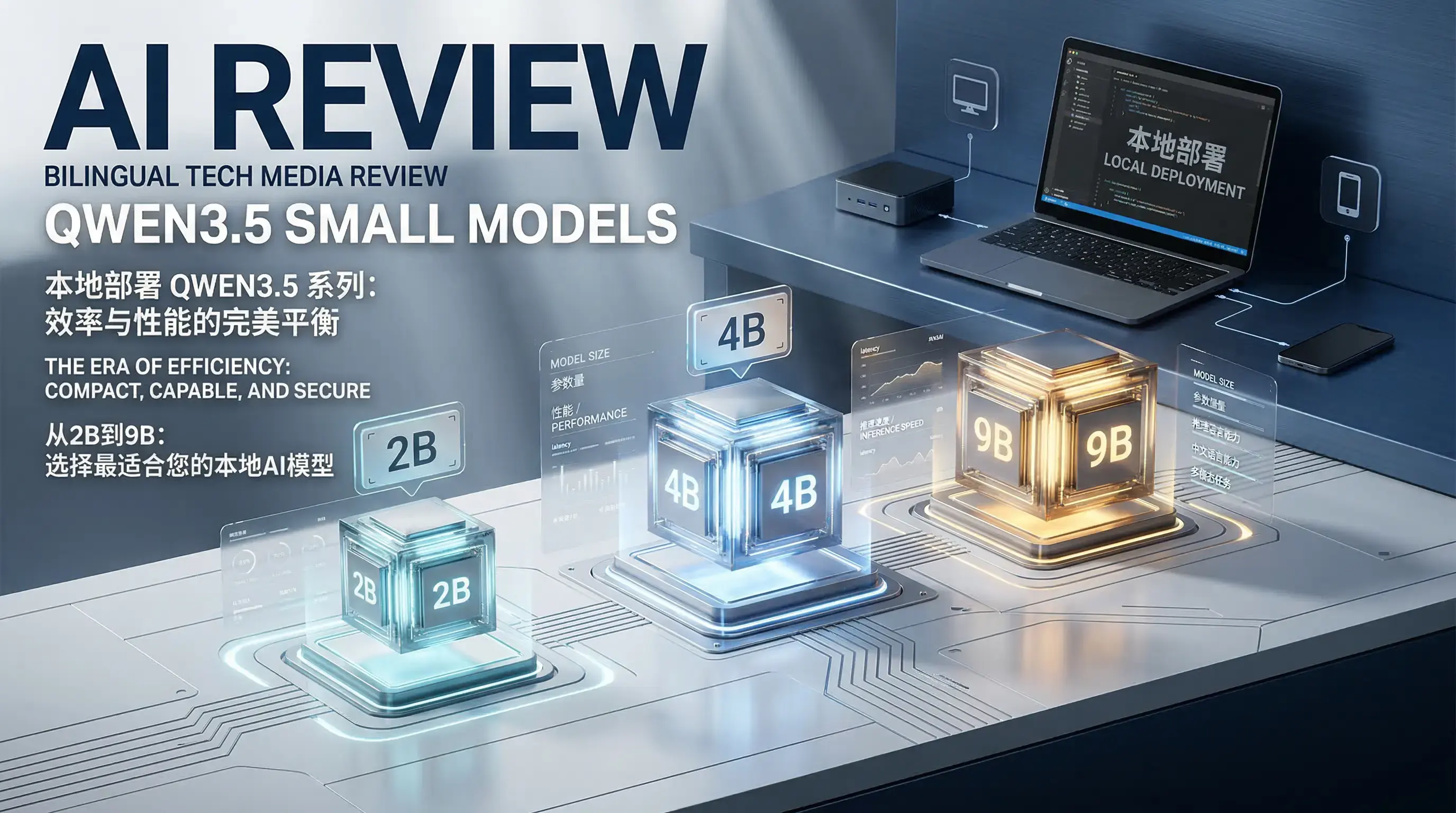
Most model launches bury you in one giant headline number. Qwen3.5 is more interesting than that. The small series, released on March 2, 2026, gives you three practical choices that matter for real local deployment: 2B, 4B, and 9B.
That sounds simple. It is not. The 2B is not just a weaker 4B. The 9B is not just a faster alternative to a larger flagship. These three models sit in different parts of the tradeoff curve, and if you pick the wrong one, you either waste hardware or accept a quality drop you did not need.
This review is based on the official Qwen3.5 release materials, model cards, and technical documentation published between February 16 and March 2, 2026. I am not pretending all three were benchmarked on every laptop and GPU under the sun. The goal here is narrower and more useful: figure out which model makes sense for actual use.
What Qwen3.5 Small Gets Right
The first thing worth saying is that Alibaba did not ship these as stripped-down text-only leftovers. According to the official Qwen3.5 blog and model cards, all three models are natively multimodal, Apache 2.0 licensed, support 201 languages and dialects, and ship with a 262,144-token native context window. The 4B and 9B can also stretch to about 1 million tokens with YaRN-style extension.
That changes the framing. You are not choosing between a toy model and a serious one. You are choosing between three different classes of deployable multimodal agent.
Here is the quick spec view:
| Model | Parameters | Native context | Extended context | Positioning |
|---|---|---|---|---|
| Qwen3.5-2B | 2B | 262K | No official 1M extension in model card | entry point for lightweight local agents |
| Qwen3.5-4B | 4B | 262K | up to about 1.01M | balanced local multimodal default |
| Qwen3.5-9B | 9B | 262K | up to about 1.01M | strongest compact reasoning option |
The second thing it gets right is architecture. Qwen3.5 uses the same broader family direction described in the official GitHub repo and the Qwen3 technical report: hybrid attention, multimodal training, and a unified thinking or non-thinking workflow instead of splitting the family into separate chat and reasoning products. That is not just a research detail. It affects latency, quality, and how predictable the model feels in daily use.
Qwen3.5-2B: Better Than a Demo Model, Still a Compromise
If you only looked at the parameter count, you might assume the 2B exists mainly for demos and edge cases. The official numbers say otherwise.
On the Qwen3.5-2B model card, the model reaches 66.5 on MMLU-Pro in thinking mode and 79.6 on MMLU-Redux. Those are not flagship scores, but they are strong enough to make the model useful for summarization, OCR-heavy workflows, basic tool use, lightweight assistants, and small multimodal agents.
The vision side is the bigger surprise. Qwen3.5-2B posts 64.2 on MMMU, 50.3 on MMMU-Pro, 76.7 on MathVista mini, and 74.5 on RealWorldQA in the official table. For a 2B model, that is the kind of result that makes people start talking about on-device AI seriously again.
Still, this is where the limits show up fast:
- complex reasoning falls off much sooner than on 4B or 9B
- coding is usable for short tasks, not something I would trust for bigger repo work
- long-context support exists on paper, but smaller models tend to feel weaker when the prompt gets messy
My read is simple. The 2B is the one you pick when deployment constraints come first. If your device budget is tight, if you need something that can sit inside a lightweight local app, or if you care more about cost and responsiveness than deep problem-solving, it makes sense. If quality is the main goal, it stops being the best option quickly.
Qwen3.5-4B: The Sensible Default for Most People
The 4B looks like the real sweet spot.
This is the model I would recommend first to most developers who want a local Qwen3.5 setup without jumping straight into the heavier 9B. It is large enough to feel capable, small enough to stay practical, and broad enough to cover text, image, and video use cases without turning every prompt into a hardware planning problem.
The official model card is strong here. Qwen3.5-4B scores:
- 79.1 on MMLU-Pro
- 76.2 on GPQA Diamond
- 57.0 on AA-LCR
- 55.8 on LiveCodeBench v6
- 79.9 on TAU2-Bench
That is a serious profile for a 4B model. It does not dominate every category, but it does not embarrass itself anywhere important either.
The vision numbers are even more telling. Qwen3.5-4B posts 66.3 on MMMU-Pro, 74.6 on MathVision, 85.1 on MathVista mini, and 83.3 on DynaMath. Those are not “good for a small model” scores. They are just good.
This matters because many local models still force you to choose one specialty. You either get decent language performance or decent visual understanding. The 4B tries to avoid that split. For document analysis, visual reasoning, OCR-adjacent tasks, lightweight UI understanding, and general multilingual work, it looks like the most rounded member of the trio.
If I had to give one blunt recommendation, it would be this: start with 4B unless you already know why you need 2B or 9B.
Qwen3.5-9B: The Compact Power Model
The 9B is where Qwen3.5 stops feeling like a “small model series” and starts feeling like a real challenge to much larger open models.
The official model card gives it 82.5 on MMLU-Pro, 81.7 on GPQA Diamond, 63.0 on AA-LCR, 65.6 on LiveCodeBench v6, and 66.1 on BFCL-V4. Those are the numbers that change buying decisions. You can argue about benchmark choice all day, but the shape is clear: the 9B pushes into territory where a local compact model starts replacing cloud calls for more serious work.
The multimodal side is even more aggressive. Qwen3.5-9B scores 70.1 on MMMU-Pro and 78.9 on MathVision, beating the numbers listed in its own table for GPT-5 Nano and Gemini 2.5 Flash-Lite on those tasks. The official README also shows 84.5 on Video-MME and 86.8 on OCRBench. That tells you what this model wants to be: not a tiny assistant, but a compact multimodal worker.
There is a price for that jump:
- hardware demands are noticeably less forgiving
- quantization choices matter more
- latency matters more, especially when thinking mode is enabled
So the 9B is not “better” in a vacuum. It is better when the task deserves it. If you want the strongest small Qwen3.5 for local reasoning, multimodal document work, code help, and agent-style workflows, this is the one. If you mainly want a responsive daily local assistant, 4B still feels like the cleaner value.
Real-World Choice: Who Should Run Which One?
Here is the practical split.
Pick 2B if:
- you care most about fitting into modest local hardware
- you are building mobile, embedded, or low-cost local products
- your workload is mostly OCR, extraction, classification, short summaries, or simple chat
Pick 4B if:
- you want one local model that does almost everything reasonably well
- you need multimodal support but do not want 9B-level resource demands
- you care about value more than chasing the highest benchmark number
Pick 9B if:
- you want the strongest small Qwen3.5 available today
- you expect real reasoning, coding, or more demanding multimodal tasks
- you are replacing API usage, not just experimenting locally
That is why this lineup works. Each model has a real job.
Pros and Cons
Qwen3.5-2B
Pros
- easiest entry point into local Qwen3.5
- strong multimodal performance for its size
- good fit for constrained environments
Cons
- reasoning ceiling arrives early
- coding ability is limited for serious use
- harder to justify if you already have room for 4B
Qwen3.5-4B
Pros
- best balance in the family
- strong language and vision numbers without heavy hardware pressure
- easiest recommendation for general local use
Cons
- not dramatically lighter than 2B in some workflows once you quantize well
- still behind 9B in tougher reasoning and coding
Qwen3.5-9B
Pros
- strongest compact option in the series
- excellent multimodal reasoning profile
- good case for replacing some cloud usage
Cons
- noticeably heavier to run locally
- less forgiving on slower machines
- can be overkill for simple assistant use
Final Verdict
The best part of this release is that Alibaba did not force everyone toward one “recommended” size. The 2B, 4B, and 9B each justify their existence.
If you want the shortest version of this review, here it is:
- 2B is the budget pick
- 4B is the smart default
- 9B is the performance pick
My final ranking is based on usefulness, not bragging rights.
| Model | Features | Performance | Value | Ease of Local Use | Overall |
|---|---|---|---|---|---|
| Qwen3.5-2B | 7.5/10 | 7/10 | 8.5/10 | 9/10 | 7.8/10 |
| Qwen3.5-4B | 8.8/10 | 8.6/10 | 9.2/10 | 8.6/10 | 8.8/10 |
| Qwen3.5-9B | 9.2/10 | 9.2/10 | 8.4/10 | 7.4/10 | 8.7/10 |
The winner for most people is Qwen3.5-4B. The winner if you want the strongest small model is Qwen3.5-9B. The winner if you need to squeeze AI into tight local budgets is Qwen3.5-2B.
That is a good lineup. More importantly, it is a useful one.
Related Reading
- Alibaba Releases Qwen3-Max: Flagship Open-Source Thinking Model Goes Head-to-Head with DeepSeek-R1
- Qoder Launches Custom Model Qwen-Coder: Can Vertical AI Coding Tools Really Beat General Models?
Sources
Reader Dispatches
No reader responses yet. Share your technical perspective below.
Related Posts
Claude Opus 4.6 Explained: 1M Context, Benchmark Claims, Pricing and Who Should Use It
What Anthropic's Claude Opus 4.6 changed: a 1M-token context window in beta, its reported benchmark results, API pricing, new developer controls, and when it is worth using over cheaper models.
Qoder's Gambit: Can a Custom-Trained 'Agentic' Model Dethrone Cursor?
Qoder releases Qwen-Coder-Qoder, a custom model for agentic coding claiming to outperform Cursor Composer-1. Here's the 'Rewarder-Attacker' training methodology and what it means for developers.
Z-Image: Why Tongyi's New 10B Parameter Model Matters for Power Users
Move over Turbo models. Tongyi-MAI's Z-Image is a 10B parameter, undistilled Single-Stream Diffusion Transformer designed for serious fine-tuning and complex workflows. Here is the deep dive.