FLUX.2 Klein Review: The Speed King of Open Source AI Art
Black Forest Labs releases the FLUX.2 Klein series, unifying text-to-image and editing in one compact model. A guide to the 4B and 9B versions, what they are designed for, and how to get started.
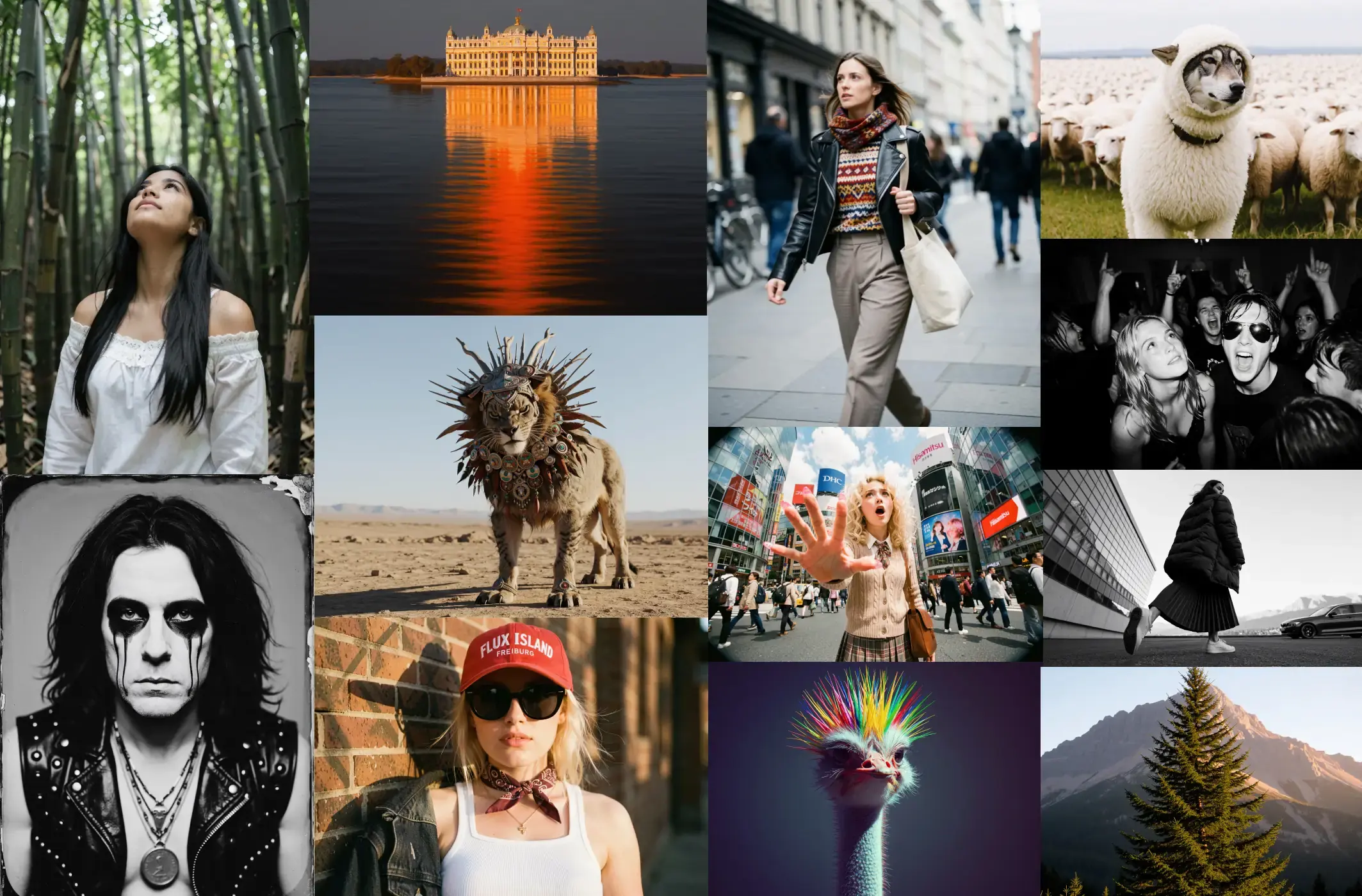
If 2025 was the year FLUX.1 took the open-source community by storm, 2026 kicks off with Black Forest Labs (BFL) releasing the FLUX.2 Klein series.
“Klein” is German for “small.” As the name suggests, BFL isn’t chasing massive parameter counts this time. Instead, they focus on efficiency, speed, and consumer hardware compatibility.
In short: Klein trades parameter count for speed and lower memory use, which makes it a strong candidate for designers who want fast local generation and editing on consumer GPUs.
1. Buying Guide: Which Version Should You Get?
Navigating Hugging Face or Draw Things, you’ll see a confusing array of filenames: 4B, 9B, Base, Distilled, FP8… Here’s the “Too Long; Didn’t Read” version.
❌ Skip the ‘Base’ Version (Unless You’re a Researcher)
Files labeled Base are non-distilled checkpoints. They default to 50 inference steps, meaning a single image can take over 30 seconds to generate. These are intended for fine-tuning and training LoRAs, not for daily use.
✅ Get the 9B Distilled Version (Recommended)
For 90% of users, the 9B 6-bit Distilled version is the sweet spot.
- Speed: Generates images in just 4 steps!
- VRAM: Consumes about 7-8GB VRAM (FP8 version is even smaller), running comfortably on an RTX 3060/4060.
- Quality: Despite being “distilled,” the 9B model retains the rich details and lighting physics of the original architecture, far surpassing the 4B variant.
⚠️ Is the 4B Version Worth It?
The 4B version (approx. 3-4GB) is ultra-lightweight and fast, but it sacrifices semantic understanding and fine detail compared to the 9B. Unless you are strictly limited by VRAM (< 6GB), use the 9B.
2. Core Features
🚀 Speed: Fast Performance
Generation time depends heavily on hardware, precision and step count; the distilled versions are designed to need only a few steps. On high-end NVIDIA hardware (RTX 4090/5090), BFL claims sub-second inference. This brings the “real-time painting” experience from the cloud down to your local machine.
⚙️ Hardcore Architecture: NVFP4 & Future Hardware
BFL isn’t just releasing a small model; they’re showcasing their ambition for next-gen hardware. FLUX.2 Klein is deeply optimized for NVIDIA’s latest Blackwell Architecture (RTX 50 Series), supporting NVFP4 (4-bit Floating Point) quantization. What does this mean? Compared to traditional INT4 quantization, FP4 offers a wider dynamic range, compressing VRAM usage to the extreme without sacrificing precision. Theoretically, the 9B model in FP4 format can fit comfortably into 8GB VRAM, with inference speeds doubling that of FP16.
🔥 Key Feature: Unified Generation & Editing
This is where Klein stands out. It employs a Unified Diffusion Pipeline, breaking the barrier between generation and editing.
1. Maskless Smart Editing
You can type a prompt like “change the background to a beach” or “swap the soda for a coffee,” and it modifies the original image directly without complex masking pipelines. This improves efficiency for creative workflows.
2. Multi-Reference Editing
This is a useful feature. Klein supports inputting multiple reference images simultaneously. For example, you can feed it a “product image” and a “style reference (e.g., cyberpunk).” It extracts the tone and lighting from the style image and applies it perfectly to the product while preserving its structure. This Latent Injection technique makes complex lighting integration far more natural than traditional ControlNet.
📝 Text Capabilities: A Mixed Bag
It uses the Qwen Text Encoder, so it understands prompts well.
- Pros: Good understanding of complex scene descriptions. Renders English text (e.g., on signs or shirts) incredibly well—even better than FLUX.1.
- Cons: Do not ask it to write Chinese characters. While it understands Chinese prompts, its ability to render Hanzi structure is still non-existent. For Chinese typography, the Qwen-Image family is still the king.
3. Klein 9B vs. Qwen Image Edit 2511: What to Compare
Qwen Image Edit 2511 is the obvious open-source alternative for editing. Rather than relying on anyone’s sample images, compare them on your own material in the areas where small, fast models typically differ:
- Character consistency: face identity across edits and multi-person scenes.
- Style and IP recognition: anime and illustration styles, where training data mix matters.
- Anatomy: hands and fingers, still a common weakness of image models.
- Product and lighting work: reflections, transparency (ice, glass, water) and colour temperature after background swaps, which is where BFL positions Klein.
- Text in images: Chinese characters in particular, where the Qwen-Image family has a strong reputation.
Run the same prompts and reference images through both and keep the one that needs fewer retries for your use case.
4. Developer Guide: Getting Started
For developers, BFL provides a developer-friendly integration path.
Python (Diffusers)
If you prefer Python, you can quickly load the 9B Distilled version via the diffusers library:
import torch
from diffusers import Flux2KleinPipeline

# Load 9B Distilled Version
pipe = Flux2KleinPipeline.from_pretrained(
    "black-forest-labs/FLUX.2-klein-9B-distilled",
    torch_dtype=torch.bfloat16
)
pipe.enable_model_cpu_offload()

# Text-to-Image
image = pipe(
    "A futuristic cyberpunk city with neon lights",
    num_inference_steps=4,  # Only 4 steps needed
    guidance_scale=1.0
).images[0]
Commercial Licensing
It’s worth noting that the 4B version uses the Apache 2.0 license, meaning you can use it freely for commercial projects, SaaS services, or even closed-source products. This is a huge win for indie studios.
Verdict
FLUX.2 Klein 9B is not a jack-of-all-trades. But in its home turf—commercial photography and realistic editing—it performs very well.
- E-commerce Designers: Consider the 9B Distilled version. It can save you hours of Photoshop work.
- Anime Fans: Use NAI or Pony models; Klein isn’t for you.
- Typography Needs: Use Qwen or Ideogram for text-heavy designs.
Black Forest Labs has made a clear choice: instead of chasing parameter counts, they optimized for efficiency and workflow. The Klein series marks the beginning of a “Pragmatic AI” era in open-source art.
References:
Reader Dispatches
No reader responses yet. Share your technical perspective below.
Related Posts
Z-Image Turbo Explained: Alibaba's 6B Open Image Model, 8-Step Generation and Its Limits
An explainer on Z-Image Turbo from Alibaba's Tongyi-MAI team: the 6B S3-DiT architecture, Decoupled-DMD distillation, how to run it with diffusers, use cases and limitations, based on the official model card.
What Is AIGC? A Plain-English Map of AI, Machine Learning, Deep Learning, Generative AI, and LLMs
Stop getting lost in buzzwords. This guide explains how AIGC (Generative AI), AI, ML, DL, and LLMs fit together, plus a practical checklist for choosing tools without getting burned.
AI Video Generation Enters 'Director Mode': The 2026 Evolution from Single Shots to Multi-Scene Orchestration
In 2026, AI video tools evolve from generating clips to orchestrating multi-scene narratives with character persistence and story awareness.