Midjourney V7 vs DALL-E 4: AI Image Generation Tools Comparison Review
Midjourney V7 and DALL-E 4 are the most prominent AI image generation tools in 2026. This article provides a comprehensive comparison across image quality, user experience, features, and use cases to help professional creators make informed choices.
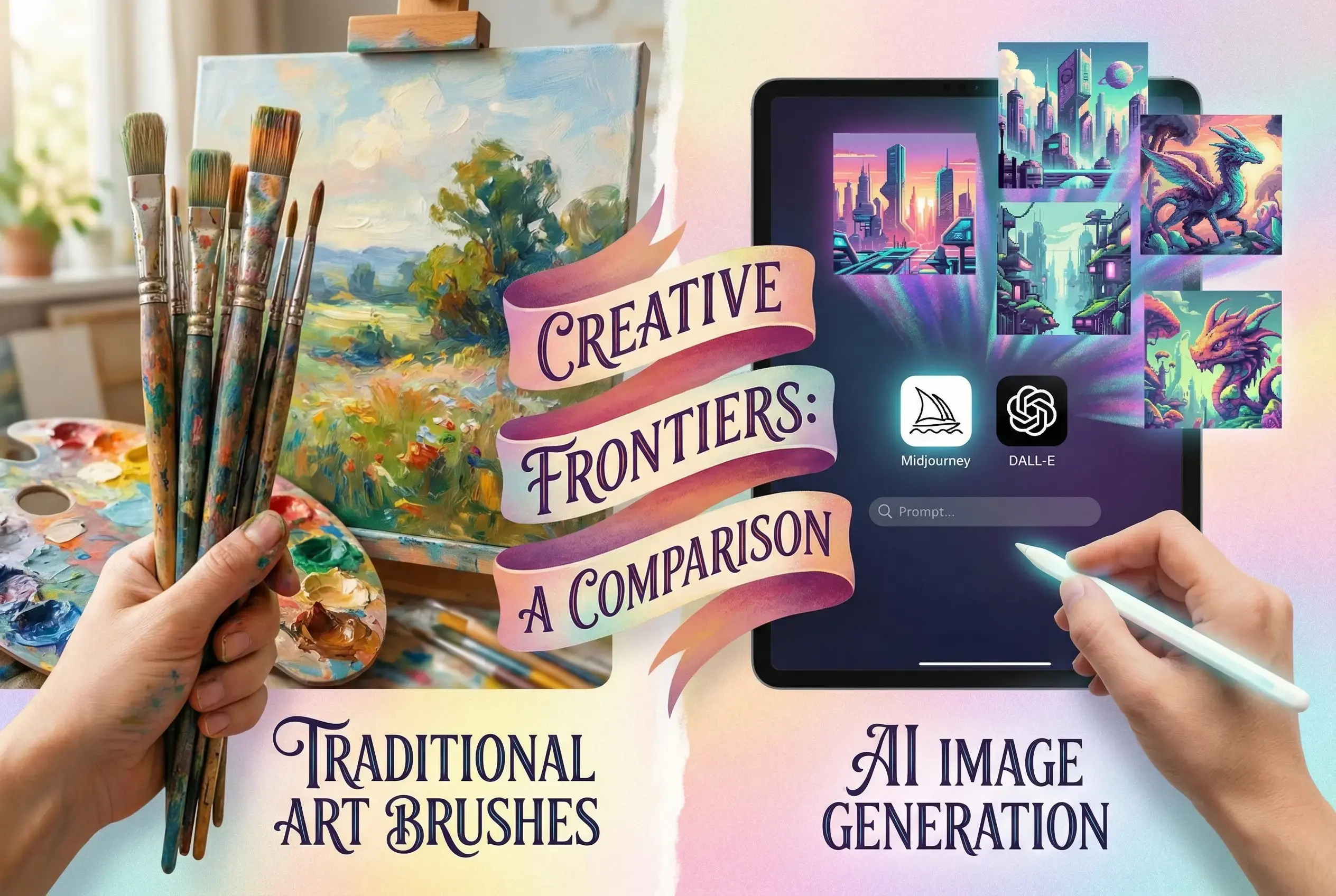
The AI image generation field in 2026 presents an unprecedented level of development. From initial proof-of-concept tools to becoming indispensable key components in professional creative workflows, AI image generators have completed a qualitative leap. In this technological revolution, Midjourney and OpenAI’s DALL-E are undoubtedly the two dominant forces—they represent fundamentally different creative philosophies and technical approaches.
One is an artist’s canvas, pursuing visual stunning effects and emotional resonance; the other is a precise production tool, emphasizing accurate execution of instructions and seamless system integration. The answer to “which is better” often depends on your use case and work requirements. This article provides an in-depth comparison across multiple dimensions to help professional creators make informed choices.
Image Quality and Artistic Expression
Midjourney V7 continues to maintain a leading position in artistic expression. According to latest test data, the V7 version has achieved astonishing precision in understanding text and image prompts, while significantly improving image quality—textures are richer, and details are more coherent. V7 introduces several powerful features, including Omni Reference, Draft Mode, Personalization, and a completely revamped Style Reference system.
Midjourney’s core advantage lies in its powerful and distinctly characteristic aesthetic style. It can create images that are not only accurate but also emotionally rich and visually stunning. For mood boards, brand exploration, and high-concept advertising creatives, its output quality is consistently excellent. However, this “art-first” design philosophy also brings some challenges—Midjourney often prioritizes aesthetics over literal instructions, which can frustrate users when complex prompts involve specific object placement, text, or subtle character expressions.
DALL-E 4 (integrated into GPT-4o) has taken a different path. According to OpenAI’s official introduction, the 4o image generation excels in accurately rendering text, precisely following prompts, and leveraging 4o’s inherent knowledge base and conversational context. DALL-E’s image quality has significantly improved—while its output is sometimes criticized for “lacking artistic spark,” this predictability becomes an advantage for professional application scenarios requiring precise execution.
User Experience and Workflow
There are significant differences in user interface and workflow between the two. Midjourney has long relied on Discord as its user interface, which is a significant operational barrier for many professional teams—feeling disconnected from standard design software. Its workflow leans more toward “guided exploration” rather than precise control, requiring users to iterate through features like “remix” and “pan/zoom.”
DALL-E’s biggest advantage is its seamless integration with the ChatGPT interface and powerful API support. Through a conversational interface, users can naturally “talk with AI” to refine images, which significantly lowers the barrier to entry. Its built-in inpainting and outpainting features provide more controllable editing workflows than Midjourney.
Feature Comparison
| Feature Dimension | Midjourney V7 | DALL-E 4 |
|---|---|---|
| Artistic Style | Unique and stunning | Precise but more standardized |
| Text Rendering | Weak, often garbled | Excellent, text clearly readable |
| Prompt Accuracy | Tends toward artistic interpretation | Strictly follows instructions |
| API Integration | Limited | Complete and powerful |
| Editing Features | Remix, pan/zoom | Inpainting, outpainting |
| Learning Curve | Higher | Lower |
Pricing and Accessibility
Both platforms offer paid subscription services. Midjourney’s subscription plans provide different tiers of image generation quotas, while DALL-E provides full access through ChatGPT Plus subscription ($20/month). Free users on DALL-E only get limited image generation credits.
A note on naming
OpenAI does not market a product called “DALL-E 4”. Its current image generation in ChatGPT launched as “4o image generation”, and the API exposes it as GPT Image models (starting with gpt-image-1) alongside older DALL-E models (OpenAI). “DALL-E 4” in this article is shorthand for that newer generation of OpenAI image models.
Midjourney plans in detail
Midjourney’s plan comparison lists four subscriptions: Basic at $10 per month, Standard at $30, Pro at $60 and Mega at $120, with a 20% discount for annual billing. The differences that matter in practice:
- Fast GPU time: about 3.3 hours a month on Basic, 15 on Standard, 30 on Pro and 60 on Mega. Extra time costs $4 per hour.
- Relax mode: unlimited, slower image generation from Standard upward; Basic has none, so it runs out once Fast time is used.
- Stealth mode: only on Pro and Mega. Without it, images made on the website are publicly visible. Even with it on, creations made in public Discord channels stay visible (Stealth Mode).
- Company use: paid subscribers can use images commercially, but a company with more than $1 million in annual gross revenue must be on Pro or Mega.
For client or unreleased product work, the privacy and revenue rules usually make Pro the practical minimum.
OpenAI’s API options
For developers, OpenAI’s image generation guide describes two routes. The Image API has a generations endpoint and an edits endpoint that can take a mask, where transparent areas mark the region to change. The Responses API treats image generation as a tool inside a conversation, which suits multi-turn editing. Some organisations must complete verification before using GPT Image models. OpenAI says generated images carry C2PA provenance metadata (OpenAI).
Midjourney, by contrast, is mainly used through its website and Discord, which makes it harder to build into automated pipelines.
Use Case Recommendations
Best Cases for Choosing Midjourney V7
- Brand Design and Advanced Creative: When you need to create unique and memorable visual identities, Midjourney’s artistic engine is unparalleled
- Concept Art and Mood Boards: For exploring aesthetics, developing brand worlds, and creating high-impact hero images
- Designers Seeking Artistic Inspiration: Its output provides a richer foundation for building unique style guides
Best Cases for Choosing DALL-E 4
- Marketing Advertising Materials: DALL-E’s superiority is evident when you need precise text overlay and quick A/B testing variants
- SaaS and Product Teams: Need UI mockups, feature icons, and visual materials for user guidance flows
- Developer and Automation Needs: API allows programmatic visual asset generation to build automated content pipelines
- Non-Design Background Users: Conversational interface and predictable output lower the barrier to entry
Conclusion
The AI image generation field in 2026 has no absolute “best” tool—only the choice best suited for specific tasks. Midjourney V7 is ideal for creators who treat the image itself as the final product—it is the preferred choice for artists, brand strategists, and creative directors pursuing unparalleled visual impact. DALL-E 4 is the top choice for users who treat images as components of a larger system—it is the first choice for marketers, developers, and product managers who need reliable, scalable, and integrable tools.
Notably, many professional teams have already begun using both tools simultaneously. They use Midjourney for creative ideation and style exploration, then use DALL-E for production and scaling. This combination strategy may represent the future direction of AI image generation workflows.
Reader Dispatches
No reader responses yet. Share your technical perspective below.
Related Posts
AI Video Generation Enters 'Director Mode': The 2026 Evolution from Single Shots to Multi-Scene Orchestration
In 2026, AI video tools evolve from generating clips to orchestrating multi-scene narratives with character persistence and story awareness.
Meta Muse Image: The Social Media Giant's First AIGC Model Arrives with a Privacy Catch
Meta Superintelligence Labs launches Muse Image, its first in-house AI image generator. Free, integrated across Instagram and WhatsApp, and built to reason through prompts — but the way it taps into public Instagram photos has raised eyebrows.
AI Image Generators Compared: Midjourney vs OpenAI Image Generation vs Stable Diffusion
How Midjourney, OpenAI's image generation in ChatGPT and the API, and open-weight Stable Diffusion differ in workflow, control, licensing and cost model, based on official documentation, with a guide to choosing.