July 2026 AI Model Releases Compared: GPT-5.6, Grok 4.5, Muse Spark 1.1 and GLM-5.2
OpenAI's GPT-5.6 family, Grok 4.5, Meta's Muse Spark 1.1 and Z.ai's open-weight GLM-5.2 arrived within weeks of each other. What each vendor announced, official pricing, availability, and the GhostApproval security disclosure, with sources.
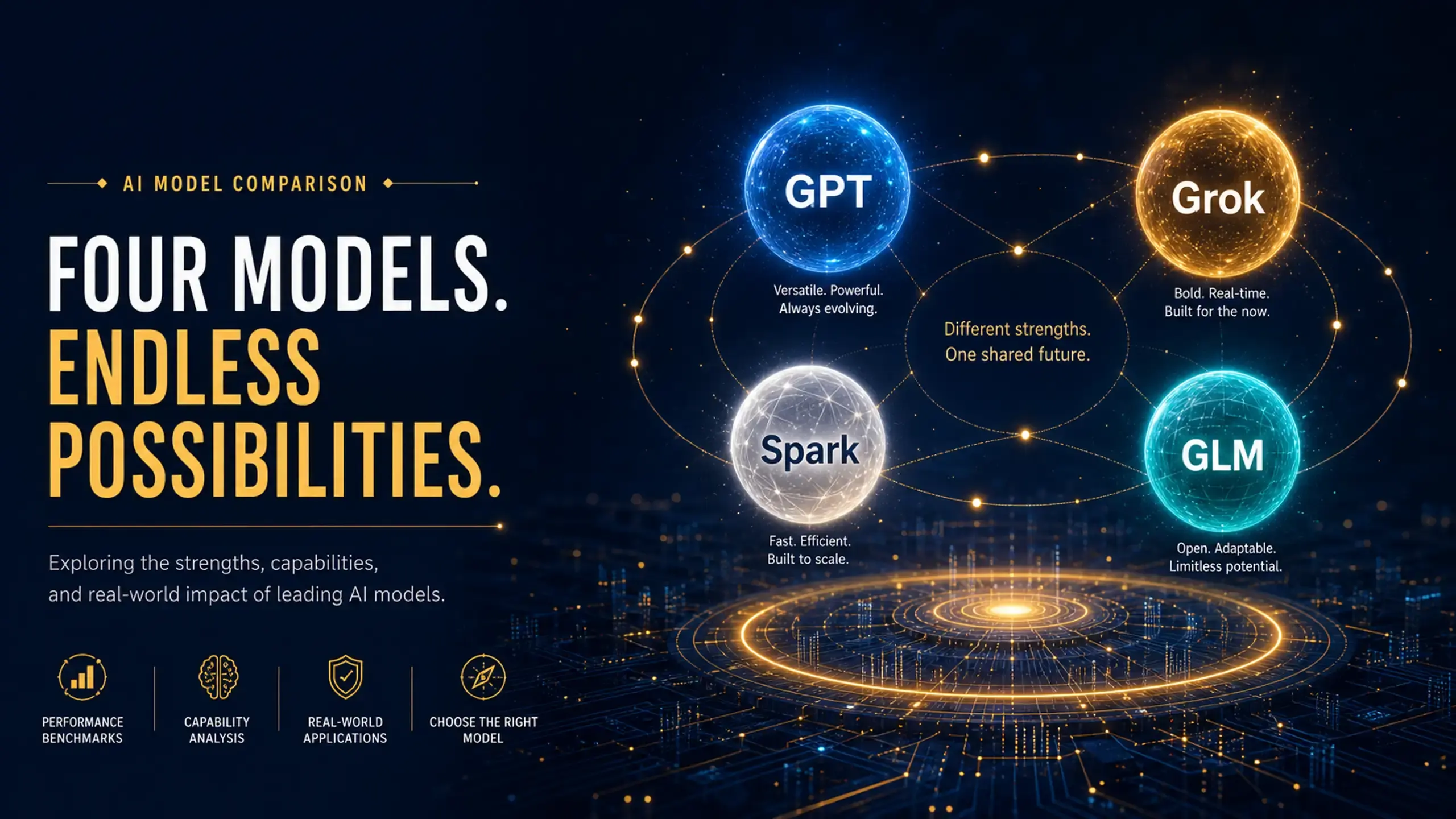
Bottom line: In early July 2026, OpenAI (GPT-5.6 and ChatGPT Work), Cursor and SpaceXAI (Grok 4.5) and Meta (Muse Spark 1.1) all shipped major models within two days, a few weeks after Z.ai released the open-weight GLM-5.2. They differ less in raw claims than in pricing, where you can use them, and whether you can self-host. All benchmark claims below are the vendors’ own; independent results vary by task.
The releases at a glance
| Model | Vendor | Date | Official API pricing (per 1M tokens, at launch) | Where to use it |
|---|---|---|---|---|
| GPT-5.6 Sol / Terra / Luna | OpenAI | July 9, 2026 | Sol $5 in / $30 out; Terra $2.50 / $15; Luna $1 / $6 | ChatGPT, Codex, OpenAI API |
| Grok 4.5 | Cursor with SpaceXAI | July 8, 2026 | $2 in / $6 out; Fast $4 / $18 | Cursor (all surfaces), Grok Build, SpaceXAI console |
| Muse Spark 1.1 | Meta | July 9, 2026 | From $1.25 in / $4.25 out | Meta AI app, Meta Model API (US public preview) |
| GLM-5.2 | Z.ai | June 16, 2026 (open weights) | Open weights under MIT; also via Z.ai API | Self-hosted or Z.ai |
Prices change: OpenAI later cut Luna and Terra prices and temporarily discounted Sol, according to updates on its GPT-5.6 post. Always check the current pricing page.
GPT-5.6 and ChatGPT Work
OpenAI’s GPT-5.6 announcement introduces three durable tiers: Sol (flagship), Terra (balanced, which OpenAI says is competitive with GPT-5.5) and Luna (fastest and cheapest). It also adds an ultra setting that coordinates multiple agents in parallel. On the same day, OpenAI launched ChatGPT Work, an agent that works across connected apps and files to produce documents, spreadsheets, slides and web apps, and can run scheduled tasks.
Who it suits: teams that want one vendor for chat, coding (Codex) and cross-app agents.
Grok 4.5
Cursor’s announcement describes Grok 4.5 as a joint model with SpaceXAI for long-running tasks in software engineering and other computer work. Cursor’s paid plans include usage from a shared pool, with per-token pricing beyond that. Axios reported it was not yet available in the EU at launch. Cursor’s docs now point to newer Grok versions for longer-running work.
Who it suits: developers already working in Cursor who want a strong model at a low per-token price.
Muse Spark 1.1
Meta’s announcement positions Muse Spark 1.1 as a multimodal reasoning model for agentic tasks, tool and computer use, and coding. It launched alongside a public preview of the Meta Model API for US developers, which is compatible with OpenAI- and Anthropic-style SDKs, according to Meta’s developer blog.
Who it suits: US developers who want a low-cost multimodal model and can work with a preview API.
GLM-5.2
Z.ai’s GLM-5.2 post highlights a 1M-token context for long-horizon tasks, multiple thinking-effort levels, and an MIT license, with weights on Hugging Face. Reuters reported growing interest from Western startups alongside data-security concerns. Self-hosting avoids sending data to Z.ai but needs substantial GPU capacity; Tech Times cites roughly 1.5 TB of GPU memory at full precision.
Who it suits: teams that need control over weights and data and have the infrastructure to run a very large model.
Security note: GhostApproval
On July 8, 2026, Wiz Research disclosed GhostApproval, a pattern affecting six AI coding assistants (Amazon Q Developer, Claude Code, Augment, Cursor, Google Antigravity and Windsurf). A malicious repository can make an approved file edit land outside the workspace through a symbolic link, while the confirmation prompt shows only a harmless-looking file name. According to The Register and the Cloud Security Alliance research note, Amazon, Cursor and Google shipped fixes, Augment and Windsurf had not at disclosure, and Anthropic disputed the classification while adding a symlink warning.
Practical advice: update your coding tools, be cautious when opening untrusted repositories with an agent, and treat approval prompts as only as reliable as the information they show.
Comparing them fairly
Four launches in a few weeks make it tempting to compare headline benchmarks, but the vendors used different tests and settings. A more useful comparison looks at cost per finished task and at the conditions around each model:
- Price per task, not per token. A cheaper model that needs three attempts can cost more than an expensive one that succeeds first time. Measure total tokens for a few complete tasks.
- Reasoning settings. GPT-5.6’s
ultramode and GLM-5.2’s thinking-effort levels change both quality and cost. Compare models at the setting you would actually use. - Availability and region. Grok 4.5 was not available in the EU at launch, and the Meta Model API started as a US-only preview. Check that a model is offered where your users are.
- Data handling. Using a hosted API sends prompts to that vendor. Self-hosting open weights avoids this but moves the cost to hardware and operations.
- Lock-in. Muse Spark’s API accepts OpenAI- and Anthropic-style SDK calls, and Cursor lets you switch models per request. Tools that make switching easy reduce the risk of committing early.
How to choose
- Lowest cost inside an editor: Grok 4.5 in Cursor.
- Broad agent work across business apps: GPT-5.6 with ChatGPT Work.
- Self-hosting and data control: GLM-5.2, if you have the hardware.
- Low-cost multimodal API (US): Muse Spark 1.1, keeping in mind it is a preview.
Whatever you pick, run a few of your own tasks before committing; vendor benchmarks rarely match a specific codebase or workflow.
FAQ
Are these prices still valid? Not necessarily. The table shows official prices at launch, and OpenAI has since changed prices for some GPT-5.6 tiers. Check each vendor’s current pricing page before buying.
Do open weights mean unrestricted commercial use? GLM-5.2 uses the MIT licence, which has very few conditions. If you use Z.ai’s hosted API instead, your data passes through its service, which needs a separate compliance review.
Can vendor benchmark scores be trusted? Treat them as a starting point. Vendors choose the test conditions, so compare a few candidates on your own tasks under the same settings.
Reader Dispatches
No reader responses yet. Share your technical perspective below.
Related Posts
Runway Media Router Review: Smart Model Routing Comes to Generative Media
Runway's new Media Router automatically picks the best image, video, or audio model based on quality, speed, and cost. Here's how it works, who it's for, and what it says about where the generative AI industry is heading.
Adobe's Project Indigo Now Critiques Your Photos — and the AI Is Surprisingly Opinionated
Adobe's experimental camera app adds LLM-powered photo critique, one-tap object removal, and style transfer. But the real story is why the former Pixel camera lead is betting against prompt-based editing.
Claude Cowork Review: Anthropic's Agent Goes Mobile and Learns by Watching You Work
Claude Cowork now runs on your phone, keeps working when you close your laptop, and can learn new tasks by watching your screen recordings. Here's what actually works and what doesn't.