U.S. Government Halts Use of Anthropic as OpenAI Signs Pentagon AI Agreement
In February 2026, the U.S. government moved to stop using Anthropic's products after a dispute over usage restrictions, and OpenAI signed an agreement with the Defense Department. What happened and what it means for AI governance.
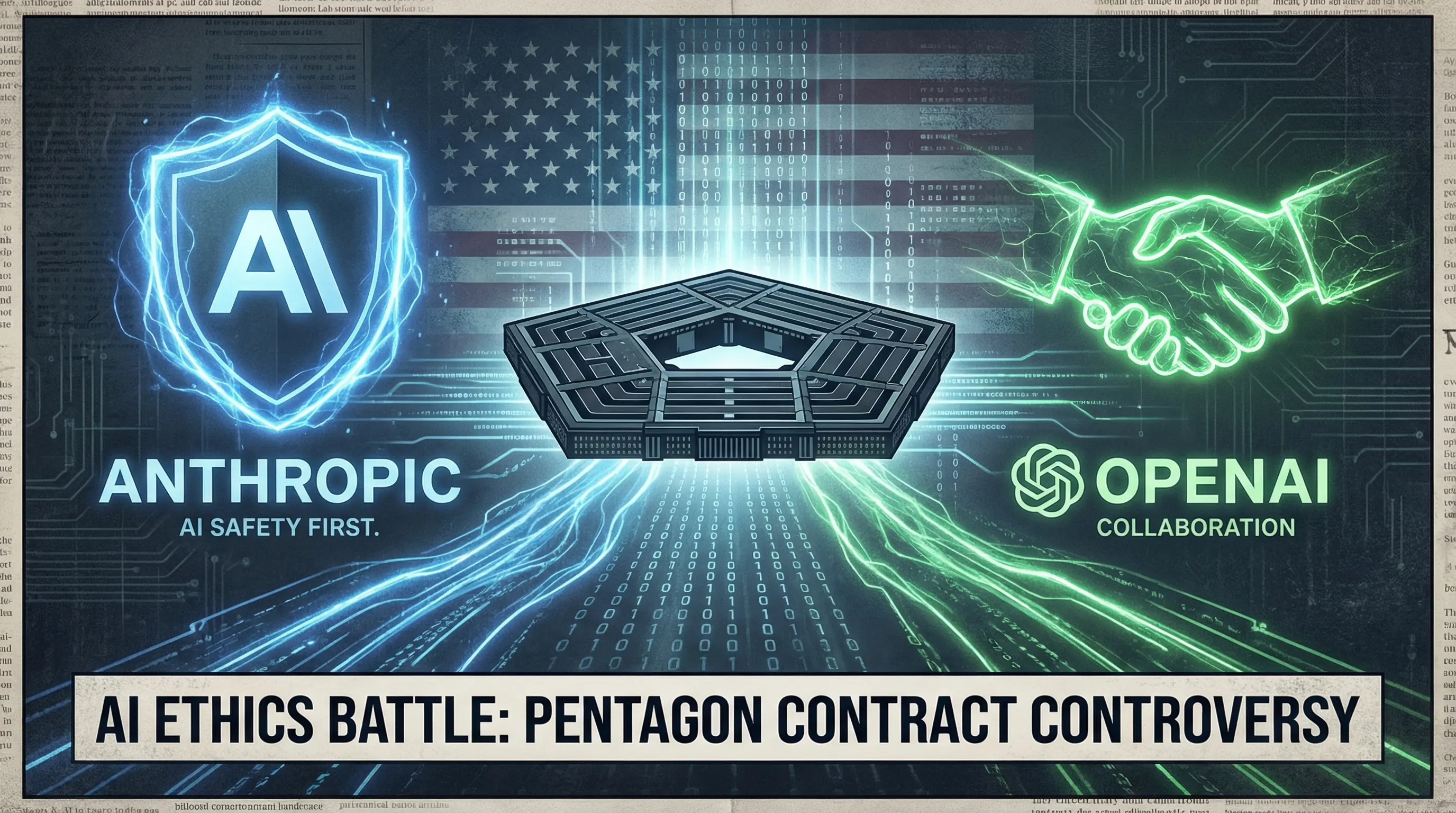
On February 27, 2026, the AI industry experienced a seismic shift. President Trump ordered all federal agencies to stop using Anthropic’s AI technology. Hours later, OpenAI announced an agreement with the Pentagon. This sudden upheaval stemmed from two “red lines” in a military contract.
Anthropic insisted on prohibiting its Claude model from being used for mass domestic surveillance and fully autonomous weapons systems. The Pentagon demanded unrestricted access for “all lawful purposes.” After negotiations collapsed, Defense Secretary Pete Hegseth designated Anthropic as a “national security supply chain risk,” a label previously reserved for foreign adversaries.
Two Usage Restrictions at the Center of the Dispute
According to multiple reports, the conflict centered on a key phrase in the contract: “all lawful purposes.” This language transferred final interpretation of the AI model’s application scope from the technology provider to administrative agencies.
Anthropic CEO Dario Amodei stated in a public announcement that Claude has been widely deployed across critical Defense Department missions, including intelligence analysis, operational planning, and cyber operations. However, the company maintained two restrictions: prohibition of use for mass domestic surveillance of Americans and prohibition of use for fully autonomous lethal weapons.
“We cannot in good conscience agree to the Department’s demands,” Amodei wrote. He emphasized that these two restrictions have never hindered military use of Claude, and that Anthropic was the first company to deploy models on classified networks.
Deputy Defense Secretary Emil Michael countered that the military would not allow tech companies to “override Congressional law” in setting usage policies. He stressed that the Department needs to establish guardrails based on its own “lawful” use cases, rather than accept restrictions preset by companies.
On February 24, Defense Secretary Hegseth issued an ultimatum to Amodei during a tense meeting: either remove the restrictions by 5:01 PM on February 27, or face sanctions. Anthropic refused to comply.
OpenAI’s Agreement
On the same evening Anthropic was banned, OpenAI CEO Sam Altman announced an agreement with the Pentagon. OpenAI accepted the “lawful purposes” framework but implemented risk controls through technical architecture.
According to OpenAI’s official statement, the agreement includes three main protective measures: cloud-only deployment, retention of full safety stack control, and deployment of security-cleared engineers to assist the government. The contract explicitly prohibits using AI to independently direct autonomous weapons and to conduct unconstrained monitoring of U.S. persons’ private information.
However, this agreement quickly sparked controversy. On March 2, OpenAI amended the agreement to add more explicit protections, prohibiting “deliberate tracking, surveillance, or monitoring of U.S. persons or nationals,” including through commercially acquired personal information. The Department also committed that OpenAI’s technology would not be used by intelligence agencies like the NSA.
Altman acknowledged on social media: “We shouldn’t have rushed to get this out on Friday. The issues are super complex, and demand clear communication. We were genuinely trying to de-escalate things and avoid a much worse outcome, but I think it just looked opportunistic and sloppy.”
Market Response: Trust Becomes Currency
Following the announcement, user reaction was intense. According to market intelligence firm Sensor Tower, ChatGPT’s daily uninstall rate surged 200%, with approximately 700,000 paid subscribers canceling. A “QuitGPT” movement emerged on social platforms, with users expressing concerns about data security and corporate values.
Meanwhile, Anthropic’s Claude rapidly climbed to the top of the U.S. App Store free download charts. Anthropic launched a “Switch without starting over” feature, allowing users to quickly import past conversation history and lower switching barriers.
This user migration represents more than a choice of features. It’s a choice of values. When technical capabilities are similar, a company’s ethical stance becomes a key factor influencing user decisions.
The Dilemma of Technical Dependence
Ironically, despite the political controversy, Claude continues to operate in U.S. military systems. BBC reported that Claude was still being used in U.S.-Israel military operations against Iran. The Pentagon declined to comment.
This reflects a reality: Claude is the only frontier generative AI model on the Defense Department’s classified networks, deeply integrated into Palantir’s Maven system. Experts estimate complete replacement would take 3 to 12 months.
A former senior U.S. defense official stated that designating Anthropic as a supply chain risk “goes beyond punishment—it’s bullying.” Claiming Claude is critical to national security while threatening to designate it as a risk is completely contradictory.
Anthropic’s close partnership with AWS also increases replacement difficulty. Claude is trained using Amazon’s proprietary Trainium chips and is optimally configured for the AWS cloud architecture that underpins the Department’s Joint Warfighting Cloud Capability.
Industry Fragmentation and Institutional Testing
This controversy marks a clear fragmentation in the AI industry. One category consists of companies highly dependent on defense and government budgets, focusing on compliance and controlled deployment. Another emphasizes ethical principles and global civilian markets, treating trust as a core asset.
Oxford University Professor Mariarosaria Taddeo told the BBC that with Anthropic’s exit, “the most safety-conscious actor” is now “out from the room.” “That is a real problem.”
Information Technology and Innovation Foundation Vice President Daniel Castro warned that this approach could send a dangerous signal to the tech ecosystem. “Companies may conclude that working with the federal government means abandoning independent safeguards or taking on huge reputational risks. Over time, this could discourage leading tech companies from working with the military, undermining defense innovation and America’s overall technological competitiveness.”
AI’s “Constitutional Moment”
This contract crisis reveals several unavoidable questions: When AI becomes a strategic asset, how do we balance tech sovereignty and national security? Should safety boundaries be clearly defined before contract signing, or determined by legal adjudication after disputes arise? Can corporate ethical positions withstand government strategic demands?
From the outcome, OpenAI secured Washington’s cooperation opportunity, while Anthropic gained significant attention in the consumer market. But the real watershed isn’t about contract ownership—it’s about how future rules will be reshaped.
AI is no longer just a tool for improving efficiency. It’s gradually becoming part of power structures. When a company’s terms of service can affect military deployment and national security strategy, traditional regulatory frameworks prove inadequate.
This controversy may be just the beginning. The tension between digital sovereignty and defense needs won’t end with one contract. Whether we can find a system that simultaneously supports innovation, security, and market operations will determine the future direction of the AI industry.
Related Links:
- OpenAI Official Statement: Our agreement with the Department of War
- The New York Times: OpenAI Amends A.I. Deal With the Pentagon
- BBC: OpenAI changes deal with US military after backlash
Later developments and sources
For reference: on February 27, the administration directed federal agencies to stop using Anthropic’s products and the Pentagon moved to designate the company a supply-chain risk, while OpenAI announced its own agreement with the Defense Department (NPR, Reuters). Anthropic challenged the designations in court. A federal judge in San Francisco ruled one designation unlawful (AP), while on September 25 the D.C. Circuit upheld the other in a 2–1 decision (AP, court opinion). Anthropic has asked for a rehearing.
OpenAI’s own description of its agreement is published on its website.
Reader Dispatches
No reader responses yet. Share your technical perspective below.
Related Posts
Anthropic and the Pentagon Negotiate Usage Limits on Claude in a $200M Contract
How Anthropic and the U.S. Department of Defense disagreed over usage terms for Claude, including autonomous weapons and domestic surveillance, ahead of a contract deadline, and what happened next.
OpenAI's Agreement With the U.S. Defense Department: Terms, Usage Limits and the Debate Over Military AI
What OpenAI's 2026 agreement with the U.S. Department of Defense covers, the usage limits it says are in the contract, how it differs from Anthropic's dispute with the Pentagon, and the open questions about AI in defense.
AI News Roundup: The 5 Official Updates That Mattered Most in the Second Week of March 2026
As of March 15, 2026, the clearest AI trend is not just better models. This week's official updates from OpenAI, Google, Microsoft, NVIDIA, and Anthropic show the race shifting toward safety, multimodal retrieval, agent governance, and enterprise deployment.